
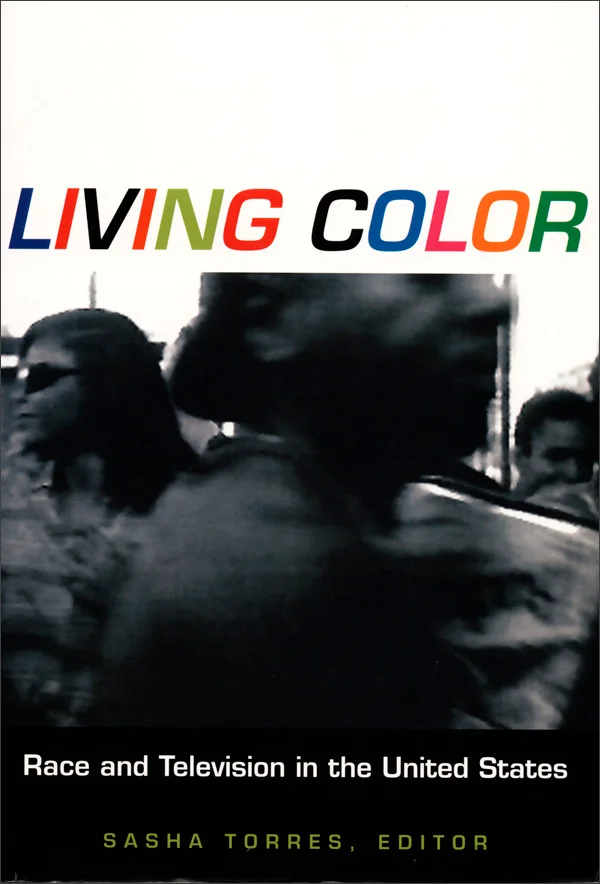
Living Color
Race and Television in the United States
Console-ing Passions: Television and Cultural Power
Book
Pages: 288
Illustrations: 54 b&w photographs
Published: August 1998
Editor: Sasha Torres
Subjects
Media Studies > TV, Theory and Philosophy > Race and Indigeneity, Gender and Sexuality > Sex and Sexuality
Media Studies > TV, Theory and Philosophy > Race and Indigeneity, Gender and Sexuality > Sex and Sexuality
Praise
Buy
Availability: Loading...
Price: Loading...
This title will be released on August 07, 1998
Buy the e-book:
Information
Author/Editor Bios
Back to TopSasha Torres is Professor of English at the Johns Hopkins University.
Table Of Contents
Back to Top
Introduction / Sasha Torres 1
Entertaining "Difference": Strains of Orientalism in Early Los Angeles Television / Mark Williams 12
Confronting "The Indian Problem": Media Discourses of Race, Ethnicity, Nation, and Empire in 1950s America / Pamela Wilson 35
Extra-Special Effects: Televisual Representation and the Claims of "the Black Experience" / Phillip Brian harper 62
Narrowcasting in Diaspora: Middle Eastern Television in Los Angeles / Hamid Neficy 82
Re-Covering Racism: Crack Mothers, Reaganism, and the Network News / Jimmie L. Reeves 97
"Reliving the Past Over and Over Again": Race, Gender, and Popular Memory in Homefront and I'll Fly Away / Mimi White 118
King TV / Sasha Torres 140
Televisual Politics: Negotiating Race in the L.A. Rebellion / John Caldwell 161
Pedro Zamora's Real World of Counter-publicity: Performing an Ethics of the Self / Jose Esteban Munoz 195
Game Theory: Racial Embodiment and Media Crisis / Stephen Michael Best 219
Here Comes the Judge: The Dancing Itos and the Televisual Construction of the Enemy Asian Male / Brian Locke 239
Selected Bibliography 255
Index 263
Contributors 273
Entertaining "Difference": Strains of Orientalism in Early Los Angeles Television / Mark Williams 12
Confronting "The Indian Problem": Media Discourses of Race, Ethnicity, Nation, and Empire in 1950s America / Pamela Wilson 35
Extra-Special Effects: Televisual Representation and the Claims of "the Black Experience" / Phillip Brian harper 62
Narrowcasting in Diaspora: Middle Eastern Television in Los Angeles / Hamid Neficy 82
Re-Covering Racism: Crack Mothers, Reaganism, and the Network News / Jimmie L. Reeves 97
"Reliving the Past Over and Over Again": Race, Gender, and Popular Memory in Homefront and I'll Fly Away / Mimi White 118
King TV / Sasha Torres 140
Televisual Politics: Negotiating Race in the L.A. Rebellion / John Caldwell 161
Pedro Zamora's Real World of Counter-publicity: Performing an Ethics of the Self / Jose Esteban Munoz 195
Game Theory: Racial Embodiment and Media Crisis / Stephen Michael Best 219
Here Comes the Judge: The Dancing Itos and the Televisual Construction of the Enemy Asian Male / Brian Locke 239
Selected Bibliography 255
Index 263
Contributors 273
Rights
Back to TopSales/Territorial Rights: World
Rights and licensingAdditional Information
Back to Top
Paper ISBN:
978-0-8223-2195-8 /
Hardcover ISBN:
978-0-8223-2178-1 /
eISBN:
978-0-8223-7810-5 /
DOI:
https://doi.org/10.1215/9780822378105
Publicity material