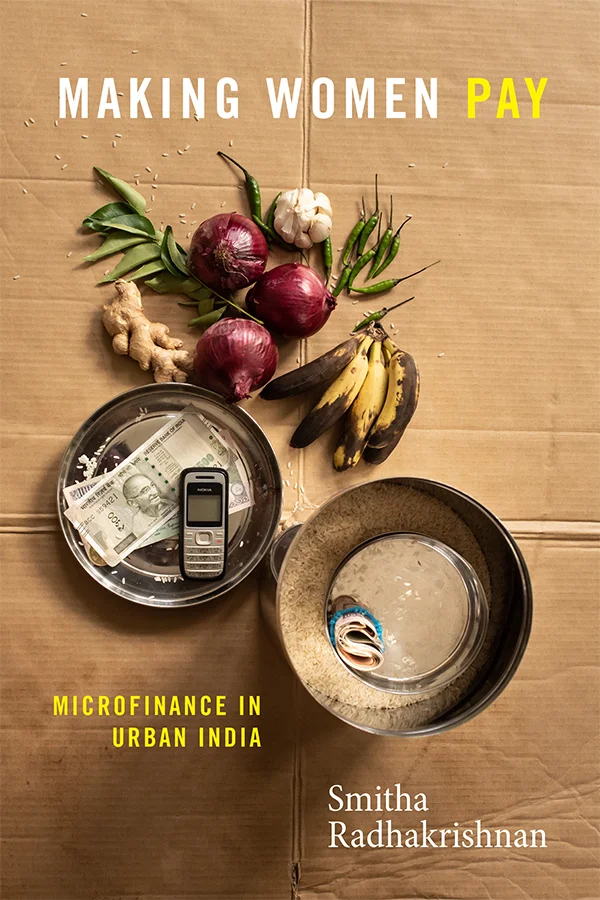
“Smitha Radhakrishnan's compelling and important study of women in the world of microfinance is one of the best books I've read in several years. No other book on the market features this kind of data, access, or methods of triangulation. With its clear writing, rich stories and nuance, Making Women Pay will challenge readers to think more critically about how microfinance is deeply gendered. Engaging, moving, and powerful.” - Kimberly Kay Hoang, author of Dealing in Desire: Asian Ascendancy, Western Decline, and the Hidden Currencies of Global Sex Work
“While the scholarship on microfinance has become increasingly nuanced over the past three decades, we still lack critical information about the very people who put microfinance into practice—namely, the loan officers, educators, and field-workers who directly interface with clients and act as brokers between clients and administration, as well as upper-level administrators. Smitha Radhakrishnan fills this critical gap, offering readers a new analysis of microfinance that takes seriously microfinance workers at all levels as social agents. Reading this book is a breath of fresh air and a true delight.” - Erin Beck, author of How Development Projects Persist: Everyday Negotiations with Guatemalan NGOs
"...[T]he book is fascinating and does well to showcase how markets hurt women. Recommended. Undergraduates and faculty."
- J. Bhattacharya, Choice
"Smitha Radhakrishnan combines a novelist’s eye with a sharp, feminist analysis. By sympathetically bringing to life the people she encounters in her research in southern India and the USA, she illustrates the serious underlying issues. . . Making Women Pay offers a disturbing but rewarding read." - Deborah Eade, Gender & Development
"Compelling. . . ." - Kevin P. Donovan, Boston Review
"Her scholarly analysis can serve as a textbook for graduate students and upper-level undergraduates, and her comprehensive bibliography offers multiple entry points to anyone interested in a deep exploration of microfinance practices." - Nancy Nyland, Resources for Women And Gender Studies
"In Making Women Pay, Smitha Radhakrishnan, a prominent voice in the studies of gender, neoliberalism, and globalisation, uncovers the complex chains of individuals, domestic and international institutions, and regulatory environments that constitute the Indian microfinance industry. . . . With its focus on social inequalities that underwrite the everyday work of MFIs in urban India, Making Women Pay is a valuable addition to the growing scholarship at the crossroads of gender and economic sociology." - Anna Wozny, Asian Studies Review
"Radhakrishnan’s forensic yet ever compassionate and human analysis provides nuanced and original insights into how class, caste, and gender divisions and inequalities are not only unchallenged by the microfinance industry but are in fact required for its smooth functioning.. . . . Radhakrishnan’s book is a powerful, accessible, and vital contribution to knowledge and understanding of the serious issues surrounding microfinance in India and beyond." - Esther Bott, American Journal of Sociology
"[Making Women Pay's] merit is Radhakrishnan’s insistence that the impact of microfinance should not be just evaluated through quantitative material indicators; it is also crucial to view microfinance as a political process in which social relations have been restructured." - Jingyi Zhang, Monthly Review
"Radhakrishnan’s book is powerful and raises very fundamental questions for all of us to engage with. It is meticulously researched and well written and provokes us to think of the entire ecosystem of the financial inclusion space and cut through the rhetoric and practice." - M. S. Sriram, Anthropos
"[Making Women Pay] is an essential reading for scholars of development, gender, and financialization not because it offers a neatly bounded story, but because it captures the unstable realities of financial governance on the ground." - Smriti Chauhan, Gender, Technology and Development
"The book's powerful argument and its arresting material . . . make it a must-read for sociologists of gender and development." - Isabel Pike, British Journal of Sociology