
Home / Books / Music, Sound, and Technology in America

Music, Sound, and Technology in America

A Documentary History of Early Phonograph, Cinema, and Radio
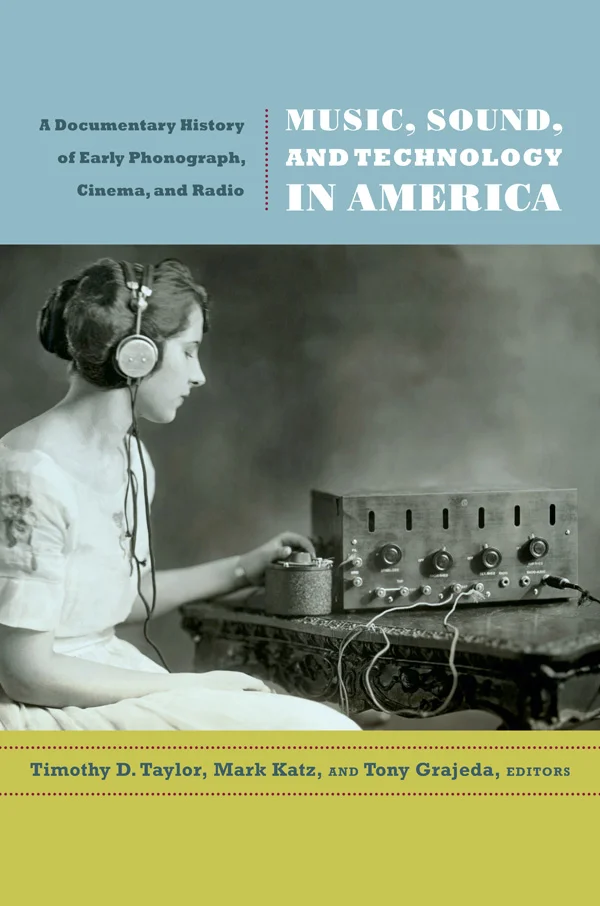
Music, Sound, and Technology in America cover image

Book

Pages: 432

Illustrations: 20 illustrations

Published: June 2012

This unique anthology assembles primary documents chronicling the development of the phonograph, film sound, and the radio. These three sound technologies shaped Americans' relation to music from the late nineteenth century until the end of the Second World War, by which time the technologies were thoroughly integrated into everyday life. There are more than 120 selections between the collection's first piece, an article on the phonograph written by Thomas Edison in 1878, and its last, a column advising listeners "desirous of gaining more from music as presented by the radio." Among the selections are articles from popular and trade publications, advertisements, fan letters, corporate records, fiction, and sheet music. Taken together, the selections capture how the new sound technologies were shaped by developments such as urbanization, the increasing value placed on leisure time, and the rise of the advertising industry. Most importantly, they depict the ways that the new sound technologies were received by real people in particular places and moments in time.

Praise

"Music, Sound, and Technology in America provides a useful overview of the impact of technologies on American music and musical culture. It is a valuable resource, an engaging, well-organized anthology that will raise provocative questions for students of American cultural history." - Michele Hilmes, author of Radio Voices: American Broadcasting, 1922–1952

"Filled with great selections, Music, Sound, and Technology in America is a salutary addition to a media studies literature lacking in such sourcebooks. It provides a ready-made trove of primary source material to use in classroom discussions of historical interpretation and methodology. In addition, by juxtaposing materials on diverse aspects of sound, the editors avoid the persistent habit of segmenting sound studies by medium or mode." - Jonathan Sterne, author of MP3: The Meaning of a Format

“A fascinating new book on early media. . . . A delightful read.” - Steve Ramm, In the Groove

“As a resource, the collection is very usable and particularly student-friendly. The introductions are insightful without being exhaustive, which encourages further inquiry and discussion by providing guidance and direction to sound studies, cultural studies, and technological studies. This approach creates a versatile collection that is not only useful for research and scholarship, but which is also strikingly teachable.” - Victoria Willis, Popular Music and Society

“Measuring the cultural importance and metaphysical weirdness of that change is part of the project of Music, Sound, and Technology in America, an anthology of fascinating artifacts whose prosaic title belies its insights into the early years of the recorded-sound era. . . . [T]he editors of Music, Sound, and Technology in America exhibit a canny ear for the electrifying echoes between then and now.” - Andy Battaglia, Wall Street Journal

“Part history of technology, part reception studies, this anthology gathers advertisements, sales agents’ scripts, personal accounts, editorials and letters from hobbyist journals of the early days of recorded sound... At its best, the selections convey an eyewitness sense of first reactions to new technologies, before users’ expectations ossified… What shines through the book is how new technologies have opened up cultural battlegrounds for creativity, access and control.” - Emily Bick, The Wire

“The editors have selected and assembled their material with perspicuity and wit, and anybody interested in the infancy of sound recording, cinema, and radio is guaranteed to experience frequent ‘aha!’ moments that transport them with a simple turn of phrase to the mind-set of an earlier age.” - James M. Keller Santa Fe, Santa Fe New Mexican

Taylor, Katz, and Grajeda have culled print and visual materials from the popular press, trade journals, and company archives that neatly capture the excitement of the new enterprises of radio, sound recordings, and film and the quandaries surrounding these media. . . . Highly Recommended. Upper-division undergraduates through faculty.” - N. Newman, Choice

“Although the book is aimed at scholars and students (the book would work admirably as a reader for any number of courses in music, media studies, or history), Music, Sound, and Technology in America will appeal to nearly anyone who has an interest in exploring further the fascinating early history of phonography, cinema, and radio from the perspective of its founders, critics, and consumers. Truly a landmark documentary in every way, this collection should go a long way in stimulating further historical work in the field.” - Rob Haskins, ARSC Journal

“This is a much needed anthology…. We owe the three editors a considerable debt for doing the necessary research and for organizing and explaining the value of what they have unearthed.” - European Journal of Communication

Buy

Availability: Loading...

Price: Loading...

Request a desk or exam copy

Information

Author/Editor Bios

Back to Top

Timothy D. Taylor is Professor of Ethnomusicology and Musicology at the University of California, Los Angeles. He is the author of The Sounds of Capitalism: Advertising, Music, and the Conquest of Culture and Beyond Exoticism: Western Music and the World, which is also published by Duke University Press.

Mark Katz is Associate Professor of Music at the University of North Carolina, Chapel Hill. He is the author of Capturing Sound: How Technology Has Changed Music and Groove Music: The Art and Culture of the Hip-Hop DJ.

Tony Grajeda is Associate Professor of Cultural Studies in the Department of English at the University of Central Florida. He is an editor of Lowering the Boom: Critical Studies in Film Sound.

Table Of Contents

Back to Top
General Introduction: Music Technologies in Everyday Life / Timothy D. Taylor 1
Part 1. Sound Recording
Introduction / Mark Katz 11
Sound Recording: Readings 29
Predictions 29
The Listener and the Phonograph 44
Learning to Listen 44
The Phonograph in Everyday Life 48
The Phonograph and Music Appreciation 65
Men, Women, and Phonographs 70
Music and the Great War 78
Performers and the Phonograph 84
In the Recording Studio 84
The Phonograph and Music Pedagogy 94
The Phonograph and the Composer 104
The Composer in the Machine Age 104
The Phonograph as a Compositional Tool 110
Phonograph Debates 113
Con 113
Pro 126
Part II. Cinema
Introduction / Tony Grajeda 137
Cinema: Readings 145
Technologies of Sight and Sound 145
Sounds of the Cinema: Illustrated Song Slides; The Role of the Voice (lecturers, actors); Incidental Musics, Special Effects, Ballyhoo, and Noise of the Audience 153
Playing to the Pictures 173
Performative Accompaniment 173
The Organist of the Picture Palace 192
Conducting and Scoring to the Movies 200
Taste, Culture, and Educating the Public 212
Responding to the Talkies 226
Part III. Radio
Introduction / Timothy D. Taylor 239
Radio: Readings 255
Radio as Dream, Radio as Technology 255
Early Broadcasts: Performer and Listener Impressions 266
Radio in Everyday Life 275
Healing 279
Economics of Radio Broadcasting 285
Advertising 288
Music on the Radio 301
Con 301
Pro 305
What Do Listeners Want? 311
Crooning 316
Radio Behind the Scenes 324
Getting on the Air 324
Talent 340
Production behind the Scenes 344
Composing for the Radio 354
How to Listen to Music on the Radio 361
Notes 367
References 387
Index 399

Rights

Back to Top

Sales/Territorial Rights: World

Rights and licensing

Awards

Back to Top

Association for Recorded Sound Collections (ARSC) Certificate of Merit in the Best General Research in Recorded Sound category

Additional Information

Back to Top
Paper ISBN: 978-0-8223-4946-4 / Hardcover ISBN: 978-0-8223-4927-3 / eISBN: 978-0-8223-9391-7 / DOI: https://doi.org/10.1215/9780822393917

Publicity material