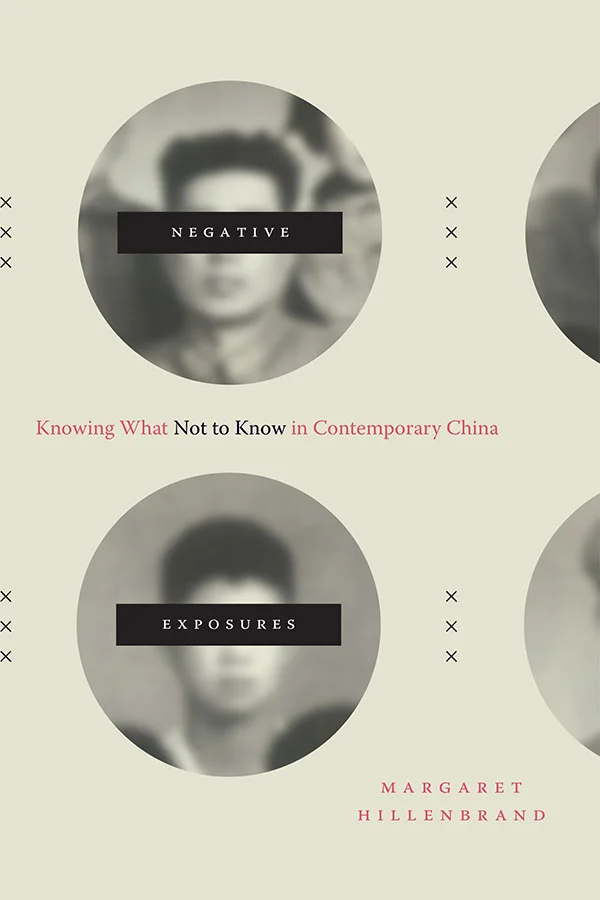
“Negative Exposures is a brave and revelatory book. With lyrical prose, nuanced argumentation, and a photosensitive eye, Margaret Hillenbrand limns the contours of China's contemporary cryptocracy, showing us how photographic images can work both to obscure and to bring the shadows of the historical past back into spectral presence.” - Andrew F. Jones, Professor of Chinese, University of California, Berkeley
“Negative Exposures is a boldly original book that analyzes cultural works based on photographs as objects that enable us to see and think through the unsayable in China. Margaret Hillenbrand contends that a culture of public secrecy, rather than censorship or historical amnesia, can explain how ordinary Chinese citizens fail or refuse to see and speak about difficult issues. This book is a powerful intervention that will be warmly welcomed and widely applauded.” - Chris Berry, Kings College London
“While sharply grounded in Chinese cultural history, Margaret Hillenbrand’s Negative Exposures is a valuable addition to current studies on visuality…. Negative Exposures is an insightful account of media objects’ centrality within anthropological, art-historical, literary, historical and sociological modes of analysis, binding often disparate methodologies together.”
- Shaowen Zhang,
Critical Inquiry
“Margaret Hillenbrand’s incisive and beautifully composed monograph takes...‘photo-forms’—repurposed historical photographs—and their circulation as the point of departure for her fascinating excursus of public secrecy in contemporary China…. Her work could not have come at a more opportune time.” - Patricia M. Thornton, China Quarterly
“Hillenbrand focuses on the medium of photography and its treatment of three key historical moments—the Nanjing Massacre, the Cultural Revolution, and the Tiananmen Movement of 1989.... This is a beautifully conceived and nicely written book that is always interesting and thought-provoking.” - Kirk A. Denton, MCLC Resource Center
“This timely book by Margaret Hillenbrand...examines the mechanism of ‘secrecy’ as a main structuring force in contemporary Chinese society.... A courageous and revelatory work like this, also beautifully written, surely blazes new trails and opens up many questions.”
- Mia Yinxing Liu, Chinese Literature
“One of the great contributions of the book is its intricate navigation across different disciplines and fields.... Filled with self-reflexive arguments, sophisticated analyses, and elegant prose, this engaging study is destined to be an important work.” - Kun Qian, Journal of Asian Studies
“Margaret Hillenbrand’s Negative Exposures is a theoretically rich and provocative study that offers a new paradigm for thinking about Chinese cultural production under repressive governance.” - Belinda Kong, The China Journal
“Negative Exposures critically investigates the role of public secrecy in managing, if not distorting, the historical violence, trauma, and collective and individual memories.... Closely examining the contingent, clandestine conditions of history and its aesthetic legacies, the book exemplifies a timely and provocative study of contemporary Chinese visual culture.” - Laura Jo-Han Wen, Prism
“How could I write a review that could possibly do justice to this eloquently written monograph?... Negative Exposures is thought-provoking reading for scholars and research students interested in culture and history, in creativity and politics, and in control and resistance, both in China and beyond.” - Yiu Fai Chow, China Review International
“A courageous and revelatory work such as this, which is also beautifully written, surely blazes new trails and opens up many questions.” - Mia Yinxing Liu, Twentieth-Century China
“Negative Exposures by Margaret Hillenbrand is a dazzling display of rigorous interdisciplinary scholarship. . . . Negative Exposures is a powerfully and colorfully argued theorization of the tense and sometimes spirited competition between the state censors, ordinary people who prefer to ‘forget,’ and others committed to prizing open and restaging the events of the past in the photo-form.” - Harriet Evans, Dazzling Revelations
“While liminal spaces indicate transitions and rites of passage, they are also spaces of power—above, beyond, and outside of time and place. Hillenbrand shows us how critique is made possible through their presence.” - Jennifer Hubbert, China Information