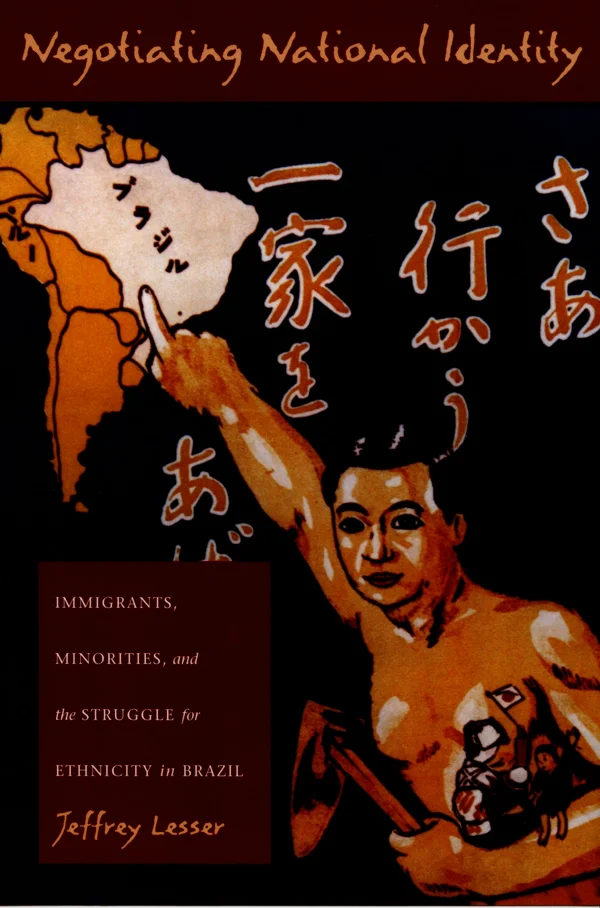
“[A] very welcome addition to Brazilian studies. . . . By giving voice to the role ethnic minorities have played in weaving a broader definition of national identity, this book challenges the notion that elite discourse is hegemonic and provides the first comprehensive look at Brazilian worlds often ignored by scholars.” - Edward J. Neugaard , South Eastern Latin Americanist
“[Lesser] avoids preconceived theoretical positions and examines the process with intellectual honesty and acumen, in graceful prose, and adds a great book-cover to boot. Who could ask for more?” - Jose C. Moya , Journal of Social History
“[Lesser] has moved the discussion of ethnicity substantially beyond its traditional bounds with this study of the ways in which immigrants may renegotiate the national identity of their host nations.” - Judith Laikin Elkin , Hispanic American Historical Review
“[V]ery well written . . . . The clarity of the writing, combined with plentiful and well-chosen examples, guide the reader through the very complicated experiences of native Brazilians and immigrants. An impressive array of sources and careful documentation supports the credibility of Lesser’s arguments. Historians of Brazil, of immigration, and of ethnicity who ignore this book will be making a serious mistake.” - Gail D. Triner , Luso-Brazilian Review
“A first-rate addition to the literature that is essential for comprehending Brazil’s infinite complexity.” - Foreign Affairs
“Lesser has written an extremely valuable addition to the field of Brazilian studies in a book that expands the intricate complexity of what constitutes the Brazilian national identity.” - American Historical Review
“Lesser masterfully documents the myriad debates over the role ‘ethnicity’ would play in the formation of Brazil’s national identity. . . . [He] provides an important corrective to studies which have focused primarily, or exclusively, on Brazilian identity as something constructed along a black/white continuum. . . . The strength of Lesser’s Negotiating National Identity is the way his analysis seamlessly flows back and forth between the changing nature of political discourse surrounding immigration policy and the actions of the immigrant communities themselves. . . . [T]he sophistication of the analysis is matched by the readability of the text, making this relatively compact text a joy to read for specialists and undergraduates alike.” - Thomas Jordan , H-Net Reviews
“Lesser redefines the model of ethnic and nationalistic identity. . . . [T]his book must remain at the top of the list for Latin American students and scholars interested in understanding Brazil, its ethnic makeup and national identity. It is precisely what the field of Brazilian studies needs. I highly recommend this book for interested parties in fields such as political science, anthropology, and area studies as well.” - Matthew D. Anderson , Nationalism and Ethnic Politics
“Lesser’s work is a welcome exploration of non-European immigration and the construction of national identity between 1850 and 1950.” - Andrew J. Kirkendall , Journal of Interamerican Studies and World Affairs
“This ground-breaking book is one in need of reading and re-reading by both historians and non-historians alike. . . . [T]his is one that anyone, even one that knows nothing about history, can read, understand, and walk away enlightened.” - Kim Richardson , Bulletin of Latin American Research
“This is an erudite and well-documented book. . . .” - Livio Sansone , Ethnic and Racial Studies
“This is good intellectual history. . . . [A] very interesting read, and refreshing and important as it discusses aspects of the nation’s history which have received so little scholarly attention to date, despite the millions of immigrants who have made Brazil one of the world’s most diverse multi-cultural societies.” - British Bulletin of Publications
“This masterful book opens up a new level of debate over issues of nationhood, ethnicity, and whiteness in Latin America, and it will surely inspire new research along these lines.” - Lauren Derby , American Journal of Sociology
"Negotiating National Identity is a powerful historical work on immigration and minority creation in Brazil."
- W. Lawrence Neuman , Critical Asian Studies
"[A]n important and welcome contribution to unraveling the more or less hidden recesses of ethnicity in Brazil." - Fernando Rosa Ribeiro , European Review of Latin American and Caribbean Studies
“A rich, welcome addition to social history in the broadest sense. . . . [This study] convincingly demonstrates the ironic fact that immigration policies seeking to ‘whiten’ Brazil instead led to the creation of an immensely multi-cultural society. A major contribution.” - Robert M. Levine, author of The Brazilian Photographs of Genevieve Naylor, 1940-1942
“Clearly written and well organized, this book makes a major contribution to the field of Brazilian studies. An outstanding work.” - Leo Spitzer, author of Hotel Bolivia: The Culture of Memory in a Refuge from Nazism