
Home / Books / Neither Cargo nor Cult

Neither Cargo nor Cult

Ritual Politics and the Colonial Imagination in Fiji
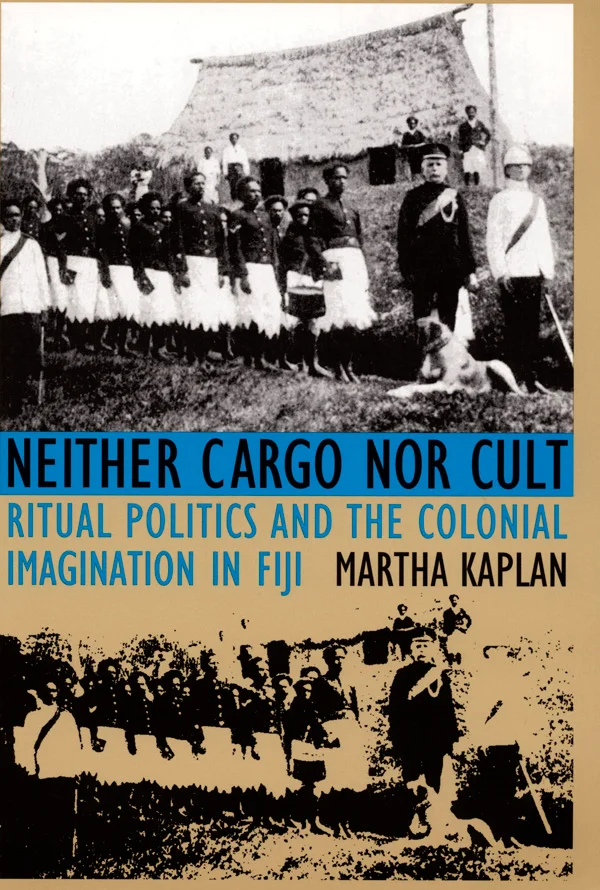
Neither Cargo nor Cult cover image

Book

Pages: 248

Published: June 1995

Author: Kaplan, Martha

In the 1880s an oracle priest, Navosavakadua, mobilized Fijians of the hinterlands against the encroachment of both Fijian chiefs and British colonizers. British officials called the movement the Tuka cult, imagining it as a contagious superstition that had to be stopped. Navosavakadua and many of his followers, deemed "dangerous and disaffected natives," were exiled. Scholars have since made Tuka the standard example of the Pacific cargo cult, describing it as a millenarian movement in which dispossessed islanders sought Western goods by magical means. In this study of colonial and postcolonial Fiji, Martha Kaplan examines the effects of narratives made real and traces a complex history that began neither as a search for cargo, nor as a cult.
Engaging Fijian oral history and texts as well as colonial records, Kaplan resituates Tuka in the flow of indigenous Fijian history-making and rereads the archives for an ethnography of British colonizing power. Proposing neither unchanging indigenous culture nor the inevitable hegemony of colonial power, she describes the dialogic relationship between plural, contesting, and changing articulations of both Fijian and colonial culture.
A remarkable enthnographic account of power and meaning, Neither Cargo nor Cult addresses compelling questions within anthropological theory. It will attract a wide audience among those interested in colonial and postcolonial societies, ritual and religious movements, hegemony and resistance, and the Pacific Islands.

Praise

“In this meticulously researched and complexly argued book, Martha Kaplan tells the dramatic story of the rise, spread, suppression, and recurrence of [the Tuka] movement in the contexts of Fijian cosmological notions, of the missionary, political, and capitalist forces of the late 19th century, and of the economic and ethnic turmoils of the 20th century. . . . Kaplan provides extensive textual documentation from oral and written sources over a 100-year period.” - Richard J. Parmentier , American Anthropologist

"Martha Kaplan’s work is essential reading for anyone interested in the intersection of history and anthropology and the use of anthropological and ethnographic insights for historical scholarship. . . . [It] is a brilliantly conceived and carried-out exercise which thus makes an extremely valuable contribution to debates regarding the interpretation of culture and colonial history." - , Journal of Pacific History

"An extraordinary book. Martha Kaplan’s cultural analysis of Fijian politics is complex and subtle." - Henry J. Rutz, Hamilton College

"Inherently multidisciplinary, Neither Cargo nor Cult is terrific. Linked with both general theoretical issues and the rich anthropological literature on Fijian societies, it consistently breaks new ground, charting new directions on the relationship between history and culture, and raising effectively perspectives not usually considered on the Fijian ethnographic record. There is nothing quite like it for Fiji or for the Pacific—and little from any other parts of the world." - Donald Brenneis, Pitzer College

Buy

Availability: Loading...

Price: Loading...

Request a desk or exam copy Spring 2026 Web Sale

Information

Author/Editor Bios

Back to Top

Martha Kaplan is Assistant Professor of Anthropology at Vassar College.

Rights

Back to Top

Sales/Territorial Rights: World

Rights and licensing

Additional Information

Back to Top
Paper ISBN: 978-0-8223-1593-3 / Hardcover ISBN: 978-0-8223-1578-0 / eISBN: 978-0-8223-8191-4 / DOI: https://doi.org/10.1215/9780822381914

Publicity material