
Neoliberalism as Exception
Mutations in Citizenship and Sovereignty
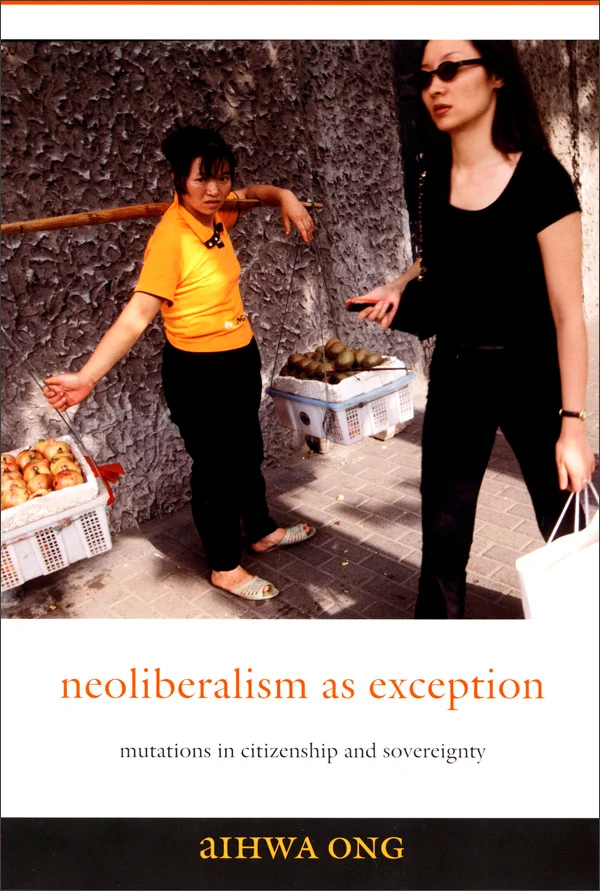
Book
Pages: 304
Illustrations: 6 b&w photos, 2 tables
Published: July 2006
Author: Aihwa Ong
Subjects
Anthropology > Cultural Anthropology, Globalization and Neoliberalism, Sociology > Social Theory
Anthropology > Cultural Anthropology, Globalization and Neoliberalism, Sociology > Social Theory
Praise
Buy
Availability: In stock
Price: $34.95
This title will be released on July 19, 2006
Buy the e-book:
Information
Author/Editor Bios
Back to TopAihwa Ong is Professor of Anthropology at the University of California, Berkeley. Her books include Global Assemblages: Technology, Politics, and Ethics as Anthropological Problems (coedited with Stephen J. Collier); Buddha Is Hiding: Refugees, Citizenship, the New America; and Flexible Citizenship: The Cultural Logics of Transnationality, winner of the Association for Asian American Studies’ Cultural Studies Book Award and also published by Duke University Press.
Table Of Contents
Back to Top
Acknowledgements ix
Introduction: Neoliberalism as Exception, Exception to Neoliberalism 1
I. Ethics in Contention
1. Sisterly Solidarity: Feminist Virtue under “Moderate Islam” 31
2. Cyberpublics and the Pitfalls of Diasporic Chinese Politics 53
II. Spaces of Governing
3. Graduated Sovereignty 75
4. Zoning Technologies in East Asia 97
III. Circuits of Expertise
5. Latitudes, or How Markets Stretch the Bounds of Governmentality 121
6. Higher Learning in Global Space 139
7. Labor Arbitrage: Displacements and Betrayals in Silicon Valley 157
IV. The Edge of Emergence
8. Baroque Ecology, Effervescent Citizenship 177
9. A Biocartography: Maids, Neoslavery, and NGOs 195
10. Reengineering the “Chinese Soul” in Shanghai? 219
Notes 241
Bibliography 261
Index 279
Introduction: Neoliberalism as Exception, Exception to Neoliberalism 1
I. Ethics in Contention
1. Sisterly Solidarity: Feminist Virtue under “Moderate Islam” 31
2. Cyberpublics and the Pitfalls of Diasporic Chinese Politics 53
II. Spaces of Governing
3. Graduated Sovereignty 75
4. Zoning Technologies in East Asia 97
III. Circuits of Expertise
5. Latitudes, or How Markets Stretch the Bounds of Governmentality 121
6. Higher Learning in Global Space 139
7. Labor Arbitrage: Displacements and Betrayals in Silicon Valley 157
IV. The Edge of Emergence
8. Baroque Ecology, Effervescent Citizenship 177
9. A Biocartography: Maids, Neoslavery, and NGOs 195
10. Reengineering the “Chinese Soul” in Shanghai? 219
Notes 241
Bibliography 261
Index 279
Rights
Back to TopSales/Territorial Rights: World
Rights and licensingAdditional Information
Back to Top
Related Links
Paper ISBN:
978-0-8223-3748-5 /
Hardcover ISBN:
978-0-8223-3736-2 /
eISBN:
978-0-8223-8787-9 /
DOI:
https://doi.org/10.1215/9780822387879
Publicity material