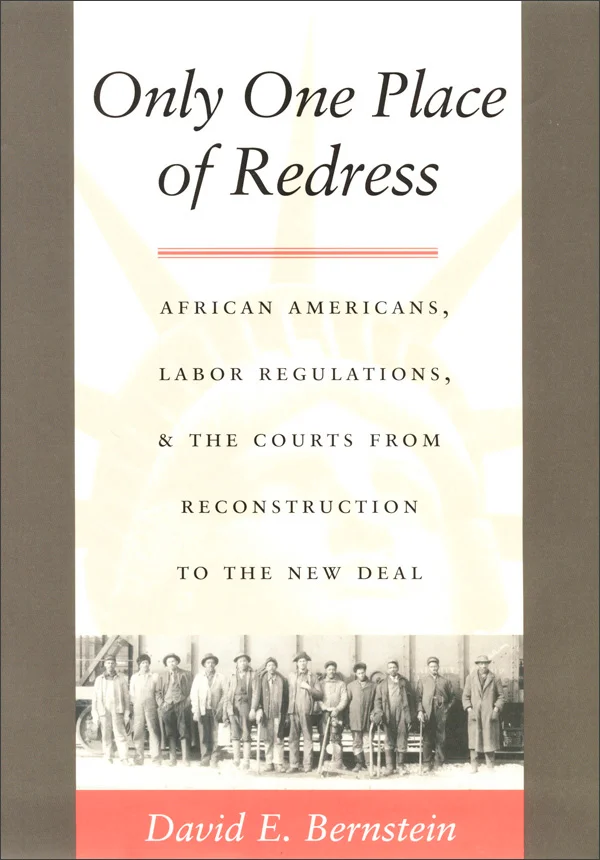
“[Only One Place of Redress] makes a unique and serious contribution to the quest to protect freedom of enterprise. It demonstrates that government is often the oppressor, rather than the salvation for the oppressed. And it shows that the beneficent facade of many economic regulations actually masks protectionistic objectives. This untold chapter of the Jim Crow saga helps explain why our society remains separate and unequal today, and underscores the need to focus on economic liberty to remove oppressive barriers to opportunity that have persisted far too long.” - Clint Bolick , American Enterprise
“[A] bold reinterpretation of American legal history.” - Yale Law Report
“[A] short and sharp challenge to the prevailing narrative of the emergence of the contemporary American welfare state. . . . Bernstein’s uniquely unsentimental account of African-American and labor history is indispensable to serious reflection on these issues, and clears the way for a reconsideration of whether blacks might be better served by the principles of limited government, property rights, and liberty of contract.” - Ken I. Kersch , Public Interest
“[A] stimulating overview of the relationships among organized labor, African Americans, and the U.S. legal system for the period 1877–1945. It usefully defamiliarizes the past and uses a briskly presented law and economics perspective to force a rereading of the traditional script of labor history.” - Robert H. Zieger, Reviews in American History
“[I]t makes a compelling case that historians cannot ignore.” - Michael S. Mayer , Journal of American History
“Bernstein advances a robust thesis. . . . [T]his readable and provocative book underscores the complexity of the race question in America and its connection with facially non-racial legal and economic principles.” - Brian K. Landsberg , Law and Politics Book Review
“Bernstein is an eloquent writer and an accomplished legal historian. . . . Bernstein should be credited with trying to open eyes to the racism of the labor movement in America, and . . . he has written a provocative book that should be read by all those interested in issues of race, labor, and economics.” - W. Lewis Burke , H-Net Reviews
“David Bernstein offers a refreshing perspective on this heavily criticized period. . . . Professor Bernstein's highly original analysis will no doubt spark debate among Lochner scholars, breathing new life into a previously tired discussion.” - Harvard Law Review
“This is a good book. . . . [A] very important addition to the literature. Bernstein, using the traditional narrative approach of legal scholars along with a little economic theory, has demonstrated, convincingly . . . that the coercive power of the state was used to hurt blacks, and that the color-blind market approach envisioned in Lochner would have provided superior job opportunities for African Americans.” - Richard K. Vedder, EH.Net
"[A] powerful new book. . . . The history here is important for what it reveals about how market institutions have performed and are likely to function in the future. . . . Only One Place of Redress has significant policy implications, which makes it an even more important contribution." - Michael B. Rappaport , Acta Biotheoretica
"Bernstein has provided us with an important narrative that is underappreciated in African-American history. . . . [P]rovocative. . . . Bernstein has written an engaging book that expands our understanding. . . .”
- Davison M. Douglas , Michigan Law Review
"Bernstein makes a solid contribution to African American and U.S. labor, legal, and economic history. . . . Only One Place of Redress fills an important gap in our understanding of the interplay of state, race, and labor policies during the industrial era."
- Joe W. Trotter , Labor History
"The book is well written and clearly argued, the footnotes are extensive, and Bernstein has an impressive . . . command of secondary sources. . . . Only One Place of Redress contains a wealth of useful information about specific types of nonmarket discrimination against African Americans and a wealth of useful references to court cases and to the secondary literature." - Robert Margo, Independent Review
“Only One Place of Redress presents a bold reinterpretation of the relationship between governmental regulations of the marketplace and economic opportunity for blacks. Bernstein challenges the conventional wisdom and invites readers to reconsider breezy assumptions about how employment regulations operated.” - James W. Ely, Jr., author of The Guardian of Every Other Right: A Constitutional History of Property Rights
“A provocative revisionist overview of legislation regulating labor relations. This will undoubtedly receive a great deal of attention from historians and students of the Constitution, and for good reason.” - Mark Tushnet, author of Making Constitutional Law: Thurgood Marshall and the Supreme Court, 1961–1991