
Home / Books / Picasso′s Demoiselles

Picasso′s Demoiselles

The Untold Origins of a Modern Masterpiece
Book

Pages: 448

Illustrations: 353 illustrations, incl. 8 page color insert

Published: December 2019

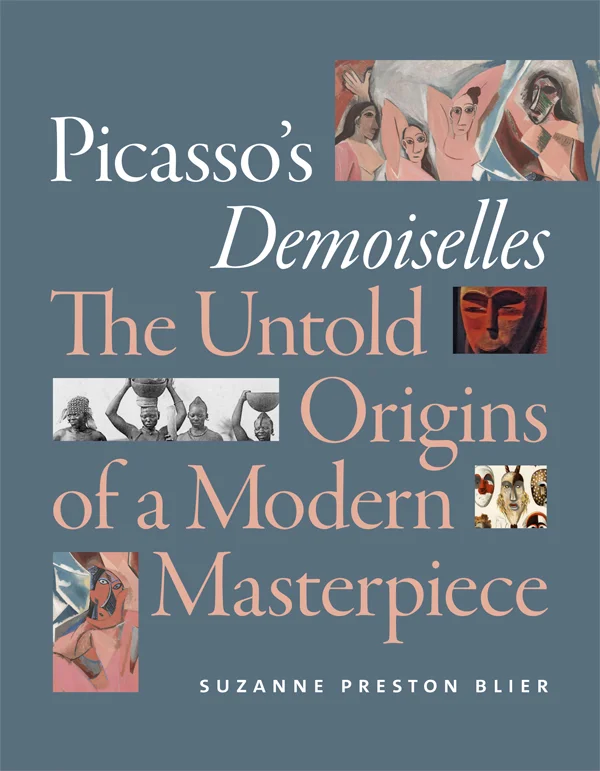
In Picasso's Demoiselles, eminent art historian Suzanne Preston Blier uncovers the previously unknown history of Pablo Picasso's Les Demoiselles d’Avignon, one of the twentieth century's most important, celebrated, and studied paintings. Drawing on her expertise in African art and newly discovered sources, Blier reads the painting not as a simple bordello scene but as Picasso's interpretation of the diversity of representations of women from around the world that he encountered in photographs and sculptures. These representations are central to understanding the painting's creation and help identify the demoiselles as global figures, mothers, grandmothers, lovers, and sisters, as well as part of the colonial world Picasso inhabited. Simply put, Blier fundamentally transforms what we know about this revolutionary and iconic work.

Praise

“It is a condition of masterworks that they attract, even demand, interpretation and reinterpretation. Picasso's Les Demoiselles d’Avignon is a case in point. In 1946, Alfred Barr called it ‘a battlefield of trial and experiment’ marking ‘the beginning of a new period in the history of modern art.’ Twenty-six years later, Leo Steinberg argued that its psychic and pictorial ‘violence’ resides in its power of displacement, in ‘the startled consciousness of a viewer who sees himself seen.’ Others have examined its ‘primitivism’ and l’art negre as central to its power and originality. Now, Suzanne Blier, through a close textual and visual analysis of an astonishing range of references, argues that Picasso’s creativity ‘involved both drawing on and subverting the past’ while reimagining the present and creating the future anew. Blier's study rewards close reading, just as the painting rewards close and sustained looking.” - James Cuno, President and CEO, The J. Paul Getty Trust

“Combining the specialized skills of an art historian with the zeal of a detective, Suzanne Preston Blier offers a bold and transformative re-reading of the Demoiselles. She startlingly shifts the interpretive foundations of Picasso and the Demoiselles: she shows us a Picasso not as bombastic egotist but as capacious globalist; not as masculine master fixated on female sexuality and its attendant anxieties, but as explorer of the power and presence of women and their generative capacities. This provocative and pathbreaking book scrambles the logic of modernism, primitivism, and feminism in the discipline of art history.” - Debora Silverman, author of Van Gogh and Gauguin: The Search for Sacred Art

"Blier uses a host of techniques including formal analysis, textual analysis, and broader global image culture to dig deep into this one painting. Most exciting is when she points out obvious but overlooked information in widely known documentation, including period photographs of Demoiselles in process that show how Picasso developed the composition. Ultimately, Blier offers a reading thoroughly of our time—one in which women are empowered and time and space compressed." - Maggie Taft, Booklist

"Blier offers a wide-ranging account of the genesis, sources, and context for Picasso’s influential masterpiece. In both cases it is especially timely and meaningful to have women shaping the conversation. . . . Recommended. Upper-division undergraduates through faculty and professionals." - E. Baden, Choice

"Picasso's Demoiselles is a thoughtful, meticulously researched investigation into the artist’s extensive creative process." - Cindy Helms, New York Journal of Books

"The book, which features hundreds of illustrations . . . is full of a vast and intriguing array of highways and forays into every possible connection that might suggest itself to construct this argument. As a Black feminist, I found most persuasive Blier’s proposition to table the idea of Les demoiselles as a brothel scene and see it, rather, as a reference to the turn-of-the-century fascination with the portrayal of racial types." - Michele Wallace, Artforum

“Every age has had its own interpretation of the Demoiselles d’Avignon and with it, its own narrative of Modernism.... Blier's interpretation is doubly interesting, directed as it is at cultural and gender identities and is, without doubt, the one which corresponds ... to our present.” - Maite Méndez Baiges (translated by Diana Mathieson), African Studies Quarterly

“What makes Blier’s book truly remarkable is not only its attention to the details surrounding Picasso’s life and work in the years when he painted Les Demoiselles but also her forensic approach to the subject.” - Simon Gikandi, Art Journal

Picasso’s Demoiselles is ... a lighthearted, even playful, book.... Blier is an extraordinary writer; her scholarly production is legendary, and her publications have shaped the field of African studies.” - Monica Blackmun Visonà, Art Journal

Buy

Availability: Loading...

Price: Loading...

Request a desk or exam copy Spring 2026 Web Sale

Information

Author/Editor Bios

Back to Top
Suzanne Preston Blier is Allen Whitehill Clowes Professor of Fine Arts and of African and African American Studies at Harvard University and the author and editor of numerous books, including Art and Risk in Ancient Yoruba: Ife History, Power, and Identity c. 1300.

Table Of Contents

Back to Top
Preface  ix
Introduction  1
1. Setting, Sources, Titles, and Time  19
2. The Making of a Painting  52
3. Art in the Flesh  81
4. The Sorcerer's Apprentice  111
5. L'Oiseau du Bénin  152
6. The Global Brothel  185
7. Le Bordel Philosophique  222
Conclusions. The Creative Nexus  264
Acknowledgments  297
Sketchbooks: New Dating  300
Chronology  305
List of Illustrations  312
Notes  333
References  365
Index  415

Rights

Back to Top

Sales/Territorial Rights: World

Rights and licensing

Awards

Back to Top

Finalist, 2020 PROSE Award in Art History and Criticism

Winner of the Robert Motherwell Award, presented by the Dedalus Foundation

Additional Information

Back to Top