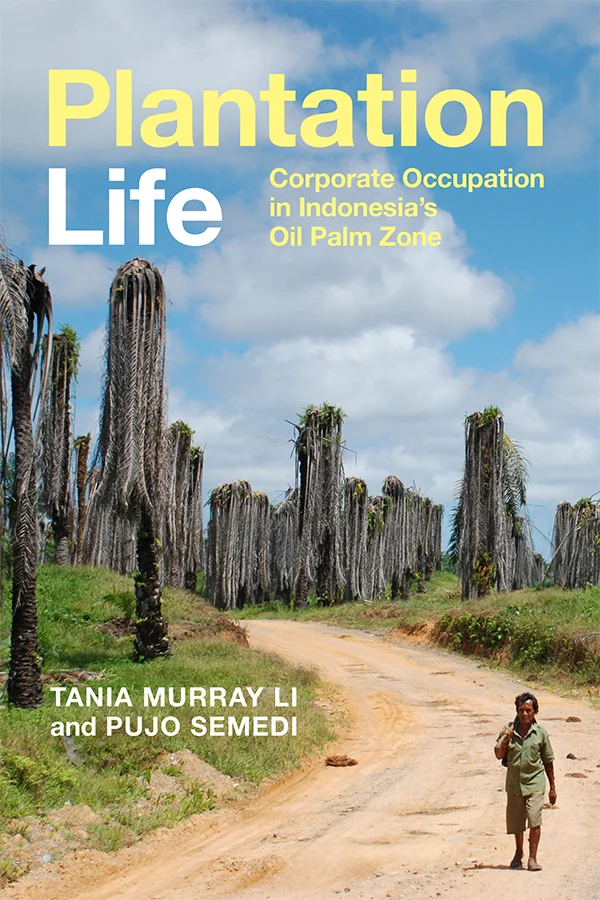
“Plantation Life is an eye-opening book on many fronts. It offers up an ethnographically and historically rich account of forms of life in Indonesia's corporate plantation zone and has much to give about method, collaboration, and evidence. Tania Murray Li and Pujo Semedi show how the plantation is a presence both fickle and contradictory, at once an occupying force and a source of neglect: occupation and abandonment, order and disorder, theft and calculability, alignment and fracture all coexist in a rough-and-tumble assemblage in which political economy and technologies of power are simultaneously in play. An important book.” - Michael Watts, Class of '63 Professor, University of California, Berkeley
“Palm oil is one of the most ubiquitous ingredients in consumer products in industrialized countries and the principal driver of landscape transformation in the Indo-Malay tropics. This, the first ethnography of oil palm plantations, convincingly demonstrates that they neither achieve their purported goal of modernizing the rural peasantry nor---remarkably---make money for the corporations involved, a paradox and perversity of modern capitalism. This is a must-read for everyone interested in tropical peoples and environments and the impact on them of consumerism in the global North.” - Michael R. Dove, author of Bitter Shade: The Ecological Challenge of Human Consciousness
"A useful primer on oil palm plantations in Indonesia but even more useful for illustrating how ethnographic research can be carried out across borders and languages. Recommended. Undergraduates and two-year program students. Recommended. Undergraduates and two-year program students." - Z. McLaughlin, Choice
“Rather than the typical colonial pattern of the local Indonesian collecting the data but having little involvement in the analysis or writing, [Plantation Life] involved the constitution of a real partnership in all aspects of the work. . . . Plantation Life represents an important contribution to the literature . . . and has a lot of potential for class adoption.” - Ian G. Baird, Antipode
“Plantation Life is a pathbreaking book. Its approach to corporate presence as a state-licensed form of occupation represents an advance in the understanding of the forms of violence that emerge in plantation zones. . . . Since the authors critically engaged in joint research and writing, the book also sets the parameters for future developments in the practice of scholarly collaboration.” - Miryam Nacimento, Journal of Peasant Studies
"Plantation Life stands out with its powerful combination of the depth of intensive ethnographic study and the refreshing conceptualization of corporate occupation and its 'world-making' consequences. Furthermore, for a book written with academic rigour, the flowing storytelling makes it easy to read for everyone." - Shofwan Al Banna Choiruzzad, Pacific Affairs
"The book describes the hardships faced by people in the plantation zone and places these in a political-economic context. This is a brilliant example of what Sherry Ortner calls ‘dark anthropology’, which focuses on ‘the harsh dimensions of social life’ – human suffering, domination and exploitation. The authors eloquently express their feelings of anger and sadness, which may seem apt for a book on a notoriously harmful sector like palm oil. It is set to become a required point of reference for future research on plantations." - Paul Thung, LSE Review of Books
"Overall, this book on life inside the Indonesian Plantationocene is an extremely valuable contribution to the literature on palm oil. However, like many good books, in the process of providing answers, it throws up even more questions." - Helena Varkey, Journal of Southeast Asian Studies
"This is a solid contribution to ‘plantationocene’ studies, which could be used as study material in graduate-level courses engaging with notions of governmentality and power distribution. The book’s appendix could be especially interesting for anthropology students as an example of collaborative data collection. Due to its focus on corporations suppressing local interests and voices, the book could also certainly be used by activists as background material for awareness raising campaigns." - Anna Varfolomeeva, Suomen Antropologi
"Plantation Life dissects a complex issue and is exemplary in its clarity. It demonstrates structural dynamics and injustice through micro-stories of loss and exclusion, and while we are never in doubt about the author's sympathies, no individual is excessively vilified." - Christian Lund, SOJOURN
"[This] is a well-written, well-researched study undertaken amid challenging circumstances: the author have documented and presented before the reader the disorders of 'plantation life'. ... In the end, this book will be of far more consequence than another anodyne statistical study of the oil palm plantation." - John McCarthy, SOJOURN
"Alongside the book’s collaborative spirit is its visual narrative, which weaves together words and images that centers and values the team’s more than thirty photographs captured in the field. Taken together, Li and Semedi’s Plantation Life is an exemplar for our times, revealing not only why research on the ground matters but also how it can be undertaken in meaningful and collaborative ways." - Anthony D. Medrano, Journal of Asian Studies
"Plantation Life is a meticulous ethnographic indictment of a system that encapsulates the institutional and ideological sources of ecological destruction and human deprivation. While it should be required reading for policymakers and economists, it will be read by scholars and students thinking about the plantation, development, and labor across disciplines." - Stuart Earle Strange, American Ethnologist
"This book is a significant contribution to understanding labour-capital relations in modern plantations and constitutes a valuable reading for those working in oil palm production and Indonesia. This detailed and deep exploration of life under plantation occupation will serve as a reference for others who can subsequently replicate this effort to study other plantations." - Joseph Alejandro Martinez Salinas, Journal of Agrarian Change
"The book offers excellent insights into the predicaments faced by those who gain little or lose out from the expansion of oil palm. The authors valuably criticize existing vocabularies and approaches espoused by human rights organizations and environmental initiatives to make plantation oil palm more just and sustain able. . . . The book should be of interest to agricultural historians, especially those grappling with how to periodize plantation histories in the Global South and under stand resistances to its persistence from the colonial era onward." - Zhe Yu Lee, Journal of Agricultural History
"[Li and Semedi's] collaborative approach offers a wide-ranging structural account of Indonesia’s plantation zone." - Geoffrey Aung, Dialectical Anthropology