
Home / Books / Queering Black Atlantic Religions

Queering Black Atlantic Religions

Transcorporeality in Candomblé, Santería, and Vodou
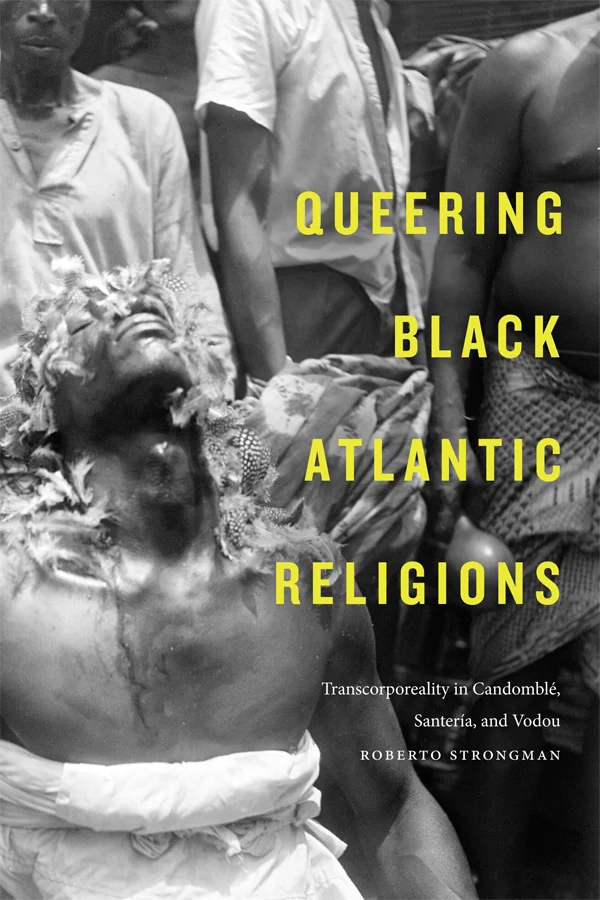
Queering Black Atlantic Religions cover image

Religious Cultures of African and African Diaspora People

More about this series

Read the Introduction

Book

Pages: 296

Illustrations: 52 illustrations

Published: May 2019

In Queering Black Atlantic Religions Roberto Strongman examines Haitian Vodou, Cuban Lucumí/Santería, and Brazilian Candomblé to demonstrate how religious rituals of trance possession allow humans to understand themselves as embodiments of the divine. In these rituals, the commingling of humans and the divine produces gender identities that are independent of biological sex. As opposed to the Cartesian view of the spirit as locked within the body, the body in Afro-diasporic religions is an open receptacle. Showing how trance possession is a primary aspect of almost all Afro-diasporic cultural production, Strongman articulates transcorporeality as a black, trans-Atlantic understanding of the human psyche, soul, and gender as multiple, removable, and external to the body.

Praise

“An intellectual and linguistic tour de force, Roberto Strongman's study on trance possession channels a love letter from the orishas to the futures of Afro-Atlantic religious studies, queer of color critique, Latinx and Latin American studies, and comparative literature. Queering Black Atlantic Religions is more than a book: it is a major, formidable achievement that will touch many and illustrate how scholarship can be an expressive and radical transformational practice.” - Carlos Decena

Queering Black Atlantic Religions provides a new theoretical language for the fields of African diasporic religions and gender and sexuality studies, all the while setting a new standard in comparative literary and cultural studies in the twenty-first century. Using an eclectic and unique cultural studies methodology, displaying proficiency in half a dozen languages, and having field work experience in a similarly impressive number of research sites, Strongman provides an advanced exploration of the creolized religions of the greater Caribbean cultural zone.” - Carole Boyce Davies

Queering Black Atlantic Religions closely reads an astonishingly circum-Atlantic and polyglot array of canonical films, paintings, photographs, novels, and ethnographies through the lens of the Afro-Atlantic religions of spirit possession. Roberto Strongman revisits the theme that these religions disrupt the conventional binaries of Western gender identity and apprehend the self through metaphors of horsemanship and vessels occupied by spirits as multiple as they are mobile. He also shows that, while many Latin American and European artists, authors, and critics have exploited the image of the black to liberate themselves from their native cultural constraints, they often come to internalize Afro-Atlantic spirits and configurations of the self.” - J. Lorand Matory

"Strongman’s contribution is an innovative deployment of cultural studies that looks at art, performance, film, and literature to research the religiosity of African diaspora communities in Latin America and the Caribbean. . . . The work is ultimately an important and sophisticated addition to the growing consideration of the transnational aesthetics that interconnect different kinds of queerness, blackness, and spirituality in the Americas." - Solimar Otero, Journal of Folklore Research

"Strongman's expansion of transcorporeality is pivotal.… This book is a necessary read that contributes to the growing body of scholarship on gender and sexuality in African diasporic religions. . . . " - Eziaku Nwokocha, Reading Religion

"[Strongman] pursues his materials with investigative prowess and scholarly verve, making this a major new reference point for scholarship on the subject." - Kieth E. McNeal and Martin Tsang, New West Indian Guide

"Strongman's exploration of the body in literary genres provides an excellent framework for a new understanding of the body, transcending the Cartesian dialectics. Strongman's three case studies present indeed the 'full queer potentiality.'" - Bettina E. Schmidt, Journal of Contemporary Religion

“Strongman’s audacity in exploring the evolution and intersection of Afro-Atlantic religiosity with queer bodies is a significant contribution to the literature and discourse on Afro-diasporic religions and cultural studies.... Strongman illustrates how scholarship can be expressive and an agent of radical transformation of social experience.” - Mary Nyangweso, Hypatia

"Strongman’s work is a worthy and important effort. . . . I can only hope that future scholars will follow in Strongman’s footsteps, laboring to patch together the shattered mirror of queer Afro-diasporic affinities in spite of the logistic difficulties this labor presents." - Marina Magloire, GLQ

"By employing artistic representations of queerness, Strongman provides an informed discussion about Afro-Atlantic traditions, and the book is an important addition to Black diasporic studies and performative studies due to Strongman’s interdisciplinary approach toward gender, religion, and sociocultural studies." - Marietta Kosma, H-Atlantic, H-Net Reviews

"Queering Black Atlantic Religions ought to be a required read—a vade mecum—for those interested in studying expressions of Afro-diasporic religions found in the trans-Atlantic world and beyond. The work sheds light on the sophistication of these religious traditions and worldviews. In fact, even adherents of these religions in their original homes in Africa cannot ignore the dynamism inherent in these religions." - SimonMary Asese Aihiokhai, Theology & Sexuality

"Strongman’s text is a valuable addition to the already rich corpus on Black Atlantic religions. Its significance is not limited to this subdiscipline, though. Readers from a wide range of disciplines, including anthropology, gender and sexuality studies, and religious studies will find much to consider and engage. Further, readers in art history and literary studies will likewise be challenged by Strongman’s attention to the role of religion in art, film, and literature." - Alejandro S Escalante, Religion and Gender

Buy

Availability: Loading...

Price: Loading...

Request a desk or exam copy

Information

Author/Editor Bios

Back to Top
Roberto Strongman is Associate Professor of Comparative Caribbean Cultural Studies at the University of California, Santa Barbara.

Table Of Contents

Back to Top
Acknowledgments  ix
Introduction: Enter the Igbodu  1
Part I. Vodou
1. Of Dreams and Night Mares: Vodou Women Queering the Body  27
2. Hector Hyppolite èl Même: Between Queer Fetishization and Vodou Self-Portraiture  49
Part II. Lucumí/Santería
3. A Chronology of Queer Lucumí Scholarship: Degeneracy, Ambivalence, Transcorporeality  103
4. Lucumí Diasporic Ethnography: Fran, Cabrera, Lam  133
Part III. Candomblé
5. Queer Candomblé Scholarship and Dona Flor's S/Exua/lity  181
6. Transatlantic Waters of Oxalá: Pierre Verger, Mário de Andrade, and Candomblé in Europe  212
Conclusion: Transcripturality  251
Notes  255
References  261
Index  273

Rights

Back to Top

Sales/Territorial Rights: World

Rights and licensing

Awards

Back to Top

Finalist, 2020 Lambda Literary Award (Lammy) in the LGBTQ Studies category

Additional Information

Back to Top
Related Links Paper ISBN: 978-1-4780-0310-6 / Hardcover ISBN: 978-1-4780-0197-3 / eISBN: 978-1-4780-0345-8 / DOI: https://doi.org/10.1215/9781478003458

Publicity material