"An excellent account of the toy industry’s interaction with the political movements of the 1960s and 1970s. . . ." - Alyssa Rosenberg, Washington Post
"Goldberg’s book describes how toys became political during the sixties and seventies—from Lionel Corporation’s toy trains’ embrace of anti-violence rhetoric to wooden figurines that allowed children to assemble families more complex than a husband, wife, and two kids. American culture was convulsed by Vietnam War protests, Title IX disputes, and the Equal Rights Amendment debates, and toys were enlisted in the fights for empowerment and equity by women and people of color." - Alexandra Lange, The New Yorker
“Presenting an arc of resistance to a dominant toy culture, Rob Goldberg shows a far more diverse and politically engaged playroom than we might assume considering stereotypes of postwar American culture. Radical Play is an eye-opening history and a hopeful story for our own times; it makes a major contribution to studies of children and childhood, American play and playthings, and 1960s radicalism in the United States.” - Amy F. Ogata, author of Designing the Creative Child: Playthings and Places in Midcentury America
“Radical Play offers a sustained narrative of how toymakers engaged with and responded to critiques of toys related to violence and racial and gender stereotypes. Rob Goldberg tells terrific stories about the efforts of activist groups and the industry, collating them in such a way that toys become linked to broader social, cultural, and political moves in the United States. His critical and nuanced account of the toy world’s politics tells an important story while serving as a model for how future researchers might engage with toys as primary sources.” - Meredith A. Bak, author of Playful Visions: Optical Toys and the Emergence of Children’s Media Culture
"Radical Play provides an excellent historical analysis of a social movement that coalesced among various groups during the 1960s and 1970s to limit consumption of toy guns and other war toys, to produce playthings (particularly dolls) that represent and empower women and minorities, and to encourage 'progressive parenting' and education that brought left-liberal values to children's popular culture. More than just a history of popular toys of the era, this book brings together social historical strands of human development psychology, sociology of the family, consumer culture, and the politics of social justice movements into a readable and riveting narrative of a formative era of the 1960s to elucidate public discourse on toys that has shaped the attitudes and expectations of future generations since then. . . . Recommended. Lower-division undergraduates through faculty."
- Choice
"Eminently readable." - Letty Cottin Pogrebin
"Fascinating and well-researched . . . . For anyone with an interest in the history of the U.S. Toy Industry, Goldberg’s book is a great read and offers a look into a segment of that history that has rarely been discussed or explored until now." - Stephen Jacobs, International Toy Research Association Newsletter
"Goldberg is a gifted storyteller, carrying readers into the worlds of colorful, nearly forgotten activists . . . . Given that this book builds on the historiographies of American peace movements, civil rights, feminist theory and practice, and the histories of childhood, material culture, and mass media, scholars and educators will find it a relevant addition to a wide range of courses addressing these topics." - Rachel Waltner Goossen, Peace and Change
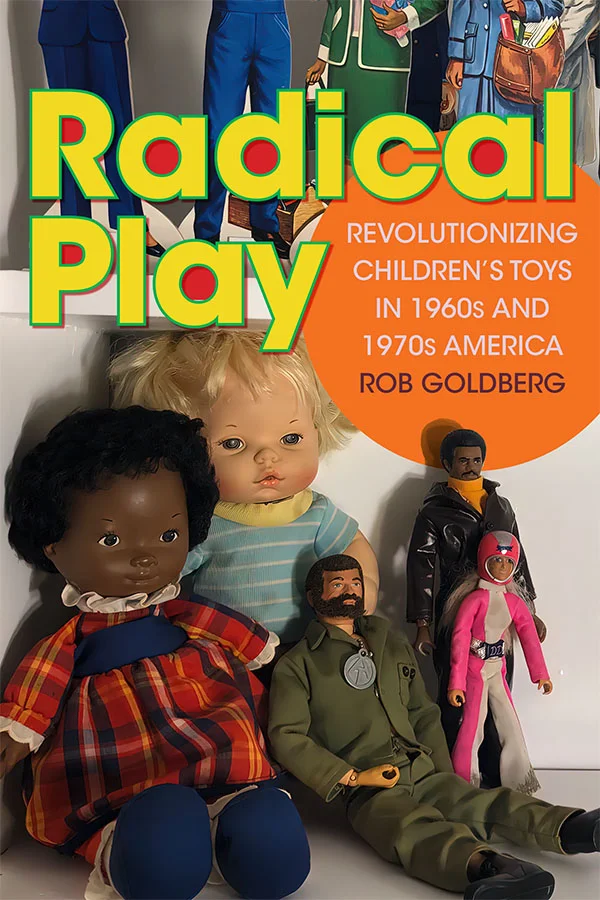
"A completely interesting look at the civil rights movements of the 60s and 70s through the lens of the toy industry. . . . Complete with photos of various toys, posters, ads, and other images, many from Goldberg’s own collection, this book expertly covers the era in history when toys became so much more than simple playthings. . . . Anyone interested in the civil rights era of history would find great interest in this book: it’s a complete and total deep dive into one of the most interesting periods of American history, with such a unique perspective, too." - Julia DeKorte, People of Play blog
"Goldberg has fashioned an important and enlightening study. . . . The documentation is full, and the bibliography includes a comprehensive list of primary and secondary sources. Goldberg also peppers the narrative with useful illustrations. Radical Play opens a new window onto toy culture. . . ." - Howard P. Chudacoff, American Journal of Play
"Radical Play is an important study that broadens our understanding of the histories of childhood, social movements, and material culture. Goldberg relies on a diverse assortment of material culture collections, oral history interviews, and archival collections of activist groups to piece together this story. The result is a thoroughly enjoyable analysis of the history of toy activism in redefining our cultural values." - Wendy Rouse, Journal of American History
"What Goldberg does particularly well is map a multiracial history of cultural shifts that take seriously—as did people of the period—the way that children’s development was correlated to toy development. . . . the book provides evidence of how consumers, then and now, can have a major impact on what is sold to us and our children. In the present moment of conservative political activism that has wrought bans of books and “divisive concepts,” and legislative changes that have ruptured societal norms under the guise of returning America to a fictional past, Goldberg . . . gives us a guidebook to make change too." - Aria S Halliday, American Historical Review
"Deeply researched and engagingly written, Radical Play mines the playroom as a major front in the broader progressive struggle for cultural change in the postwar United States. . . . Goldberg skillfully blends object-based and documentary sources." - Colin Fanning, Winterthur Portfolio
"One of the book’s greatest strengths lies in its innovative approach, offering a fresh and deeply insightful perspective on the Civil Rights era that goes beyond traditional political narratives. . . . Radical Play is a significant contribution to understanding 1960s and 1970s America." - Yagmur Burhan-Lim, Journal of Design History
"[A] valuable contribution to the socio-materiality of toys and historical understandings of children’s culture. It will be of immense use for researchers and educators." - Donna Varga, Journal of the History of Childhood and Youth