
Re-Understanding Media
Feminist Extensions of Marshall McLuhan
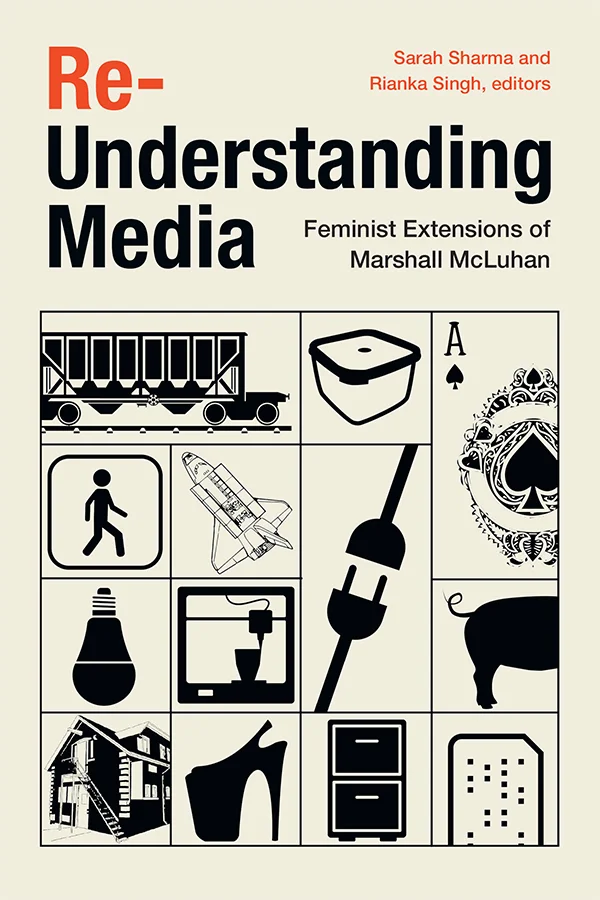
Book
Pages: 280
Illustrations: 39 illustrations
Published: May 2022
Editors: Sarah Sharma and Rianka Singh
Contributors: Nasma Ahmed, Morehshin Allahyari, Wendy Hui Kyong Chun, Sarah Banet-Weiser, Brooke Duffy, Ganaele Langlois, Sara Martel, Shannon Mattern, Cait McKinney, Jeremy Packer, Craig Robertson, Ladan Mohamed Siad, Nicholas Thiel Taylor, Armond Towns, and Jennifer Wemigwans
Media Studies > Media Technologies, Cultural Studies, Gender and Sexuality > Feminism and Women’s Studies
Praise
Buy
Price: $27.95
This title will be released on May 20, 2022
Buy the e-book:
Information
Author/Editor Bios
Back to TopRianka Singh is Assistant Professor in the Department of Communication and Media Studies at York University, Toronto.
Table Of Contents
Back to TopAcknowledgments xiii
Introduction: A Feminist Medium Is the Message / Sarah Sharma 1
Part I. Retrieving McLuhan's Media
1. Transporting Blackness: Black Materialist Media Theory / Armond R. Towns 23
2. Sidewalks of Concrete and Code / Shannon Mattern 36
3. Hardwired / Nicholas Taylor 51
4. Textile, the Uneasy Medium / Ganaele Langlois 68
Part II. Thinking with McLuhan: An Invitation
5. Dear Incubator / Sara Martel 87
6. Wifesaver: Tupperware and the Unfortunate Spoils of Containment / Brooke Erin Duffy and Jeremy Packer 98
7. “Will Miss File Misfile?” The Filing Cabinet, Automatic Memory, and Gender / Craig Robertson 119
8. Computers Made of Paper, Genders Made of Cards / Cait McKinney 142
9. Sky High: Platforms and the Feminist Politics of Visibility / Rianka Singh and Sarah Banet-Weiser 163
Part III. Media after McLuhan
10. Scanning for Black Data: A Conversation with Nasma Ahmed and Ladan Siad / Sarah Sharma and Rianka Singh 179
11. 3D Printing and Digital Colonialism: A Conversation with Morehshin Allahyari / Sarah Sharma and Rianka Singh 192
12. Toward a Media Theory of the Digital Bundle: A Conversation with Jennifer Wemigwans / Sarah Sharma 208
Afterword: After McLuhan / Wendy Hui Kyong Chun 225
Bibliography 233
Contributors 255
Index 259
Rights
Back to TopSales/Territorial Rights: World
Rights and licensingAdditional Information
Back to TopPublicity material