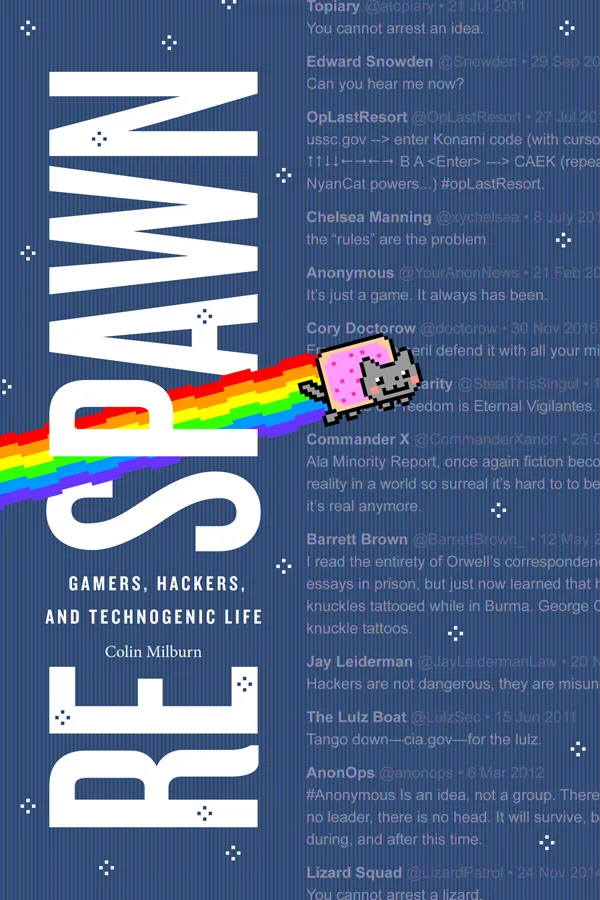
“Drawing out the tight historical, aesthetic, and even political connections between sci-fi, video games, and hacking, Colin Milburn offers an engaging and innovative account of how video games give players a place to experiment with speculative futures and to form critical habits of thinking and acting. Respawn is a fantastic book.” - Gabriella Coleman, author of Hacker, Hoaxer, Whistleblower, Spy: The Many Faces of Anonymous
“Respawn is more than just a book about video games; it is an exploration of digital culture at a moment in which games have reached unprecedented popularity. Employing a lively style, anecdotes from online culture, and a deep archive of games,Respawn contributes to a number of fields, including studies of the history of science, fan cultures, science fiction, games, and even cybersecurity.” - Patrick Jagoda, cofounder of the Game Changer Chicago Design Lab and author of Network Aesthetics
"This is a detailed and precise account, with a clear narrative that identifies the course of the elements used and their evolving style and context. But among the many intertwined stories, the clever quotes and the endless virtual environments, what keeps emerging is a strong value of responsibility, taking sensible decisions, showing a proper understanding of what Milburn calls as 'technogenic life.'" - Aurelio Cianciotta, Neural
"This is an accessible work that might give ardent gamers newfound appreciation of the social sciences, and it does an excellent job of neither raising up nor tearing down the historical processes it documents. . . . Recommended. All readers." - P. L. Kantor, Choice
"Respawn offers a detailed analysis of the entanglements of broader game cultures, political activism and the sociotechnical dilemmas of our present. Drawing on a plethora of game examples and their histories, online discussion threads and occasionally humorous imagery, the book is an engaging account for everyone working at the intersections of digital media theory, game studies, political theory and science and technology studies." - Yana Boeva, LSE Review of Books
"Milburn [provides] detailed, sympathetic, and imaginative descriptions of what it feels like to play some of the most artistically ambitious computer games to have attained widespread popularity and cultural cachet over the past few decades." - Mark Silcox, Metascience
"This author is a worthy bard, and the stories he tells are hella helpful for making sense of the somewhat ephemeral moments of resistance that emerge within, alongside, and out of gaming culture. Using schlxr skillz like research and archives, he weaves together tales of gamer resistance with careful attention to detail, but not without a few lulz, some lite L337speak, and some deep philosophical reflection on what it means to pwn." - H-Cat, Slingshot
"Colin Milburn’s Respaw not only offers a series of close readings of video games as literary objects, but it also posits that the practice of gaming can be thought of as an interpretive method in its own right, a lens through which to view a technologically mediated world and a philosophy that can govern our movements through it..." - Megan Condis, American Literary History
"Respawn is a valuable and ambitious intervention in the field of video game studies that locates important issues in the context of this technogenic philosophy. . . . Even as the words 'gaming' and 'gamer' continue to evolve and grow more ephemeral, Milburn’s look at technogenic philosophy through gaming and hacktivist history will remain persistently relevant." - Andy Fischer Wright, Velvet Light Trap
"Respawn will be accessible and interesting to a wide range of readers. Milburn has distilled his ideas and arguments, framed them with easy-to-engage theories, and connected them with a compelling narrative that effortlessly carries readers along. . . . The book deserves to be on library shelves, and in this era of increasing austerity, its open-access edition should be linked in libraries’ online catalogs, many of which look like technogenic life via baked-in communication, collaboration, and social networking tools." - Jason W. Ellis, Extrapolation
“Balancing detail and systemic overview, Milburn’s book is one of the most perceptive, incisive, and clear analyses of the dynamic imbrications of sf imaginaries, video games, and contemporary digital culture in a while.”
- Pawel Frelik,
Science Fiction Studies
"Overall, this book was educational, engaging, and evocative. The author was able to take the broad concepts of video games, hacking, and weave them together to present cogent and timely arguments about technological activism and technological communities." - William Thomas Howe, International Journal of Communication
"A thought-provoking analysis of contemporary digitized sociality that is eclectic and requires further interrogation. It makes for a fruitful starting point for further discussions about the historical, present, and future impact of digital technology." - Pieter Van den Heede, Technology and Culture
"[A] strong exampl[e] of interdisciplinary research pulling together an admixture of cultural studies, game studies, digital media, and literary studies, [Respawn shines in its] commitment to uncovering the hidden histories of gamers and hackers and presenting them in thoughtful detail." - Brad Rittenhouse, American Literature