
Home / Books / River Life and the Upspring of Nature

River Life and the Upspring of Nature
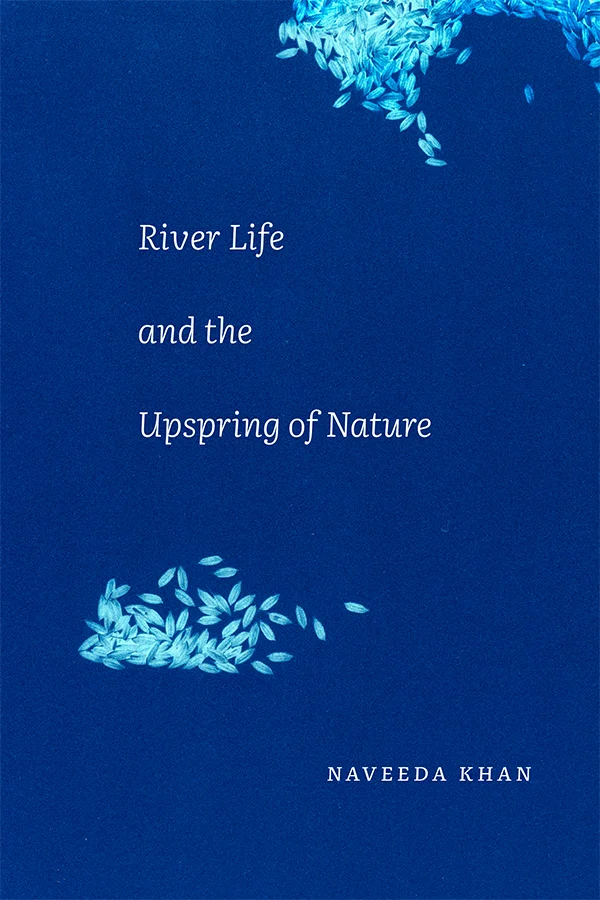
Book

Pages: 256

Illustrations: 27 illustrations

Published: January 2023

Author: Naveeda Khan

In River Life and the Upspring of Nature Naveeda Khan examines the relationship between nature and culture through the study of the everyday existence of chauras, the people who live on the chars (sandbars) within the Jamuna River in Bangladesh. Nature is a primary force at play within this existence as chauras live itinerantly and in flux with the ever-changing river flows; where land is here today and gone tomorrow, the quality of life itself is intertwined with this mutability. Given this centrality of nature to chaura life, Khan contends that we must think of nature not simply as the physical landscape and the plants and animals that live within it but as that which exists within the social and at the level of cognition, the unconscious, intuition, memory, embodiment, and symbolization. By showing how the alluvial flood plains configure chaura life, Khan shows how nature can both give rise to and inhabit social, political, and spiritual forms of life.

Praise

“This stunningly written ethnography demonstrates how life, and our ethnographic approach, might be configured in conversation with nature. The ethnographic form itself demonstrates this approach in which one feels, upon reading, as if one is experiencing the sociality of an alluvial flow of people, politics, histories, and memories. River Life and the Upspring of Nature is a tour de force that reveals an author who reads widely and deeply, thinks in compelling and novel ways about the field, and lets the ethnography tell a story and make the theory come alive.” - Vincanne Adams, author of Glyphosate and the Swirl: An Agroindustrial Chemical on the Move

“This rich, perceptive, and multifaceted ethnography may pave the way for a more playful, poetic, and evocative style of representation of ordinary Bangladeshi life. Of unusual ambition and conceptual scope, River Life and the Upspring of Nature makes an important contribution to the study of Bangladesh and South Asia as well as to future anthropological work on how the physical environment, climate, and many other more-than-human forces are intimately involved in virtually every aspect of social practices and imaginings.” - Thomas Blom Hansen, author of The Law of Force: The Violent Heart of Indian Politics

"An empirically rich study of changing land and those seeking to carve out an existence upon it. [River Life and the Upspring of Nature] can serve as a model for other authors seeking to look at the interrelation between our environment and ourselves, and the existential questions that a changing world poses to us."

- Andrew Alan Johnson, Ethnos

"The book is well written, impressive in its scope, and detailed in its application. . . . a valuable addition to the growing literature on rethinking rivers, lands, and peoples in South Asia, especially those people who are living on river islands that had remained beyond the periphery of mainstream academic vision. It aids understanding of why people live tenuous lives on uncertain grounds, and how their lives are shaped by the river and how they shape the river’s flow." - Kuntala Lahiri-Dutt, Asian Studies Review

"Khan successfully renders the difficult relationship of the chaura people to their shifting waterscape as a complicated context that is informed by poverty, history, religion, etc., etc., which she is then able to combine and draw from to account for their struggle beyond the edges of power in Bangladesh." - David Lipset, The Asia Pacific Journal of Anthropology

"[River Life and the Upspring of Nature] is a compelling read and the author’s skill as a writer is remarkable." - Rishabh Raghavan, HAU: Journal of Ethnographic Theory

"River Life and the Upspring of Nature usefully stretches the ethnographic imagination and vocabulary for engaging environmental change." - Jason Cons, HAU: Journal of Ethnographic Theory

"The aesthetic texture of Khan’s writing . . . enables astute insight to break through the specters of knowledge shadowing anthropological notions of nature, climate, and mythology." - Lotte Buch Segal, HAU: Journal of Ethnographic Theory

"This evocative work may be primarily focused on the chars of Bangladesh—but it provides deeply thought-provoking insights into 'nature' as a mode of unconscious interiority." - Sophie Chao, HAU: Journal of Ethnographic Theory

Buy

Availability: Loading...

Price: Loading...

Request a desk or exam copy

Information

Author/Editor Bios

Back to Top
Naveeda Khan is Associate Professor of Anthropology at Johns Hopkins University, author of Muslim Becoming: Aspiration and Skepticism in Pakistan, also published by Duke University Press, and In Quest of a Shared Planet: Negotiating Climate from the Global South, and editor of Beyond Crisis: Re-evaluating Pakistan.

Table Of Contents

Back to Top
List of Maps  ix
Preface  xi
Acknowledgments  xiii
Introduction. River Life and Death  1
1. Moving Lands in the Skein of Property and Kin Relations  28
2. History and Morality between Floods and Erosion  59
3. Elections on Sandbars and the Remembered Village  94
4. Decay of the River and of Memory  131
5. Death of Children and the Eruption of Myths  160
Epilogue. The Chars in Recent Years  191
Notes  197
References  215
Index  229

Rights

Back to Top

Sales/Territorial Rights: World exc South Asia

Rights and licensing

Awards

Back to Top

Second Prize, 2023 Victor Turner Writing Prize, presented by the Society for Humanistic Anthropology

Additional Information

Back to Top
Related Links Paper ISBN: 978-1-4780-1939-8 / Hardcover ISBN: 978-1-4780-1673-1 / eISBN: 978-1-4780-2400-2 / DOI: https://doi.org/10.1215/9781478024002