
Home / Books / Ruderal City

Ruderal City

Ecologies of Migration, Race, and Urban Nature in Berlin
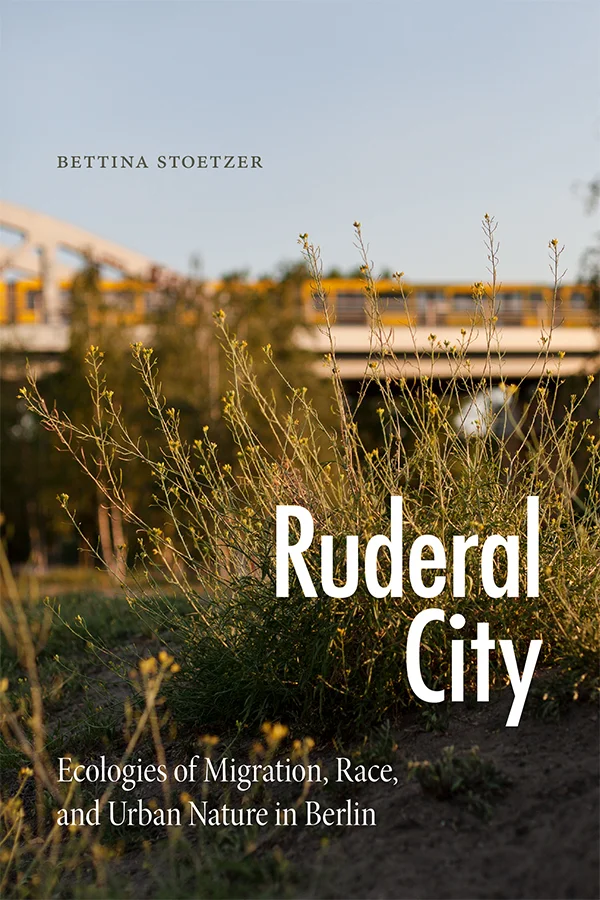
Ruderal City cover image

Experimental Futures: Technological Lives, Scientific Arts, Anthropological Voices

More about this series

Read the Introduction

Book

Pages: 352

Illustrations: 37 illustrations

Published: December 2022

In Ruderal City Bettina Stoetzer traces relationships among people, plants, and animals in contemporary Berlin as they make their lives in the ruins of European nationalism and capitalism. She develops the notion of the ruderal—originally an ecological designation for the unruly life that inhabits inhospitable environments such as rubble, roadsides, train tracks, and sidewalk cracks—to theorize Berlin as a “ruderal city.” Stoetzer explores sites in and around Berlin that have figured in German national imaginaries—gardens, forests, parks, and rubble fields—to show how racial, class, and gender inequalities shape contestations over today’s uses and knowledges of urban nature. Drawing on fieldwork with gardeners, botanists, migrant workers, refugees, public officials, and nature enthusiasts while charting human and more-than-human worlds, Stoetzer offers a wide-ranging ethnographic portrait of Berlin’s postwar ecologies that reveals emergent futures in the margins of European cities. Brimming with stories that break down divides between environmental perspectives and the study of migration and racial politics, Berlin’s ruderal worlds help us rethink the space of nature and culture and the categories through which we make sense of urban life in inhospitable times.

Praise

“Anthropology at its best: ethnographically rich, theoretically informed, and offering innovative concepts that allow us to see things we would otherwise miss—things that are of particular pertinence to understand the dead-ends and the possibilities of our world.” - Ghassan Hage, author of The Diasporic Condition: Ethnographic Explorations of the Lebanese in the World

“The city, once imagined as the center of civilization, is revealed here as an assemblage of refugees and rubble. For US readers, this is the city inside out: instead of racial subordination inscribed in lifeless concrete, here it emerges from urban parks and gardens and the unhomelike forests of suburban edges. Ruderal City turns understandings of urban natureculture on their heads.” - Anna Lowenhaupt Tsing, coeditor of Feral Atlas: The More-than-Human Anthropocene

"A thought-provoking read for anyone looking to not only learn about how relationships between people, plants, and places shape urban socialites in post-socialist Europe, but those interested in rethinking the legacies and possible futures of urban studies, environmental anthropology, and city planning today." - Victoria Nguyen, City & Society

"The book examines the legacies of racism and colonial extractivism upon which European life is still based, using them to develop the idea of urban life as ruderal. She deploys this ecological term—that is, a ruderal plant is one that grows and even thrives in poor soil and disturbed landscapes—to contribute to the swelling literature on social–material relations and multispecies theorising. Regardless of how a reader might approach this topic, this book is well-researched, ethnographically rich, and conceptually ambitious." - Eeva Berglund, Suomen Anthropologi

"Stoetzer’s Ruderal City is a compelling anthropological study of the everyday formations of social fabric taking place in and around Berlin’s green spaces." - Charrlotte Adelina, Journal of Urban Affairs

"Stoetzer’s book is a powerful ethnography which skillfully juxtaposes heterogenous actors and stories of migration, racialization, urban nature, and colonial legacies. . . . The book will be valuable to scholars of migration, race, urban life, Europe, and advanced anthropology students." - Elena Popa, Journal of Anthropological Research

"Although not written by a geographer, Ruderal City builds on one of geography’s core methods: observation. By providing us with a new lens—the ruderal—Stoetzer encourages us to observe our surroundings more closely. . . . We learn from Stoetzer’s gift for observation and her capacity for seeing the complex interrelations of urban life. Her book challenges us to question both the intimate and small-scale ecologies we are part of and our complicity in the legacies of colonialism and racism in Germany and Europe." - Judith Keller, Geographical Review

"Ruderal City is engaging and provocative and offers the opportunity to think differently about ruderal ecologies and analyze urban life in a new way to learn more about Berlin." - Thomas Sullivan, German Studies Review

"In this unconventional and innovative monograph, the anthropologist Bettina Stoetzer explores the diverse manifestations, meanings, and experiences of nature in Berlin." - Eagle Glassheim, Central European History

Buy

Availability: Loading...

Price: Loading...

Request a desk or exam copy Spring 2026 Web Sale

Information

Author/Editor Bios

Back to Top
Bettina Stoetzer is Associate Professor of Anthropology at the Massachusetts Institute of Technology and coeditor of Shock and Awe: War on Words.

Table Of Contents

Back to Top
Preface: Forest Tracks  vii
Acknowledgments  xi
Introduction  1
Rubble
1. Botanical Encounters  35
Gardens
2. Gardening the Ruins  67
Parks
3. Provisioning against Austerity  103
4. Barbecue Area  138
Forests
5. Living in the Unheimlich  173
6. Stories of the “Wild East”  205
Epilogue: Seeding Livable Futures  239
Notes  245
References  283
Index  319

Rights

Back to Top

Sales/Territorial Rights: World

Rights and licensing

Awards

Back to Top

Winner of the 2023 Best Book Award from the German Studies Association

Winner of  the 2023 Diana Forsythe Prize, presented by the Committee for the Anthropology of Science, Technology and Computing (a part of the General Anthropology Section of the American Anthropological Association)

Additional Information

Back to Top
Related Links Paper ISBN: 978-1-4780-1860-5 / Hardcover ISBN: 978-1-4780-1596-3 / eISBN: 978-1-4780-2320-3 / DOI: https://doi.org/10.1215/9781478023203