
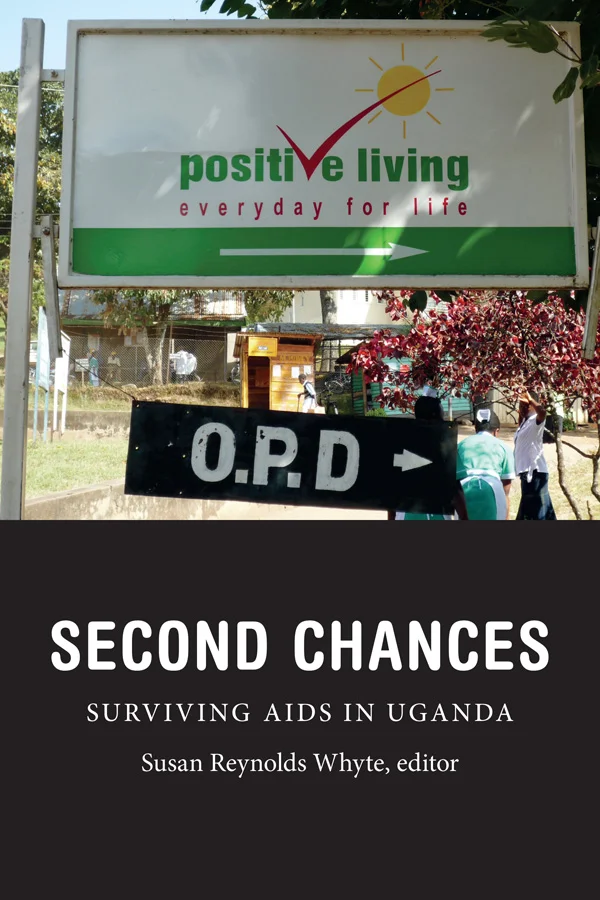
Second Chances
Surviving AIDS in Uganda
Critical Global Health: Evidence, Efficacy, Ethnography
Book
Pages: 328
Illustrations: 12 illustrations
Published: November 2014
Editor: Susan Reynolds Whyte
Contributors: Godfrey Etyang, Phoebe Kajubi, David Kyaddondo, Lotte Meinert, Hanne Mogensen, Jenipher Twebaze, and Michael A. Whyte
Praise
Buy
Availability: Loading...
Price: Loading...
This title will be released on November 21, 2014
Buy the e-book:
Information
Author/Editor Bios
Back to TopSusan Reynolds Whyte is Professor of Anthropology at the University of Copenhagen. She is the author of Questioning Misfortune: The Pragmatics of Uncertainty in Eastern Uganda, coauthor of Social Lives of Medicines, and coeditor of Disability in Local and Global Worlds.
Table Of Contents
Back to Top
Polygraphy vii
Introduction. The First Generation 1
Case I. Robinah and Joyce: The Connecting Sisters 25
1. Connections 34
Case II. Saddam: Treatment Programs 47
2. Clientship 56
Case III. Suzan: The Necessity of Travel 71
3. Mobility 80
Case IV. MamaGirl & MamaBoy: Family Matters 95
4. Families 104
Case V. Alice: Keeping a Good Man 119
5. Partners 128
Case VI. Jackie: Children without Grandparents 143
6. Children 152
Case VII. John: Working Contingencies 167
7. Work 176
Case VIII. Hassan: Soft Food and Town Life 191
8. Food 200
Case IX. Jolly: Appearances and Numbers 215
9. Bodies 223
Case X. Rachel: Buckets of Medicine 237
10. Medicine 245
Case XI. Dominic: A Multitude of Adversities 259
11. Life 268
Acknowledgments 285
Bibliography 287
Contributors 299
Index 301
Introduction. The First Generation 1
Case I. Robinah and Joyce: The Connecting Sisters 25
1. Connections 34
Case II. Saddam: Treatment Programs 47
2. Clientship 56
Case III. Suzan: The Necessity of Travel 71
3. Mobility 80
Case IV. MamaGirl & MamaBoy: Family Matters 95
4. Families 104
Case V. Alice: Keeping a Good Man 119
5. Partners 128
Case VI. Jackie: Children without Grandparents 143
6. Children 152
Case VII. John: Working Contingencies 167
7. Work 176
Case VIII. Hassan: Soft Food and Town Life 191
8. Food 200
Case IX. Jolly: Appearances and Numbers 215
9. Bodies 223
Case X. Rachel: Buckets of Medicine 237
10. Medicine 245
Case XI. Dominic: A Multitude of Adversities 259
11. Life 268
Acknowledgments 285
Bibliography 287
Contributors 299
Index 301
Rights
Back to TopSales/Territorial Rights: World
Rights and licensingAwards
Back to TopHonorable Mention, 2015 New Millennium Book Award, Society for Medical Anthropology
Additional Information
Back to Top
Paper ISBN:
978-0-8223-5808-4 /
Hardcover ISBN:
978-0-8223-5795-7 /
eISBN:
978-0-8223-7597-5 /
DOI:
https://doi.org/10.1215/9780822375975
Publicity material