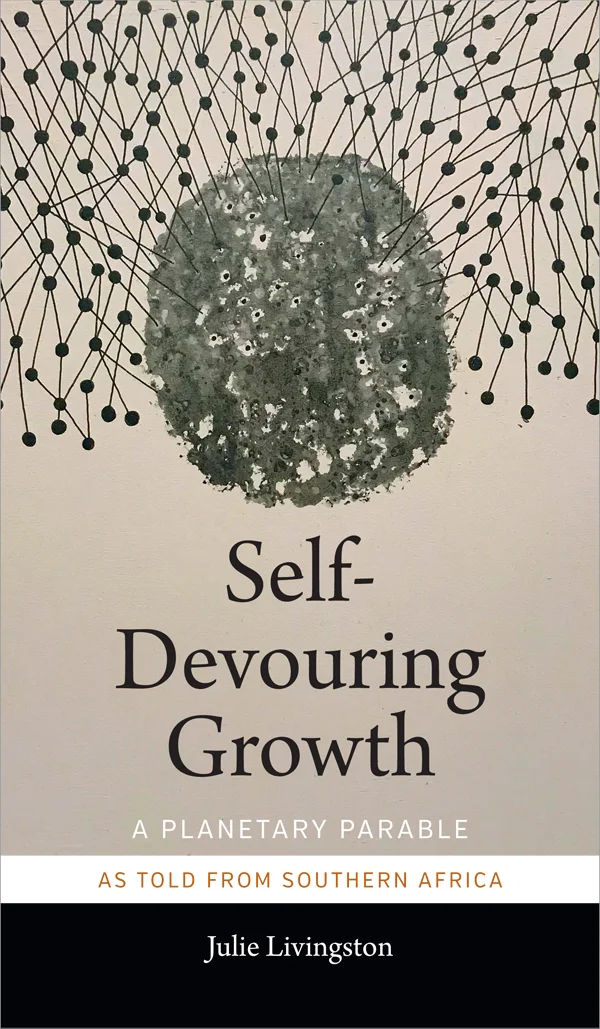
“Highly engaging, deeply thoughtful, and beautifully written, Self-Devouring Growth helps us to understand the environmental dangers the planet faces not as something to be avoided or prevented, but as something to expect and to live through. Julie Livingston's thinking about environmental and other futures is a breath of fresh air and cuts across stale debates around economic development and environmental sustainability in a very original way.” - James Ferguson, author of Give a Man a Fish: Reflections on the New Politics of Distribution
“Julie Livingston's concept of ‘self-devouring growth’ will become an essential tool across many forms of scholarship—and for concerned earth dwellers across the planet. As Livingston puts it, “GROW! is a mantra so powerful that it obscures the destruction it portends.” Self-Devouring Growth tells of the failure of Botswana's public water system, strained by failing rains and pumped dry by mining and commercial beef rearing for export. Regarded as a success of development, Botswana is the ideal site for a parable of the Anthropocene.” - Anna Lowenhaupt Tsing, coeditor of Feral Atlas: The More-than-Human Anthropocene
"Livingston has written a beautiful book, which speaks from Tswana cosmology towards the complexities of global problems, and that points towards forms of activism that we can all take forward." - Shannon Morreira, Africa Is a Country
"An imaginative parable about human society and life on Earth. . . . The author notes that everyone cries foul when poorer countries achieve a standard of living enjoyed elsewhere, yet the global inequality reflected in this complaint suggests the need for collective creative thinking about new forms of growth for life on Earth to survive. Highly recommended. Upper-division undergraduates through faculty; general readers."
- E. P. Renne, Choice
"I find self-devouring growth a powerful and clarifying concept. I’m more accustomed to thinking about the climate change emergency through numbers, like the temperature beyond which the earth must not warm, or the number of tons of carbon we can safely put into the atmosphere. Instead, Livingston illuminates our way of life. She is asking a lot of the reader: she is asking us to understand that many of the things that make us feel well, prosperous, and secure are the very things that are killing us. . . . It is deeply unsettling to live with." - Emily Callaci, Dissent
"Livingston has forged a path into an anthropology of futures, one responsive to and reflective of the Anthropocene and the threats to human survival we witness daily on our ever-more vulnerable planet. She offers methodological and conceptual tools that will enable other scholars to grapple with futures, those that are unfolding now because of self-devouring growth, and those we want to imagine differently. This book is for everyone." - Sharon R. Kaufman, Medical Anthropology Quarterly
“I like reading Julie Livingston’s Self-Devouring Growth as a push against the consumption of modernist time—that is, against the suspension of historical flux, imaginative possibility, and alter-social development.... The book so convincingly dispels efforts to reduce the planetary condition to a matrix problem begging for technological solutions....” - Alex Blanchette, Somatosphere
“It is a testament to the distilled clarity and prescience of Julie Livingston’s parable of a book that its title, Self-Devouring Growth, can strike one immediately as both so true and suddenly so evident....”
- Abou Farman,
Somatosphere
“Livingston documents how the push to produce diamonds, beef, and a highway infrastructure for automobiles is decimating Botswana. The three parables she recounts together make a parable of climatic ruin: the goal of prosperity has turned upon itself, a serpent devouring its tail.” - Emily Yates-Doerr, Somatosphere
“[Self-Devouring Growth is] a book that offers an elegant and important argument about industrial capitalism and growth that is devouring the world in which we live.... It is a book firmly grounded in critical medical anthropology, which has for a long time dug into the political economy of health and the structural violence of capitalism....”
- Fanny Chabrol,
Somatosphere
Only Julie Livingston could write this book because of the sources, sensibilities, and experiences from which she draws.... [She] leads us to think about the biggest burning question of our common era: What kind of future is possible when our ways of living are literally invested in our collective destruction?”
- Juno Salazar Parreñas,
Somatosphere
“What Livingston’s remarkable book teaches us...is that parable makes possible a politics of collective refusal. By allowing us to recognize ourselves in the stories of others..., parable opens up the possibility of creating worlds that are more just than the ravaged ones we currently inhabit.”
- Radhika Govindrajan,
Somatosphere
“Julie Livingston’s pithy and poignant treatise, Self-Devouring Growth, is a powerful aid for thinking through the Anthropocene and, more specifically, the limits of growth-driven development.”
- Simukai Chigudu,
Somatosphere
“Julie Livingston tells three wonderfully poetic tales about a process of ‘self-devouring growth,’ which is firmly situated in insatiable consumption practices and a society-wide commitment to economic growth. She uses the literary form of the parable.... [Livingston] urge[s] ethnographers to reconfigure our practices of storytelling....” - Kathleen M. Sullivan, PoLAR
“[Self-Devouring Growth] convincingly lays out the unpleasant consequences of self-devouring growth in Botswana and demonstrates their application in Southern Africa and at the planetary level.” - Jack Parson, South African Historical Journal
“This is an important and thought-provoking book that offers a strong stimulus to connect the disasters Livingston so clearly relates to what seems to be one of capitalism’s most destructive trends generally: the progressive generation of socioeconomic inequality....” - Ørnulf Gulbrandsen, Anthropos
“Through the realist genre of the parable, this marvelous little book discusses an interconnected world organized by ‘self-devouring growth’.... This immensely readable book will appeal to a broad audience of academics, policymakers and practitioners in international development....” - Tanya Matthan, Progress in Development Studies
“A compelling read, Self-Devouring Growth situates climate change at the heart of anthropological debates from development to ethics, and personhood to public health. It contributes a novel account from southern Africa to thinking on the more-than-human and the Anthropocene.” - Koreen M. Reece, Journal of the Royal Anthropological Institute
“Livingston has dared to write a book that deviates from the micro and forces the reader to engage with an unsettling set of truths about development that apply to the world as a whole. . . . The point of a parable, and the point of this book, is that readers should come away with a new understanding of the intertwined system of relationships in which they find themselves enmeshed, at both local and planetary levels.” - Dayna Hansberger and Melissa Graboyes, African Studies Review
"The book is a powerful testimony to the difficulties inherent in confronting the maladies of the economic logic of perpetual and unfettered growth which governs global society, placing the microcosm of one particular society under the contemporary historical microscope." - Dominique Santos, Anthropology Southern Africa