
Home / Books / Settler Garrison

Settler Garrison

Debt Imperialism, Militarism, and Transpacific Imaginaries
Book

Pages: 272

Illustrations: 1 illustrations

Published: May 2022

Author: Jodi Kim

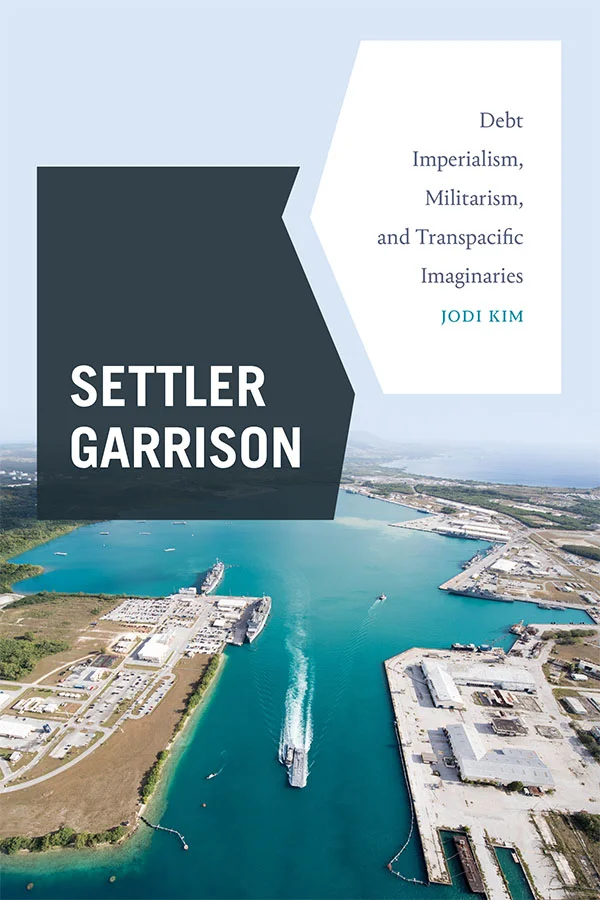
In Settler Garrison Jodi Kim theorizes how the United States extends its sovereignty across Asia and the Pacific in the post-World War II era through a militarist settler imperialism that is leveraged on debt as a manifold economic and cultural relation undergirded by asymmetries of power. Kim demonstrates that despite being the largest debtor nation in the world, the United States positions itself as an imperial creditor that imposes financial and affective indebtedness alongside a disciplinary payback temporality even as it evades repayment of its own debts. This debt imperialism is violently reproduced in juridically ambiguous spaces Kim calls the “settler garrison”: a colonial archipelago of distinct yet linked military camptowns, bases, POW camps, and unincorporated territories situated across the Pacific from South Korea to Okinawa to Guam. Kim reveals this process through an analysis of how a wide array of transpacific cultural productions creates antimilitarist and decolonial imaginaries that diagnose US militarist settler imperialism while envisioning alternatives to it.

Praise

Settler Garrison is a stunning, magisterial work that provides an entirely original definition of US empire as predicated on the production of its legitimation to wield power. Jodi Kim frames spaces heretofore deemed anomalous or marginal—the camptown, the POW camp, and the unincorporated territory—as the very sites where US empire establishes its authority to rule. In the process of redefining and reframing US empire, Kim offers a unique and sorely needed relational methodology for understanding the connection between its various modes, in particular between military empire and settler colonialism." - Grace Kyungwon Hong, author of Death beyond Disavowal: The Impossible Politics of Difference

“In this ambitious and brilliantly executed book, Jodi Kim offers a crucial bridge between frameworks of Anglo settler colonialism in North America and US settler military imperialism across the Pacific. Drawing connections that are breathtaking in their scope and historical comprehensiveness, she outlines the double standard in which the United States can indefinitely roll over its debts while demanding tribute for a military presence that protects freedoms that remain unrealized. I learned tremendously from this book.” - Iyko Day, author of Alien Capital: Asian Racialization and the Logic of Settler Colonial Capitalism

"Building on an impressive array of work from cultural theorists, historians, literary critics, and others, Kim adds new ways to consider the devastating impact of the postwar US empire and the various responses to it through the paradigm of debt." - Edward Tang, American Literary History

"An ambitious undertaking. . . . Settler Garrison is a powerful antidote to conceptions of the Pacific as merely a US mare nostrum." - Jim Glassman, Pacific Affairs

"That Settler Garrison is a study of many things (e.g., capitalism, decolonization, militarism, settler colonialism, and sexual violence) should draw scholars from an extensive range of disciplines to examine this question alongside her and consider it in their own work." - Sarah Meiners, Journal of American Ethnic History

"This book is a worthwhile read for those who are interested in further understanding the mechanisms of exported US imperialism and in search of articulations of transpacific futurities. . . . Settler Garrison maintains a strong argument surrounding the operations of US militarism and a thoughtful commitment to transpacific futurities as envisioned by the people who have endured this violence and its settler imperial failures." - Katherine Funes, Modern Fiction Studies

"It makes a major contribution to the remapping of the spatiality and temporality of the US empire and the underlying neoliberal structures of debt and dependency that form national subjectivity." - Bob Johnson, Journal of American Culture

Buy

Availability: Loading...

Price: Loading...

Request a desk or exam copy

Information

Author/Editor Bios

Back to Top
Jodi Kim is Associate Professor of Media and Cultural Studies at the University of California, Riverside; coeditor of Critical Ethnic Studies: A Reader, also published by Duke University Press; and author of Ends of Empire: Asian American Critique and the Cold War.

Table Of Contents

Back to Top
Introduction. US Exceptionalisms, Metapolitical Authority, and the Aesthetics of Settler Imperial Failure  1
1. Perverse Temporalities: Primitive Accumulation and the Settler Colonial Foundations of Debt Imperialism  39
2. The Military Base and Camptown: Seizing Land "by Bulldozer and Bayonet" and the Transpacific Masculinist Compact  62
3. The POW Camp: Waging Psychological Warfare and a New Settler Frontier  113
4. The Unincorporated Territory: Constituting Indefinite Deferral and "No Page Is Ever Terra Nullius"  138
Epilogue. Climate Change, Climate Debt, Climate Imperialism  174
Acknowledgments  185
Notes  189
Bibliography  229
Index  249

Rights

Back to Top

Sales/Territorial Rights: World

Rights and licensing

Awards

Back to Top

Honorable Mention, 2024 AAAS Book Award in the Multidisciplinary/Interdisciplinary Studies Category

Additional Information

Back to Top
Paper ISBN: 978-1-4780-1831-5 / Hardcover ISBN: 978-1-4780-1568-0 / eISBN: 978-1-4780-2292-3 / DOI: https://doi.org/10.1215/9781478022923