
Home / Books / Somatic States

Somatic States

On Cartography, Geobodies, Bodily Integrity
Book

Pages: 320

Illustrations: 35 illustrations

Published: April 2025

Author: Franck Billé

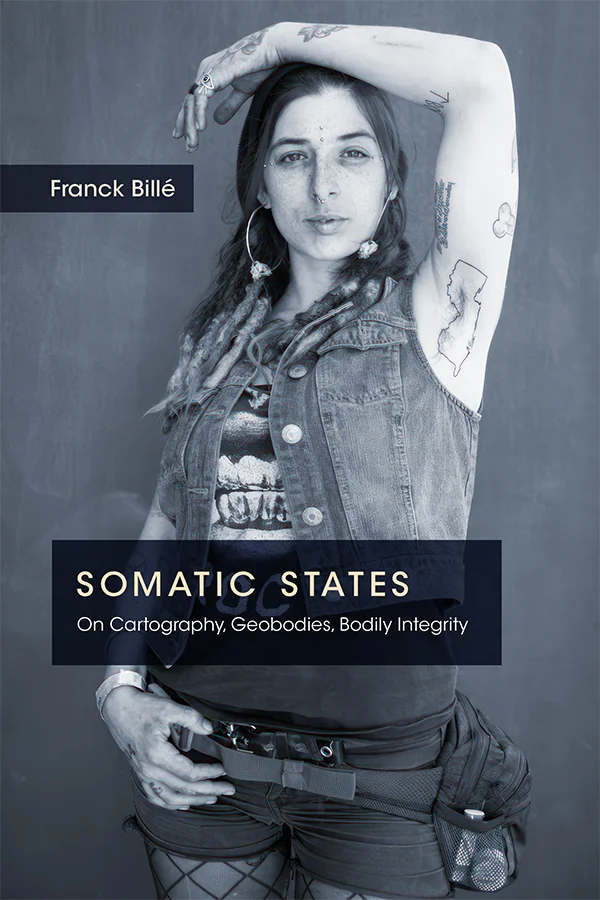
In Somatic States, Franck Billé examines the conceptual link between the nation-state and the body, particularly the visceral and affective attachment to the state and the symbolic significance of its borders. Billé argues that corporeal analogies to the nation-state are not simply poetic or allegorical but reflect a genuine association of the individual body with the national outline—an identification greatly facilitated by the emergence of the national map. Billé charts the evolution of cartographic practices and the role that political maps have played in transforming notions of territorial sovereignty. He shows how states routinely and effectively mobilize corporeal narratives, such as framing territorial loss through metaphors of dismemberment and mutilation. Despite the current complexity of geopolitics and neoliberalism, Billé demonstrates that corporeality and bodily metaphors remain viscerally powerful because they offer a seemingly simple way to apprehend the abstract nature of the nation-state.

Praise

“The idea of a somatic state makes immediate, intuitive sense: once you read it, you realize that you yourself have thought in exactly such terms. This is why, at the same moment you know that this is an absolutely new idea, it feels intensely (and sometimes uncomfortably) familiar. Franck Billé brilliantly denaturalizes this idea, thus opening up new possibilities for critique and political action. Somatic States is scholarship at its finest: it unsettles things you thought you knew while providing a compelling analytic frame for the world’s most urgent issues.” - Elizabeth Cullen Dunn, author of No Path Home: Humanitarian Camps and the Grief of Displacement

“The strengths of this extremely persuasive book lie in its intellectual scope and how it brings together hitherto different ways in which territory has been related to the question of state and imperial sovereignty. Franck Billé’s scholarship, which is stunning in its geographical range and historical and philosophical depth, made me rethink topics I had thought settled. Somatic States will appeal to political theorists, anthropologists, and geographers interested in contemporary statehood as well as a broader audience interested in the rise of populist nationalism worldwide.” - John Agnew, author of Hidden Geopolitics: Governance in a Globalized World

"Somatic States is a literary feast that offers you an entrée of compelling arguments related to the state and how bodily metaphors shape our current understandings of borders and territoriality, but also an abundance of captivating information on a range of topics. Like a good meal, it leaves you satisfied, but wanting more." - Theresa Catalano, Journal of Anthropological Research

Buy

Availability: Loading...

Price: Loading...

Request a desk or exam copy

Information

Author/Editor Bios

Back to Top
Franck Billé is Program Director of the Tang Center for Silk Road Studies at the University of California, Berkeley. He is editor of Voluminous States: Sovereignty, Materiality, and the Territorial Imagination, also published by Duke University Press, and author of Sinophobia: Anxiety, Violence, and the Making of Mongolian Identity.

Table Of Contents

Back to Top
Acknowledgments  ix
Introduction  1
Part I.
1. Cartographic Revolutions  29
2. The Goddess, the Book, and the Square  60
Part II.
3. Territorial Phantom Pains  103
4. Epidermic States  137
5. Archipelagoes, Enclaves, and Other Cartographic Monsters  163
Coda. Beyond the Map?  192
Notes  205
Bibliography  263
Index

Rights

Back to Top

Sales/Territorial Rights: World

Rights and licensing

Awards

Back to Top

Winner of the 2026 Julian Minghi Distinguished Book Award, presented by the Political Geography Specialty Group of the Association of American Geographers

Additional Information

Back to Top
Related Links Paper ISBN: 978-1-4780-3172-7 / Hardcover ISBN: 978-1-4780-2849-9 / eISBN: 978-1-4780-6070-3 / DOI: https://doi.org/10.1215/9781478060703