
Home / Books / Surrogate Humanity

Surrogate Humanity

Race, Robots, and the Politics of Technological Futures
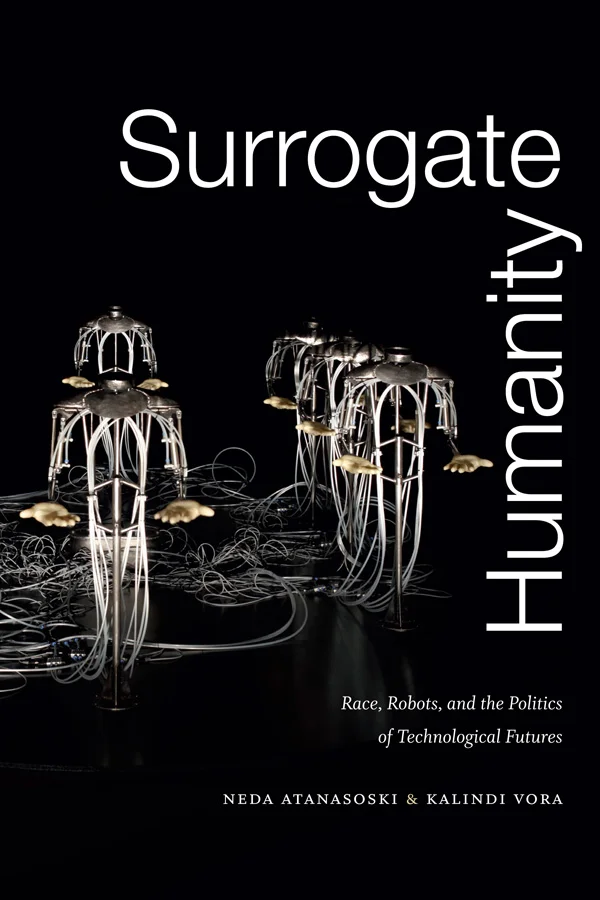
Surrogate Humanity cover image

Perverse Modernities: A Series Edited by Jack Halberstam and Lisa Lowe

More about this series

Read the Introduction

Book

Pages: 256

Illustrations: 30 illustrations

Published: March 2019

In Surrogate Humanity Neda Atanasoski and Kalindi Vora trace the ways in which robots, artificial intelligence, and other technologies serve as surrogates for human workers within a labor system entrenched in racial capitalism and patriarchy. Analyzing myriad technologies, from sex robots and military drones to sharing-economy platforms, Atanasoski and Vora show how liberal structures of antiblackness, settler colonialism, and patriarchy are fundamental to human---machine interactions, as well as the very definition of the human. While these new technologies and engineering projects promise a revolutionary new future, they replicate and reinforce racialized and gendered ideas about devalued work, exploitation, dispossession, and capitalist accumulation. Yet, even as engineers design robots to be more perfect versions of the human—more rational killers, more efficient workers, and tireless companions—the potential exists to develop alternative modes of engineering and technological development in ways that refuse the racial and colonial logics that maintain social hierarchies and inequality.

Praise

Surrogate Humanity is a stunning, original analysis of the fantasies, surrogacies, and technologies of ‘the human’ that uphold present-day racial capitalism and empire. Neda Atanasoski and Kalindi Vora examine ‘technoliberal’ projects that promise revolutionary liberation from labor inequality, and demonstrate their centrality to the social reproduction of the very dispossessions, differences, and exploitations they seek to transcend. An examination of the close relationship of automation, robotics, media platforms, drones, and artificial intelligence to U.S. racial logics, this is an indispensable book for feminist studies of science and technology, race and colonialism, and critiques of liberalism.” - Lisa Lowe, author of The Intimacies of Four Continents

“With clarity and force, Neda Atanasoski and Kalindi Vora intervene into the formulations of human---machine interaction by tracking how race, colonialism, and patriarchy are woven into the fabric of robots, thereby bringing urgent scholarship on antiblackness, settler colonialism, and the racial structures of labor into the center of technoscience. The world needs this superb book!” - Michelle Murphy, author of The Economization of Life

“Throughout their work, at the end of each chapter, Atanasoski and Vora offer glimpses into what the technological future can look like when it resists the problems they foreground... and it is this resistance that needs further exploration.” - Chad A. B. Wilson, Journal of American Culture

“By bringing a much more nuanced reading of race, gender, and difference to science and technology studies, Atanasoski and Vora provoke us to think more deeply about how our imagined technological futures always already serve to reproduce our most problematic pasts—and what forms or processes can disrupt and transcend these. This is a vital project that should speak to us all.” - Barbara Herr Harthorn, American Ethnologist

Surrogate Humanity...confirm[s] that the human is a contingent concept.... The authors also spotlight how contemporary discourses concerning automation, in particular, alternately promise liberation and threaten debasement while eliding the roles of racialized and colonial subjects in producing the technologies and materials on which automation relies.” - Rebecah Pulsifer, Women's Studies Quarterly

“Neda Atanasoski and Kalindi Vora’s Surrogate Humanity is a wide-ranging and ambitious analysis of the relationships between labor practices, artificial intelligence, and other technologies in modern society.... Labor and critical AI researchers will appreciate the scope of the book and its examination of the digital work and the gig economy in particular.” - Andrea Flores, Information & Culture

“...Surrogate Humanity usefully provides examples from literary, artistic, engineering, and scientific projects that critique or outright refuse technoliberalism’s frame for recognizing full humanity. These rebellious acts of imagination show us that the potential exists to develop alternative designs and trajectories for technological development ... in ways that prioritize equity and justice.” - Anita Lam, Surveillance & Society

Surrogate Humanity is a fascinating and important book that provides a much-needed counter narrative to prevailing approaches in science and technology studies.... Complemented by their mode of collaborative writing as a radical feminist act, the book is thus certain to inspire scholars and activists alike....” - Sibille Merz, Ethnic and Racial Studies

Surrogate Humanity is an insightful analysis of humanity’s relationship to technology under racial capitalism.... The book draws attention to theoretical, activist and artistic efforts to create technologies outside of the use, productivity and value paradigm of racial capitalism. These alternate human-robot relationships offer a glimmer of hope and encouragement for ongoing resistance against racial capitalism.” - Raquel Bosó Pérez, Sociology of Health & Illness

“...Surrogate Humanity takes readers on a rapid tour of six different emerging technological settings: racialized labor struggles, the sharing economy, the automation of service work, the design of robot emotion, warfare, and sex robots.... [It is] a provocative book that forcefully demonstrates the potential of the disciplinary interface of STS and critical race theory.” - Danya Glabau, BioSocieties

“Atanasoski and Vora’s major intervention in the automation debate is their argument that automation imaginaries are shaped by liberal humanism and the racial hierarchies embedded in it.... One strength of Surrogate Humanity is the range of technological discourses, objects, and processes in which the authors elucidate the logics of technoliberalism.” - J. Jesse Ramírez, American Quarterly

“Atanasoski andVora write with thoughtful scholarship and careful word selection.... [Surrogate Humanity] also provides a generative grounding in relevant science and technology studies and race theory literatures.... [I]t should be required reading in any sociology course on colonization and empire.” - Laurel Smith-Doerr, Contemporary Sociology

Surrogate Humanity is a timely and worthwhile read.... There is a clear and rich theoretical analysis at play.”
  - Kevin Pabst, Security Journal

Surrogate Humanity is a nuanced study, which will be of use to students and scholars interested in science and technology studies, neo/liberalism, critiques of Enlightenment, and technical modernities. The book provides a rigorous approach to mechanical warfare and important questions about the ethics and future of technological innovation.” - Chase Ledin, Fantastika Journal

Surrogate Humanity questions what it means to be human at all, and is an incredibly useful analysis for anyone interested in shifting from thinking about robots within a tool-using paradigm, to an ethics paradigm.” - Lindsay Balfour, Cultural Studies

Buy

Availability: In stock

Price: $26.95

Request a desk or exam copy

Information

Author/Editor Bios

Back to Top
Neda Atanasoski is Professor of Feminist Studies and Critical Race and Ethnic Studies at the University of California, Santa Cruz, and author of Humanitarian Violence: The U.S. Deployment of Diversity.

Kalindi Vora is Professor of Gender, Sexuality, and Women's Studies at the University of California, Davis, and author of Life Support: Biocapital and the New History of Outsourced Labor.

Table Of Contents

Back to Top
Acknowledgments  vii
Introduction: The Surrogate Human Effects of Technoliberalism  1
1. Technoliberalism and Automation: Racial Imaginaries of a Postlabor World  27
2. Sharing, Collaboration, and the Commons in the Fourth Industrial Revolution: The Appropriative Techniques of Technoliberal Capitalism  54
3. Automation and the Invisible Service Function: Toward an "Artificial Artificial Intelligence"  87
4. The Surrogate Human Affect: The Racial Programming of Robot Emotion  108
5. Machine Autonomy and the Unmanned Spacetime of Technoliberal Warfare  134
6. Killer Robots: Feeling Human in the Field of War  163
Epilogue: On Technoliberal Desire, Or Why There Is No Such Thing as a Feminist A1  188
Notes  197
Bibliography  225
Index  233

Rights

Back to Top

Sales/Territorial Rights: World

Rights and licensing

Additional Information

Back to Top
Paper ISBN: 978-1-4780-0386-1 / Hardcover ISBN: 978-1-4780-0317-5 / eISBN: 978-1-4780-0445-5 / DOI: https://doi.org/10.1215/9781478004455

Publicity material