
Home / Books / Survival of a Perverse Nation

Survival of a Perverse Nation

Morality and Queer Possibility in Armenia
Book

Pages: 304

Illustrations: 4 illustrations

Published: November 2024

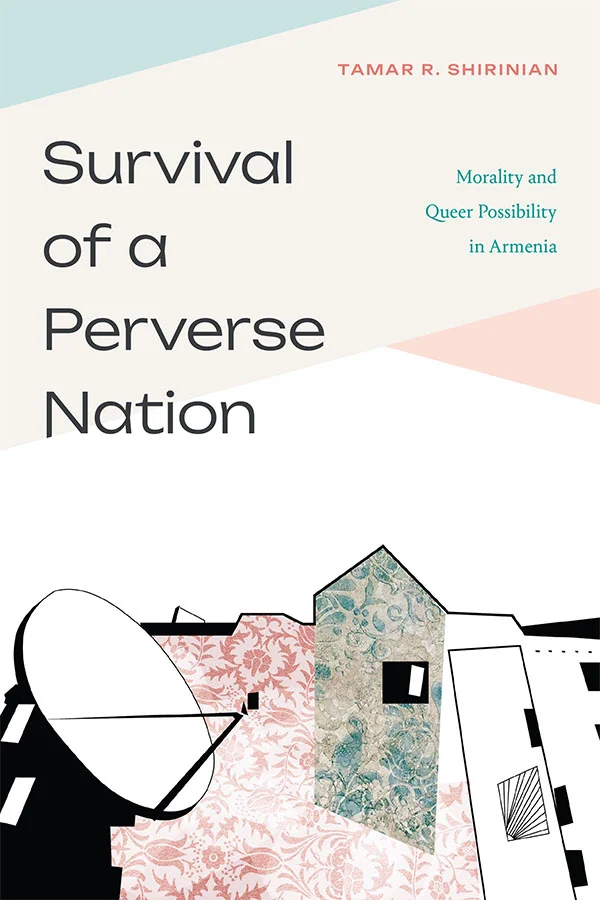
In Survival of a Perverse Nation, Tamar R. Shirinian traces two widespread rhetorics of perversion—sexual and moral—in postsocialist Armenia, showing how they are tied to anxieties about the nation’s survival. In her fieldwork with Armenians, Shirinian found that right-wing nationalists’ focus on sexual perversion centers the figure of the homosexual, while questions of moral perversion surround oligarchs and other members of the political-economic elite. While the homosexual is seen as non- or improperly reproductive, the oligarch’s moral deviations from the caring and paternalistic expectations associated with national leadership also endanger Armenia’s survival. Shirinian shows how both figures threaten the nation’s proper social reproduction, a source of great anxiety for a nation whose primary point of identity is surviving genocide. In the existential threat posed by these forms of perversion Shirinian finds paths where nonsurvival might mean the creation of futures that are queerer and more just. Detailing how the language of perversion offers trenchant critiques of capitalism as a perversion of life, Shirinian presents a new queer theory of political economy.

Praise

“In this evocative and provocative work Tamar R. Shirinian uses the lens of perversion to generate a queer theory of political economy that considers the radical potential for world-building that moves away from political patriarchy. Despite how deeply neoliberal capitalism has permeated our daily lives and how intractable it seems, reading Survival of a Perverse Nation left me feeling inspired and optimistic. The actions of thinking and creating alternative worlds appear at every scale in this book, making for a truly enjoyable read.” - Emily Channell-Justice, author of Without the State: Self-Organization and Political Activism in Ukraine

“With rich ethnographic research, Tamar R. Shirinian develops a queer theory of political economy that explains how moral anxieties regarding national survival are inextricably tied to capitalism’s disturbances and violations. Survival of a Perverse Nation is an outstandingly intelligent critique of the mythohistory of Armenia’s survival and the state’s configuration of perverse sex in the social reproduction of the body politic.” - Petrus Liu, author of The Specter of Materialism: Queer Theory and Marxism in the Age of the Beijing Consensus

"Learned, provocative, and in some ways groundbreaking, this book will matter to students studying post-Soviet elites and their lingering domination of the societies whose fabric they have damaged grievously. Equally, it is an inspiring and often persuasive analysis of forms of resistance to societies that represent resistance as sexually deviant, queer, or feminist. Highly recommended." - K. Tölölyan, Choice

"Unlike many ethnographies that I know in the vein of postsocialist research, this is a special one. It gives us a window not only into words and actions of people, but also into the fantasies of the people who were interviewed." - Bogdan Popa, Slavic Review

Buy

Availability: Loading...

Price: Loading...

Request a desk or exam copy

Information

Author/Editor Bios

Back to Top
Tamar R. Shirinian is Assistant Professor of Anthropology at the University of Tennessee.

Table Of Contents

Back to Top
Acknowledgments  ix
Introduction. Survival of a Perverse Nation  1
1. From National Survival to National Perversion  37
2. The Figure of the Homosexual  66
3. The Names-of-the-Fathers  93
4. Wandering Yerevan  128
5. An Improper Present  163
6. The Politics of “No!”  195
Conclusion. Futures without Daddy, or On Not Surviving  223
Notes  235
References  253
Index  273

Rights

Back to Top

Sales/Territorial Rights: World

Rights and licensing

Additional Information

Back to Top
Related Links Paper ISBN: 978-1-4780-3111-6 / Hardcover ISBN: 978-1-4780-2687-7 / eISBN: 978-1-4780-6010-9 / DOI: https://doi.org/10.1215/9781478060109