
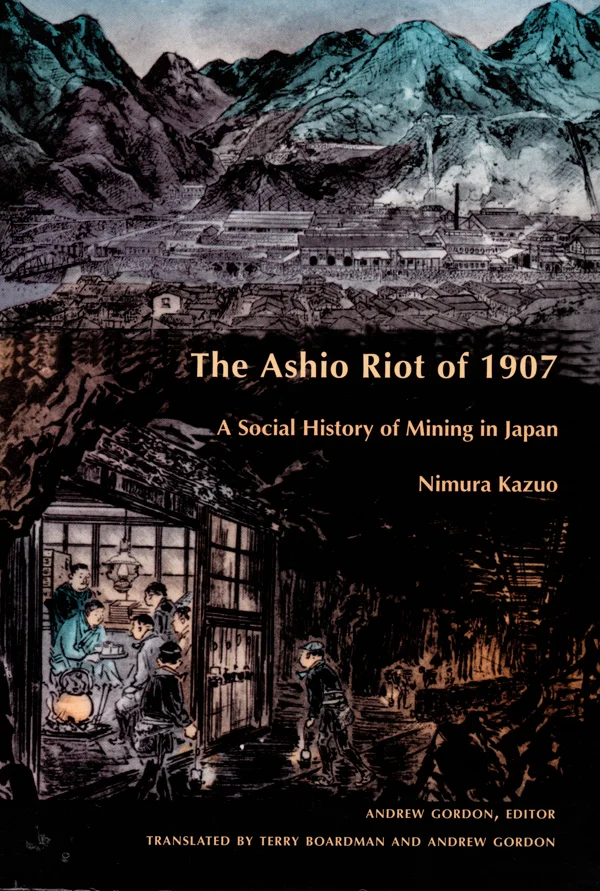
The Ashio Riot of 1907
A Social History of Mining in Japan
Comparative and International Working-Class History
Book
Pages: 296
Illustrations: 11 illustrations, 4 figures, 2 maps, 9 tables
Published: January 1998
Praise
Buy
Availability: Loading...
Price: Loading...
This title will be released on January 14, 1998
Information
Author/Editor Bios
Back to TopKazuo Nimura is Professor of History at the Ohara Institute for Social Research at Hosei University, Japan. Andrew Gordon is Professor of History at the Reischauer Institute of Japanese Studies at Harvard University.
Kazuo Nimura is Professor of History at the Ohara Institute for Social Research at Hosei University, Japan. Andrew Gordon is Professor of History at the Reischauer Institute of Japanese Studies at Harvard University.
Table Of Contents
Back to Top
List of Figures and Tables ix
Editor's Preface / Andrew Gordon xi
Acknowledgments xvii
Author's Introduction to the English Edition 1
Prologue: The Ashio Copper Mine and the Japanese Mining Industry 12
1. The Subjective Conditions of the Ashio Riot: A Critique of the Theory of "Atomized Laborers" 41
2. A Historical Analysis of the Lodge System: A Critique of the Migrant Labor Theory 154
Conclusions: The Significance of Ashio 186
Epilogue: Japanese Miners in Comparative Perspective 217
Notes 233
Index 267
Editor's Preface / Andrew Gordon xi
Acknowledgments xvii
Author's Introduction to the English Edition 1
Prologue: The Ashio Copper Mine and the Japanese Mining Industry 12
1. The Subjective Conditions of the Ashio Riot: A Critique of the Theory of "Atomized Laborers" 41
2. A Historical Analysis of the Lodge System: A Critique of the Migrant Labor Theory 154
Conclusions: The Significance of Ashio 186
Epilogue: Japanese Miners in Comparative Perspective 217
Notes 233
Index 267
Rights
Back to TopSales/Territorial Rights: World
Rights and licensingAdditional Information
Back to Top
Paper ISBN:
978-0-8223-2018-0 /
Hardcover ISBN:
978-0-8223-2008-1 /
Publicity material