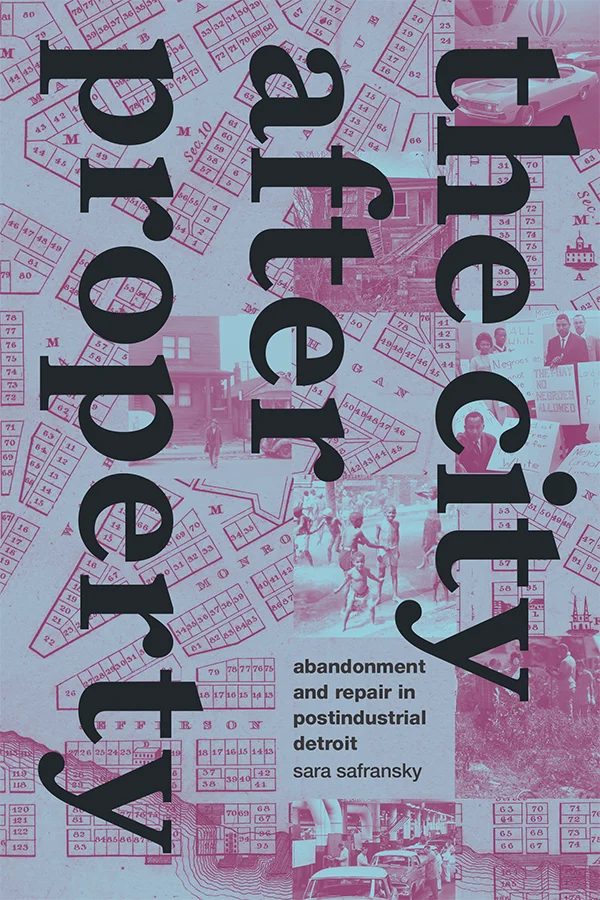
“Sara Safransky’s fresh perspective on issues of land and property provides urban theorists and practitioners with a sophisticated and engaging argument for the way property is structured as well as the peril and promise of thinking of what comes after property. Theoretically imaginative and lyrically written, this outstanding book offers a timely and important contribution to the fields of urban studies, American studies, geography, ethnic studies, and anthropology.” - Rebecca Jo Kinney, author of Beautiful Wasteland: The Rise of Detroit as America’s Postindustrial Frontier
“By asking ‘What comes after property?’ Sara Safransky opens up a captivating and incisive mix of political economy and urban geography to think with and against dominant discourses on Detroit’s decline. The result is a refreshing take on the entanglements of property, race, and urban politics that adeptly weaves ethnographic and archival research with political theory and global struggles for freedom into a rich analysis that makes The City after Property essential reading for scholars of racial capitalism and urban change.” - Kate Derickson, Associate Professor of Geography, University of Minnesota
“With lucid storytelling, flowing prose, and rich historical contextualization of a city that has been, contradictorily, both ignored and over-analyzed, Sara Safransky has produced a text that is a must-read.” - Rachel Brahinsky, Urban Geography
"In The City after Property, Safransky masterfully weaves rich stories, her own experiences doing field research, and data together to show the devastating impact of planning decisions in the City of Detroit. . . . The City after Property teaches us to trust Black and Brown people as they lead the way in stewarding land, defining collective ownership, and redesigning cities – after property." - tamika l. butler, Urban Geography
"A magisterial work of urban geography. The book is a fluid and remarkable conversation between the concrete and the abstract, between the empirical and the theoretical, between the streets of Detroit and debates in the critical social sciences. Abstractions such as racial capitalism, property regimes, and sustainability fixes, among others, are grounded through thick description and rich ethnographic detail, drawn from interviews and archives." - Nathan McClintock, Urban Geography
"The City After Property... is a thoughtful, powerful, and respectful examination of Detroit, its history and people, and the everyday land and property struggles embedded in the reimagining of a city. Safransky shines a light on well-worn popular narratives of Detroit’s recent history, including debates ranging from vacancy and evictions to utopian visions of postindustrial agrarian urbanism, to expose the complexities, challenges, and lived realities of modern-day Detroit." - Rachel Barber & Maxwell Hartt, Journal of Urban Affairs
"While much of the literature on housing and urban property in the contemporary United States rightfully examines cities where affordability is the major issue, leading to rising tides of street homelessness, evictions, and other forms of housing injustice, Safransky’s book fills a gap by studying a city where the challenges look much different: where vacancy and deindustrialization, rather than gentrification per se, are the major challenges of the day." - Madeleine Hamlin, Dialogues in Urban Research
"In the academic literature, a well-crafted book is more than words on paper; it becomes a guiding light, illuminating solutions to specific challenges and opening new avenues of thought. The City After Property does no less: it offers a comprehensive exploration of land and property issues in Detroit, providing valuable insights into the city’s urban planning and development landscape in the early 2010s." - Micaela Mancini, Dialogues in Urban Research
“The City after Property is at once an intimate ethnography of the city, a geographic critique of racial capitalism, and a celebration of the visionary work of Detroiters fighting to remain in the city in the context of massive displacement. One of the feats of this book is the fluid narration of the structural to the intimate. This means that as it describes the roots of tax policy it always returns to the lived experience of it, the human, the intimate, loss and grief. The result is Safransky’s own refusal, over and over, to reduce the forces of dispossession in Detroit to abstraction.” - Jessi Quizar, Antipode
"I would like to pay tribute to the high quality of Safransky’s writing. Beyond her excellent research, she masterfully employs various literary devices, from metaphors drawn from colonial myths to provide historical context and strengthen her arguments, to irony, satire, and paradoxes when describing the actions of state and city political actors in Detroit. Her book could be an important example for courses on contemporary geographical thought, demonstrating how critical engagement with widely used methods and involvement with local communities can produce high-quality academic work."
- Edwin Alejandro Ramirez-Aguilar, Geographical Review
"In a sense, The City after Property not only archives a particular conjuncture in Detroit when the work of residents is helping to create a vastly different future from the one being plotted by racial capitalist logics and the neoliberal state, but also, Safransky’s writing itself can be understood as a form of reparative work. By refusing to reproduce familiar narratives of postindustrial blight and decline, and by narrating the many worlds that are being created despite and beyond the politics of abandonment, her book contributes to a form of collective knowledge making necessary for the city after property." - Erin McElroy, AAG Review of Books
"Increasingly, communities are demanding more of their researchers—as they should. The City After Property is not only a valuable addition to the literature on postindustrial cities in the broader sense, but also a useful account of the challenges of genuine scholar-activism. With intellectualism itself now a political target, it has never been more important for research to be meaningfully engaged with its subjects, despite the inherent challenges. Anyone hesitant to enter the fray need only look around to realize this choice has already been made for us." - Dan Trepal, Michigan Historical Review
"The City After Property reinvigorates the ideal of community-engaged scholarship, achieving a rare fusion of activist praxis and academic research." - Jason Molesky, H-Environment