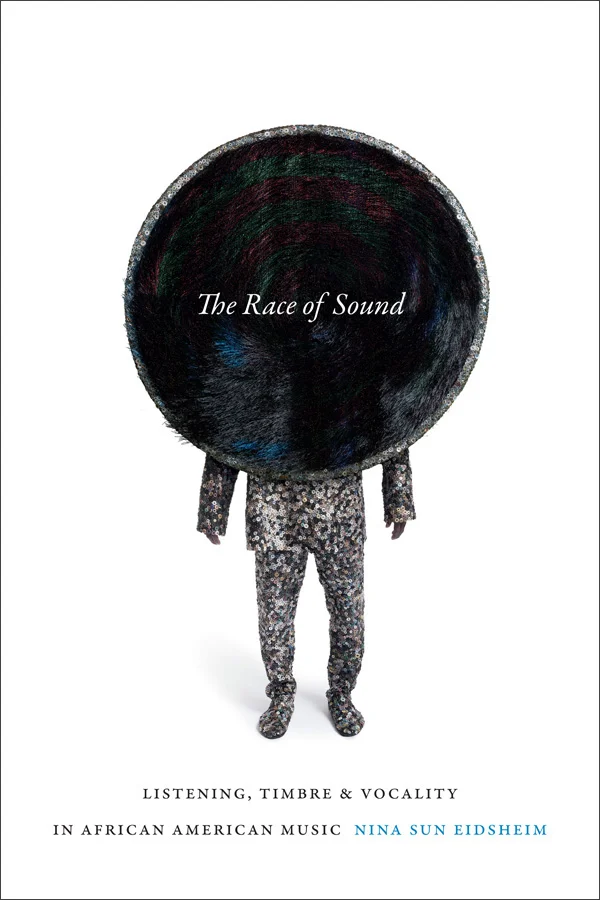
“In her own magisterial voice, Nina Sun Eidsheim speaks outward from musicology to scholars in a host of cultural studies-oriented fields, doing indispensable work to make nuanced and collaborative discussions possible across borders many have considered impermeable. This brilliant book will be the benchmark for discussions of voice, sound, and race for many years to come.” - Gustavus Stadler, author of Troubling Minds: The Cultural Politics of Genius in the United States, 1840–1890
“Voice is ‘a thick event’ in Nina Sun Eidsheim's pathbreaking study of race and vocality. Her visionary work challenges us to rethink and ultimately disassemble the long-standing, putative metrics for reading identity and the body in sonic cultures. The Race of Sound takes readers on an epistemological journey that boldly challenges us to question what we know about the wondrous vocal instrument. This is the book that scholars in feminist sound studies and black performance studies have been waiting for.” - Daphne A. Brooks, author of Bodies in Dissent: Spectacular Performances of Race and Freedom, 1850–1910
"Should be required reading in music education—and no doubt it will become required reading in many academic disciplines that touch on voice studies." - Marit MacArthur, Yale Review
"An important read within sound studies and race studies." - Jeff Donison, Journal of Radio & Audio Media
"The Race of Sound is brimming with insight and originality. Not every chapter contributes new knowledge (e.g., Eidsheim is not the first to note that black classical singers were constrained by listener expectations), but in tandem they constitute a groundbreaking argument that should inform all listeners and be part of all music courses. If enough readers take Eidsheim’s work to heart, we can begin to counter the effect of institutions that create and perpetuate the racialized voice." - Sandra Jean Graham, ARSC Journal
“Eidsheim demonstrates an impressive ability to weave together different critical modes and diverse topics without faltering in her project…. New and established scholars interested in the study of race, gender, voice, and/or African American musics will find much to engage with in Eidsheim’s push toward nonessentializing listening.”
- Alex C. Valin,
Women and Music
"Like Eidsheim’s earlier work, The Race of Sound presents meticulously researched, compelling, and detailed accounts of reception, race, and voice throughout the careers of important historical figures. The author provides ample evidence to support her groundbreaking arguments that will give readers a new understanding of how we construct voice, race, and identity every time we engage in the act of listening." - Victoria Malawey, MUSICultures
“The Race of Sound is ... an insightful addition to the growing body of work on the voice.... We continue to live in a time in which Black voices struggle to be heard. The Race of Sound contributes to this struggle in recognition and joins the record of activist scholarship that centres and respects Black humanity.” - Natalie Hyacinth, Feminist Review
“By focusing on how race is understood through the timbre of the human voice, Eidsheim’s book offers a unique contribution to the field. . . . Eidsheim is uniquely placed to write on this topic.” - Matthew A. Williams, Popular Music
“This book should be required reading for faculty members everywhere. . . . By asking listeners to reflect on their assumptions . . . The Race of Sound seeks greater freedom for Black musicians and people, opening the door to new possibilities for us all.” - Loren Kajikawa, Journal of the American Musicology Society
“The Race of Sound will be an excellent teaching text, especially for classes interrogating historical understandings of race and voice.” - Stephanie Gunst, Journal of Musicological Research
“The Race of Sound allows us to rethink our understanding of identities through voice and thus better understand the social construction of race and gender. Brilliantly written, as approachable as it is accurate, The Race of Sound goes beyond the framework of musicology alone to embrace all cultural studies.” (Translated from French) - Jean-René Larue, Volume
“The Race of Sound would be of great interest to scholars and students of voice, as well as those interested in a transdisciplinary voice studies.” - Nicole Furlonge, Journal of Popular Music Studies
“[The Race of Sound] will appeal to readers wishing to learn about vocal timbre and the ways it may be perceived, and its framing in African American music, as well as to readers focusing on race, gender, and other forms of discrimination in both African American music and other musical contexts.” - Flora Henderson, Ethnomusicology
“Eidsheim provides an elaborate and powerful addition to music scholarship and sound studies as well as to humanities disciplines more broadly. . . . In exposing the plethora of mechanisms that build cultural lenses though which we hear voice, her work serves to puncture even the most trained musical ear or the deepest listener.” - Kira Dralle, Notes