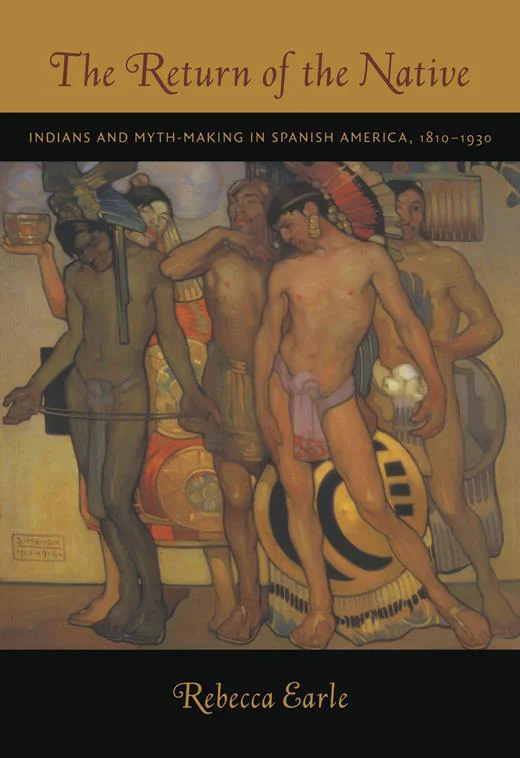
“The Return of the Native is an ambitious and exceptionally well-written book. . . . The product is remarkable for its breadth and clarity. . . . [T]he quality of the prose and thought that went into this book will inspire a new generation of scholars and graduate students who work on discursive themes: they will recognize that complexity of thought can be expressed with clarity and grace.” - Jeffrey Gould, Social History
“[The Return of the Native] provides a wonderful overview of the creation of Spanish American nationalism and underlines the changing role of the pre-Colombian past. In doing so, it offers a rich set of comparisons and larger arguments for subsequent research on these questions. This is a timely and important work.” - Charles Walker, American Historical Review
“Bringing the indianesque, indigenismo, and everything in between into the same frame of analysis is a significant contribution, highlighting the continuities between 19th- and 20th-century discourses, among other things. . . . [M]ost will be intrigued by what Earle has gathered from other areas and impressed with the extent of the Spanish American ‘lingua franca’ of indigeneity that she documents.” - Alan Durston, Canadian Journal of Latin American and Caribbean Studies
“Earle makes an original and convincing case for an overlooked, continent-wide ideology of Indian revival. . . . [The] comparative breadth makes Return of the Native both a sophisticated synthesis of a very big process indeed – the emergence of nationalism in Spanish America – and a useful handbook for individual country scholars who wish to contextualize their own, more local, nationalisms. . . . Rebecca Earle has filled a significant gap in the literature for students of both colonial and postcolonial history, while at the same time reminding us that nationalism is central to understanding modern state formation. . .” - Paul Gillingham, Journal of Colonialism & Colonial History
“Earle’s work makes a useful contribution to the genre in that it demonstrates the views expressed in literature, art, coinage, and so forth vis-à-vis past Indian civilizations and contemporary indigenous groups. . . . Impressively, her bibliography and ample notes make up almost a third of the reviewed volume.” - Sheldon Avenius, History: Reviews of New Books
“Rebecca Earle does not directly engage debates surrounding contemporary Indigenous politics in her book The Return of the Native, but she does provide a much deeper and very useful context for how Indigenous identities have been constructed over time. . . . In this broad ranging book, Earle moves seamlessly in her discussion between Argentina, Chile, Peru, Colombia, Guatemala, Mexico, and Ecuador. Rather than creating a simplified and generalized image, her broad readings result in a very complex depiction of diverse realities.” - Marc Becker, A Contracorriente
“This book will be useful in giving the cultural background in which the churches developed during this turbulent period, and in suggesting some methodologies in studying popular Protestant and Catholic pieties and mission strategies” - Jeffrey Gros, Missiology
“An ambitious and important contribution to Latin American cultural and intellectual history, The Return of the Native is unique in its broad, comparative focus on nationalism in Spanish America and the uses of the Amerindian past. Moreover, it is refreshing in its attention to nineteenth-century historiography and the relation between that historiography and the process of state-building.” - Raymond B. Craib, author of Cartographic Mexico: A History of State Fixations and Fugitive Landscapes
“[A] fascinating and informative picture of the ways that Spanish American elites in the first century after independence appropriated the ‘Indian’ in their attempts to create national identities for the new republics. . . . Earle’s book is an important contribution to the intellectual and cultural history of the period.” - Peter Blanchard, Bulletin of Latin American Research
“[A] fascinating, clearly written book . . . [that] investigates the importance and use of the preconquest past and ‘indianesque nationalism’ by elites in Argentina, Chile, Peru, Colombia, Guatemala, and Mexico. . . . Highly recommended.” - M.A. Burkholder, Choice
“[A] tour-de-force. . . a thoroughly researched and skillfully argued treatise that will reward any scholar, not just Latin Americanist geographers, interested in the ideas, and ideologies, of nationalism and nation-building, especially the distortions, exclusions, and selected borrowings that charge the project.” - W. George Lovell, Journal of Latin American Geography
“[T]he achievements of this book are substantial and impressive. . . . This is a book that will stimulate new questions and debates among all historians of nineteenth century Spanish America.” - Nicola Miller, Journal of Latin American Studies
“Historians interested in nationalism and myth-making will find this book remarkable in its regional scope and in the details of its explanations. This is an excellent book that illuminates how pre-conquest Indians came to symbolize the national pasts from the Rio Brava to Tierra del Fuego.” - Bridget M. Chesterson, Canadian Journal of History
“In The Return of the Native we find a clever and detailed examination of key components of Spanish American nationhood, such as ideology and power, rather than a general narrative of chronological events. In addition, by taking into consideration the “indigenismo” movement that attempted to bridge the chasm, Earle not only does justice to the genealogy of a political debate, but also shows how current this debate is.” - Héctor James, New Mexico Historical Review
“Rebecca Earle has produced an imaginative work. . . . This book should serve as a benchmark against which to gauge the subsequent rise of populism; native and pan-native mobilizations and movements; and the development of counternarrative national discourses. As such, it deserves a wide audience in and outside academia.” - Susan E. Ramirez, Journal of American History