
Home / Books / The Stone and the Wireless

The Stone and the Wireless

Mediating China, 1861–1906
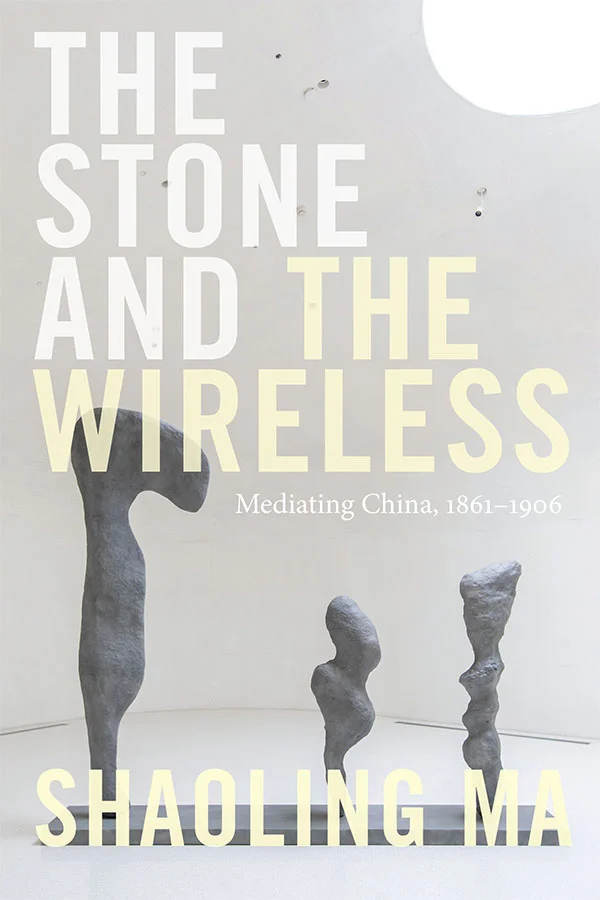
Book

Pages: 312

Illustrations: 10 illustrations

Published: June 2021

Author: Shaoling Ma

In the final decades of the Manchu Qing dynasty in China, technologies such as the phonograph, telephone, telegraph, and photography were both new and foreign. In The Stone and the Wireless Shaoling Ma analyzes diplomatic diaries, early science fiction, feminist poetry, photography, telegrams, and other archival texts, and shows how writers, intellectuals, reformers, and revolutionaries theorized what media does despite lacking a vocabulary to do so. Media defines the dynamics between technologies and their social or cultural forms, between devices or communicative processes and their representations in texts and images. More than simply reexamining late Qing China's political upheavals and modernizing energies through the lens of media, Ma shows that a new culture of mediation was helping to shape the very distinctions between politics, gender dynamics, economics, and science and technology. Ma contends that mediation lies not only at the heart of Chinese media history but of media history writ large.

Praise

“The beauty of Shaoling Ma's inspiring and provocative argument is that it allows for a reconsideration of late Qing culture through a new prism and for the expansion of mediality beyond the familiar confines of Western culture. Offering fresh readings and giving new life to key texts in modern Chinese history and literature, Ma makes an intervention that will force the field of Chinese studies to reassess its methodology and fundamental assumptions.” - Yomi Braester, author of Painting the City Red: Chinese Cinema and the Urban Contract

“From late Qing texts and media studies to Marxist criticism and affect theory, The Stone and the Wireless combines different archives, discourses, and theoretical registers in new and exciting ways. This innovative, rich, and intellectually engaging work will appeal to those in Chinese studies and media studies more broadly.” - Andrea Bachner, author of The Mark of Theory: Inscriptive Figures, Poststructuralist Prehistories

"Scholars and graduate students interested in global media cultures and media theory will find The Stone and the Wireless a valuable addition to the North American and Western European canon of media theory. This book not only challenges the predominant emphasis on forms and objects, but also constructs a complex web of mediation through its narrative. Chinese notions, texts, and historical contexts serve as the subjects of discussion, not the backdrop. For scholars of world literature, comparative literature, and science fiction, the book offers close readings of untranslated and understudied sources." - Xuenan Cao, Modern Chinese Literature and Culture

"Connecting history, theory, and area studies, The Stone and the Wireless makes contributions to many fields, including media studies, literary criticism, and cultural studies. It introduces new sources to the study of media history and science fiction history in China. It also provides valuable insights and fresh materials to the global history of technology by investigating the circulation of technical knowledge between new areas and regions." - Yue Zhao, H-Sci-Med-Tech, H-Net Reviews

"The Stone and the Wireless . . . sets an important example for readership in and beyond the China field that sources such as Guo’s diplomatic diaries and newspaper photojournalism have immense interdisciplinary potential. Using media theory methods, these objects of historical interest can exist within area-specific history and form part of generative, ongoing debates surrounding media and media technology." - Alina Scotti, Technology and Culture

"Scholars in gender studies and labor history will also be inspired by its discussion of gendered subjectivity and the working masses in Chinese literature. Since our current era is marked by the widespread popularity and significant influence of Artificial Intelligence, general readers will find the debates surrounding the capacity of machines to replicate human cognition and language during the late Qing era very relevant as well." - Yu Liu, Asian Ethnicity

"Ma’s book is a valuable addition to the growing literature on media in Chinese history. Her focus on the late Qing period, instead of the republican era, is especially worthy of praise. The Stone and the Wireless opens an intellectual space to think about mediation and ponder its strengths and weaknesses as a method. It will be an essential read for Chinese media studies going forward." - Ulug Kuzuoglu, Cultural Politics

Buy

Availability: Loading...

Price: Loading...

Request a desk or exam copy Spring 2026 Web Sale

Information

Author/Editor Bios

Back to Top
Shaoling Ma is Assistant Professor of Humanities at Yale-NUS College, Singapore.

Table Of Contents

Back to Top
Acknowledgments  ix
Introduction. The Forms of Media  1
Part I. Jl | Recordings
1. Guo Songtao's Phonograph: The Politics and Aesthetics of Real and Imagined Media  37
2. Stone, Copy, Medium: "Tidbits of Writing" and "Official Documents" in New Story of the Stone (1905–1906)  74
Part II. Chuan/Zhuan | Transmissions
3. Lyrical Media: Technology, Sentimentality, and Bad Models of the Feeling Woman  111
Part III. Tong | Interconnectivity
4. 1900: Infrastructural Emergencies of Telegraphic Proportions  149
5. A Medium to End All Media: "New Tales of Mr. Braggadocio" and the Social Brain of Industry and Intellect  181
Conclusion: Stone, Woman, Wireless  207
Notes  219
Bibliography  261
Index  285

Rights

Back to Top

Sales/Territorial Rights: World

Rights and licensing

Additional Information

Back to Top
Paper ISBN: 978-1-4780-1147-7 / Hardcover ISBN: 978-1-4780-1046-3 / eISBN: 978-1-4780-1305-1 / DOI: https://doi.org/10.1215/9781478013051