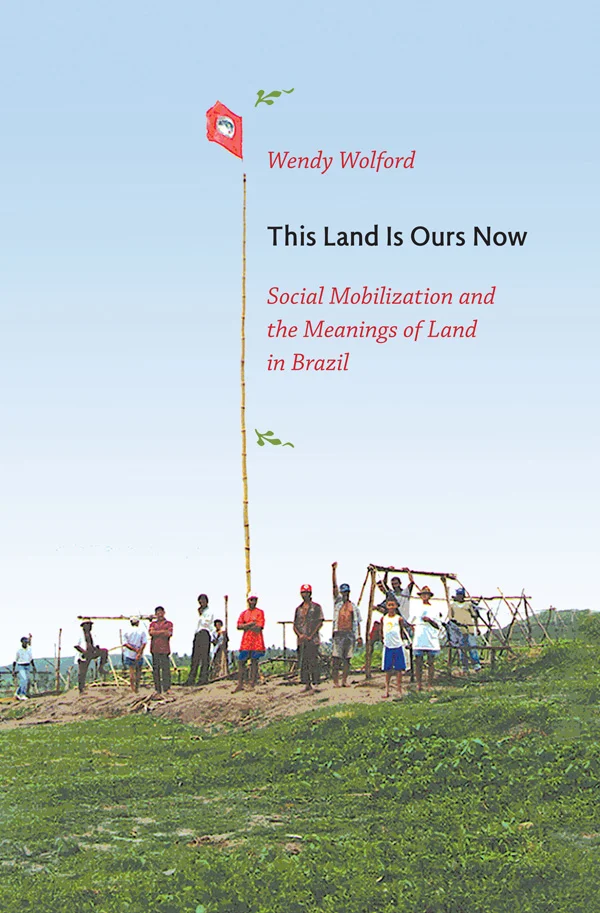
“This Land is Ours Now is a substantial contribution to this approach to social movements as well as an elegant model for exceptional anthropological work that digs beneath the surface of stated aims and presumed intentions to make sense of the cacophony of voices that speak simultaneously of one and many things.” - Analía Villagra, Journal of Latin American and Caribbean Anthropology
“Human geographers who seek a fine example of ethnographic methods should be drawn to this book. Hopefully This Land Is Ours Now will inform how geographers develop new research into social movements grounded in territories, resources, and land- or sea-based production systems. Overall, the book is a significant addition to the geographical literature on development and social movements.” - Christian Brannstrom, Geographical Review
“Overall, This Land is Ours Now is an important contribution to the literature on land reform in Latin America, and serves more completely to explore the intricacies of the land reform movement.… Scholars of social movements, agrarian reform, and Latin American history will appreciate the complex analysis Wolford presents.” - Stephen Aldrich, Journal of Historical Geography
“The book is well-written and makes a valuable contribution to the study of land reform in Brazil in an original framework. It makes good use of social movement theories and will be a valuable work for geographers who have interests in social movements in Latin America, particularly in rural Brazil.”
- Marcellus M. Caldas, Journal of Latin American Geography
“Wendy Wolford’s book on rural mobilization in Brazil is a delightfully interdisciplinary, broad and mixed piece.… Lucidly and smoothly written, and relying on vivid and well-contextualised interviews as its main data, the book makes an easy and fascinating read.” - Markus Kröger, Journal of Latin American Studies
“Wendy Wolford’s well-written and engaging book on Brazil’s Landless Movement (Movimento Sem Terra, MST) brings fresh insight on this famous grassroots political powerhouse by recapturing and analyzing the diverse viewpoints of members in two very distinct regions of Brazil…. This Land is Ours Now is a welcome and thought-provoking ethnography of the differences within a social movement, as told from the ‘common sense’ perspective of ordinary members.” - Marianne Schmink, Journal of Anthropological Research
“Wolford bases her analysis upon intensive research…. Her broader theoretical and historical overviews are the book’s strengths. She deserves credit for her grassroots research.” - Bjorn Maybury-Lewis, EIAL
“Wolford’s book delights us by presenting a very sophisticated theoretical framework built upon the study of the everyday political economy of politics in a space–time contextualized approach. It is an indispensable reading for all those interested in the MST’s trajectory as well as those interested in social movement theory.”` - Marta Inez Medeiros Marques, Journal of Agrarian Change
“Wolford’s excellent book offers a sophisticated and nuanced examination of Brazil’s renowned social movement, the Movimento dos Trabalhadores Rurais Sem Terra (Rural Landless Workers’ Movement), or MST.... This book deserves to become a staple of syllabi in courses on social movements, peasants, Brazil and Latin American studies. It is undoubtedly a major contribution.” - Benjamin Goldfrank, Bulletin of Latin American Research
“This Land Is Ours Now is destined to become a classic in social movement literature and among those who study property relations, land tenure, and development policy. Offering a fresh, honest, and insightful take on a compelling but previously oversimplified story, it has broad implications for the political strategies of social movements, autonomous communities, and development alternatives in Latin America and throughout the world.” - Dianne Rocheleau, Professor of Geography and Global Environmental Studies, Clark University
“Precious few ethnographic subjects have ever been accorded the respect, critical eye, and deep attention Wendy Wolford pays on every page to ordinary Brazilians. Her study of the MST is exemplary in every way. The voices and texture are palpable and are woven into an analytically powerful and conceptually original argument. A signal contribution to the study of land reform, of social movements, and of Brazilian politics. I’m frankly a little jealous of what she has achieved here.” - James C. Scott, Sterling Professor of Political Science and Anthropology, Yale University
“Wolford’s narrative style accommodates her heterogeneous sources, but she is rooted in ethnography, and the density of her description is a significant virtue. She allows space for extended material directly from interviews with MST settlers and leaders, which ground her analysis. In her conclusion, she offers a careful, balanced, and subtle evaluation of President Lula’s record on agrarian reform that avoids the polemics associated with this subject.” - Thomas D. Rogers, Hispanic American Historical Review