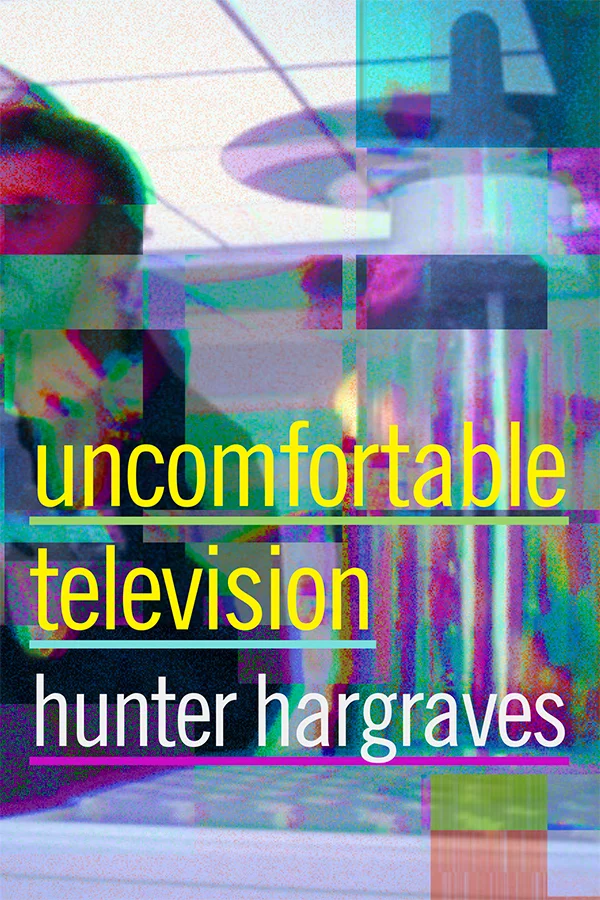
“Uncomfortable Television shifts our conceptual lens by tracking the pleasure and power of television that irritates, upsets, and disturbs. Bringing affect theory to bear on a changing mediascape, Hunter Hargraves brilliantly shows how the uncomfortable feelings of TV viewers can be channeled into neoliberal agendas.” - Laurie Ouellette, Professor of Media and Cultural Studies, University of Minnesota
“As the first book to focus on millennial/postmillennial television through the lens of affect, Uncomfortable Television is a notable contribution. Hunter Hargraves shows how televisual encounters with repulsion, profanity, and violence attenuate the late capitalist subject to feelings of discomfort, which emerges as a regulatory norm and a form of exposure therapy under neoliberalism. Readers interested in critical theoretical interventions in TV studies will be thrilled by this book, while those who are invested in the field’s more standard approaches will find a new account of current televisual cultural available to them.” - Karen Tongson, author of Why Karen Carpenter Matters
"Uncomfortable Television is an interesting work that raises many compelling questions about the relationship between televisual content and our own processing of reality and invites further discussion on affect theory and how affect potentially shapes most of our behavior. It is an insightful read for academics, political theorists, and students of many strands of humanities . . . ." - Ana Yorke, Popmatters
"Hargraves's book sits at the intersection of scholarship focusing on neoliberalism, affect, and popular culture and synthesizes these conversations in fruitful ways. . . . Recommended. Advanced undergraduates through faculty." - S. Pepper, Choice
“Uncomfortable Television provides television, performance, and American studies scholars and graduate students with an interesting and insightful look into how televisual affect is mobilized. … [A] compelling illustration of the complex constellation of components that provide a framework for the affective and ideological functions of television.”
- Courtlyn Pippert,
European Journal for American Studies
"Hargraves’s timely evaluation of television’s metamorphosis in the early twenty-first century is a welcome addition to contemporary media scholarship. The imbrication of critical race studies, affect, and genre means readers from a variety of disciplinary backgrounds will find something useful in Uncomfortable Television." - Alex Remington, The Velvet Light Trap
"Uncomfortable Television is an excellent example of analysis capable of placing the reader in a critical—and ultimately metatextual—condition: uncomfortable is both the television the book discusses and the state in which the viewer-reader finds themselves, seeking a better position to sit in their chair while reading, as well as a new perspective for confronting and resisting the cultural and economic logics of neoliberalism." - Gabriele Prosperi, International Journal of Communication
"Hargraves’s writing style is easy to read and his examples drawn from a vast corpus of TV series are quite convincing. . . . Uncomfortable Television shall undoubtedly prove to be a worthy addition to anyone launching into a close study of the relationship between television and current American culture and politics from the early 2000s to the late 2010s." - Anne-Marie Paquet-Deyris, Journal of Popular Film and Television
"Uncomfortable Television is ambitious in scope and sprawling at times. That the text gestures in many directions and offers few points of closure is not a weakness of the book, but rather allows it to serve as a point of departure for future scholars to
engage in a new periodization of television and a new set of discourses that characterize that period. By contextualizing the new periodization within discourses of neoliberalism and late capitalism, Hargraves articulates the ways in which uncomfortable television might work to disrupt those discourses." - Michael Mario Albrecht, Television & New Media
“Hargraves’s thoughtful and provocative theory . . . combined with a rejection of a binary critical approach, makes Uncomfortable Television a deeply original and valuable contribution to television studies.”
- Grey Mangan Blackwell,
New Review of Film and Television Studies
“Hargraves’ book undeniably offers a very original study of postmillennial television and its social and political implications in today’s society. He thoroughly analyses these elements through the lens of Affect Theories, thus offering an approach to televisual pleasure (and discomfort), which in many ways, helps us understand our own position as viewers in a neoliberal system."
- Sophie Chadelle,
e-Rea