
Home / Books / Under Construction

Under Construction

Technologies of Development in Urban Ethiopia
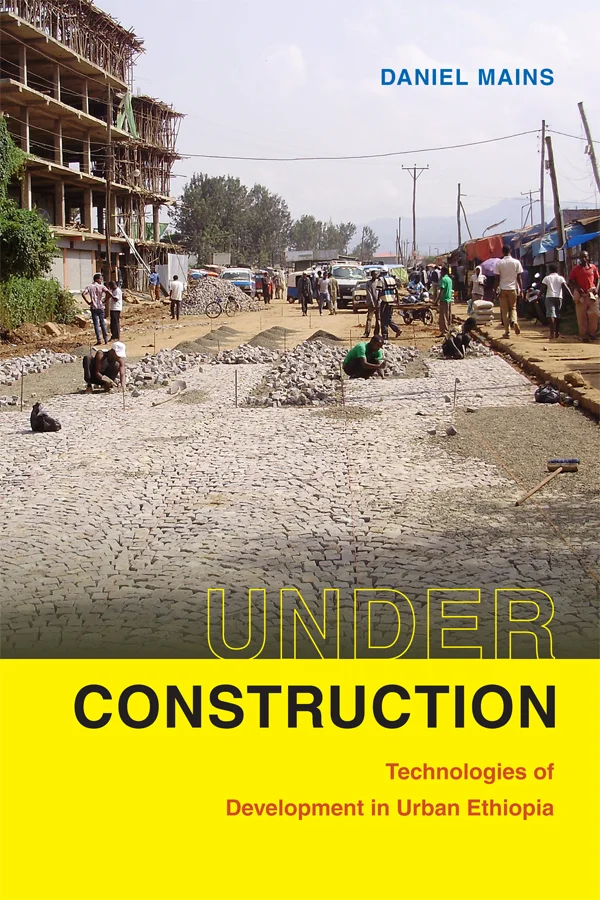
Book

Pages: 240

Illustrations: 15 illustrations

Published: September 2019

Author: Daniel Mains

Over the past decade, Ethiopia has had one of the world's fastest growing economies, largely due to its investments in infrastructure, and it is through building dams, roads, and other infrastructure that the Ethiopian state seeks to become a middle-income country by 2025. Yet most urban Ethiopians struggle to meet their daily needs and actively oppose a ruling party that they associate with corruption and mismanagement. In Under Construction Daniel Mains explores the intersection of development and governance by examining the conflicts surrounding the construction of specific infrastructural technologies: asphalt and cobblestone roads, motorcycle taxis, and hydroelectric dams. These projects serve as sites for nation building and the means for the state to assert its legitimacy. The construction process—as well as Ethiopians' experience of living with the disruption of construction zones—reveals the tension and conflict between the promise of progress and the possibility of failure. Mains demonstrates how infrastructures as both ethnographic sites and as a means of theorizing such concepts as progress, development, and the state offer a valuable contrast to accounts of African abjection and decline.

Praise

“Based on years of ethnographic research, Under Construction is a magnificent and thorough exposition that describes the ambivalence and hope invested in construction projects in Ethiopia. Construction, Daniel Mains demonstrates, is a vital location at which relationships between states and citizens are grounded. While they are powerful gatherings of technology and finance, construction projects are also precarious and full of danger. In exploring the tensions that are intrinsic to construction projects, Mains effortlessly brings together theorizations of historical materialism, vital materialism, and affect theory to produce a dazzling and clear account of how construction is incrementally and yet fundamentally transforming the political landscape of cities of the global South.” - Nikhil Anand, author of Hydraulic City: Water and the Infrastructures of Citizenship in Mumbai

Under Construction stages urgent interventions into development and governance, citizen and state, Afro-optimism and neoliberal pessimism in order to depict the complexities of infrastructure in Africa. Daniel Mains's work makes clear that the relationships between infrastructure, state, labor, and modernity are variable and contingent—sometimes smooth, often sticky and fraught—while making a compelling case for Ethiopia as a rich site for theoretical and ethnographic attention.” - Charles Piot, author of The Fixer: Visa Lottery Chronicles

“[This] book offers an interesting account of the potential tensions between material infrastructure and human infrastructure and gives insight into processes of economic and urban development in Ethiopia.”

- Paulo Rui Anciaes, LSE Review of Books

"This study by Mains should be accepted with gratitude, and welcomed as a huge contribution to Ethiopian studies of urban development." - Fasika Gedif, African Studies Quarterly

"Under Construction''s strength is in its historical depth and social political contextualization presented in clear language. Theoretical arguments are well-presented and empirically supported, linking well with topical development literature. The book is valuable to both development practitioners and students of anthropology of development." - Elias Madzudzo, International Social Science Review

"Under Construction makes an important contribution not only to the field of the anthropology of development but also to urban development, at a time when many studies in Ethiopia have been placing more emphasis on rural communities. Daniel Mains, while basing his empirical evidence on the selected urban projects which appear to be perpetually under construction, shows that the process of construction has changed the relationship between citizens and the state, and not always for the better." - Gemechu Admassu Abeshu, African Studies Review

"The book represents an important contribution to the field of infrastructure within anthropology and beyond. . . . Under Construction represents a seminal contribution to this field of study." - Felipe Fernandez, Anthropologica

"Under Construction raises enduring questions about the politics, economics, and affects of public works projects around the globe as process, promise, and probable letdown." - Christina Schwenkel, City and Society

“Offering a much-needed ethnographic investigation into the lives, livelihoods and labour relations that inhabit construction work in contemporary urban Africa, Under Construction contributes significantly to current debates and scholarship in urban studies, infrastructure, international development, and African Studies.” - Pauline Destrée, Anthropological Notebooks

“Provides an unusual and particularly compelling engagement with affect theory, encouraging us to pay as much attention to the breeze through the open door of the Bajaj and the dust coating our skin as we do to the politics of infrastructural development.” - Michael Crawley, Journal of the Royal Anthropological Institute

Buy

Availability: Loading...

Price: Loading...

Request a desk or exam copy Spring 2026 Web Sale

Information

Author/Editor Bios

Back to Top
Daniel Mains is Wick Cary Associate Professor of Anthropology and African Studies at the University of Oklahoma and author of Hope Is Cut: Youth, Unemployment, and the Future in Urban Ethiopia.

Table Of Contents

Back to Top
Acknowledgments  ix
Introduction. Foundations for Development: Infrastructure, the State, and Construction  1
1. Constructing a Renaissance: Hydropower and the Temporal Politics of Development  29
2. Asphalt Roads, Regulating Infrastructures, and Improvised Lives  58
3. Feeling Change through Dirt and Water: The Affective Politics of Urban Development of Jimma, 2009–2015  92
4. Governing the Bajaj: States, Markets, and Multiple Materialisms  121
5. What Can a Stone Do? Cobblestone Roads, Governance, and Labor  151
Conclusion. The Time of Construction  181
Notes  193
References  203
Index  217

Rights

Back to Top

Sales/Territorial Rights: World

Rights and licensing

Additional Information

Back to Top
Paper ISBN: 978-1-4780-0641-1 / Hardcover ISBN: 978-1-4780-0537-7 / eISBN: 978-1-4780-0704-3 / DOI: https://doi.org/10.1215/9781478007043