
Home / Books / Unintended Lessons of Revolution

Unintended Lessons of Revolution

Student Teachers and Political Radicalism in Twentieth-Century Mexico
Book

Pages: 376

Illustrations: 22 illustrations

Published: January 2022

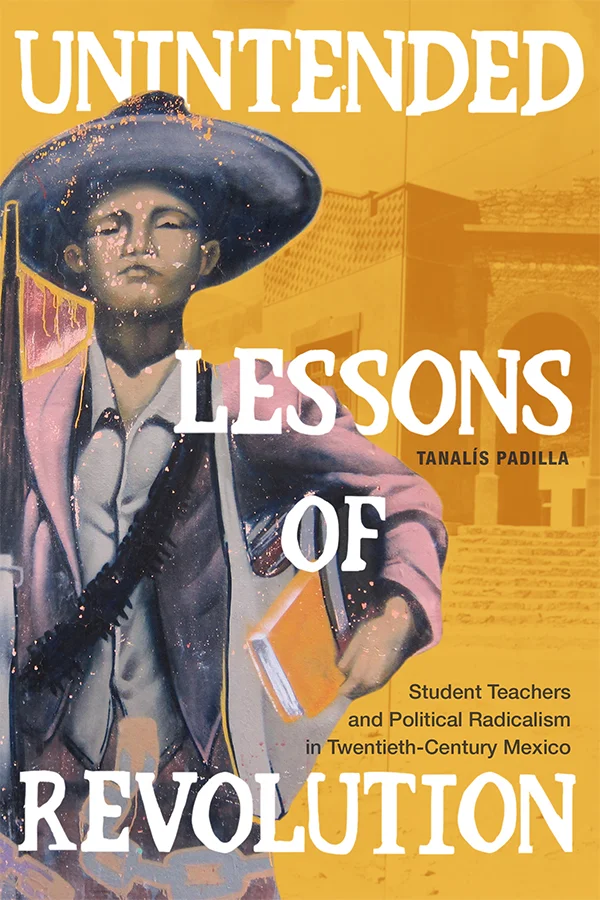
In the 1920s, Mexico established rural normales—boarding schools that trained teachers in a new nation-building project. Drawn from campesino ranks and meant to cultivate state allegiance, their graduates would facilitate land distribution, organize civic festivals, and promote hygiene campaigns. In Unintended Lessons of Revolution, Tanalís Padilla traces the history of the rural normales, showing how they became sites of radical politics. As Padilla demonstrates, the popular longings that drove the Mexican Revolution permeated these schools. By the 1930s, ideas about land reform, education for the poor, community leadership, and socialism shaped their institutional logic. Over the coming decades, the tensions between state consolidation and revolutionary justice produced a telling contradiction: the very schools meant to constitute a loyal citizenry became hubs of radicalization against a government that increasingly abandoned its commitment to social justice. Crafting a story of struggle and state repression, Padilla illuminates education's radical possibilities and the nature of political consciousness for youths whose changing identity—from campesinos, to students, to teachers—speaks to Mexico’s twentieth-century transformations.

Praise

Unintended Lessons of Revolution demonstrates that Mexico's rural normal schools may be the most durable legacy of the 1910 revolution. Rural schoolteachers in postrevolutionary Mexico served communities not only as instructors but also as community organizers, social workers, and secular confessors and pastors. Tanalís Padilla weaves together oral histories with local and national documentary evidence into an empirically rich study of how the rural normales endured as incubators of political radicalism despite their original purpose as instruments to co-opt resistance into the postrevolutionary regime.” - Jocelyn Olcott, Professor of History, Duke University

“This is a tremendously impressive study of the rural normal school, which became a vibrant locale of social mobility, cultural change, and political mobilization of student-teachers at various stages in Mexican political history. This book transcends the constricted scope of a narrow institutional study to throw new light on a series of larger questions concerning Mexico's legacy of revolution, its failed rural policies, and the explosion of unrest among rural teachers and activists. It is a pleasure to read.” - Brooke Larson, author of Trials of Nation Making: Liberalism, Race, and Ethnicity in the Andes, 1810–1910

"Padilla draws on a rich array of archival sources and oral histories to tell this story, constructing a narrative that blends urban and rural events and perspectives and draws on episodes from various states. . . . Recommended. Advanced undergraduates through faculty." - J. M. Rosenthal, Choice

"Unintended Lessons of Revolution is a wonderful contribution to the rich historiography of agrarian history and student radicalism in Mexico." - Kevan Antonio Aguilar, Journal of Social History

"Padilla’s book casts light on the ways professionalism and professionalisation measures, both now and historically, often operate as mechanisms for consolidating state authority and minimising the agency of individual teachers and teacher associations. . . . Padilla’s book provides insights into the ongoing political violence student teachers face today, and creates a through-line from the revolutionary praxis of a century ago to the contemporary moment of global neoliberal reforms today." - Christian A. Bracho, Journal of Latin American Studies

"Unintended Lessons of Revolution will be of particular interest to scholars of education, and especially its intersection with organized labor, statecraft, institutional dynamics, political consciousness, and revolutionary ideals. This book will also be useful for its narration of twentieth-century Mexican history through the lens of rural education."
  - Finn West, Exertions

"Unintended Lessons of Revolution does much more than contextualize Ayotzinapa. It shows the profound power that the disenfranchised have, even from a position of dispossession, in occupying the imaginary of the state." - Elena Jackson Albarran, HAHR

"Padilla excels at highlighting on-the-ground voices and experiences while providing the reader at the same time with a detailed description of policy shifts at the national level. In addition, the book is graced with a series of images drawn from archival sources and teacher-produced public art. . . . [T]he beauty of this book, and history more broadly, is in illustrating how the most humble among us become historical protagonists in unexpected ways." - A.S. Dillingham, The Americas

"In her new book, Unintended Lessons of Revolution, historian Tanalís Padilla makes a deep dive into the rich and empowering history of student teachers, known as normalistas. Padilla expertly navigates the complex interplay of power, ideology, and education, illustrating how student teachers exercised their political authority by taking ownership of their educational experiences, contesting curriculum changes, and exposing the contradictions in the Institutional Revolutionary Party’s self-proclaimed revolutionary identity." - Fernando Herrera Calderón, American Historical Review

Buy

Availability: Loading...

Price: Loading...

Open Access

Read OA Edition

Funding information for the OA format is found at the bottom of the page.

Request a desk or exam copy Spring 2026 Web Sale

Information

Author/Editor Bios

Back to Top
Tanalís Padilla is Professor of History at Massachusetts Institute of Technology and author of Rural Resistance in the Land of Zapata: The Jaramillista Movement and the Myth of the Pax-Priísta, 1940–1962, also published by Duke University Press.

Table Of Contents

Back to Top
Acknowledgments  ix
List of Abbreviations  xv
Introduction: Ayotzinapa and the Legacy of Revolution  1
1. Normales, Education, and National Projects  23
2. A New Kind of School, a New Kind of Teacher  43
3. "And That's When the Main Blow Came"  68
4. Education at a Crossroads  99
5. "The Infinite Injustice Committed against Our Class Brothers  133
6. Learning in the Barricades  165
7. "A Crisis of Authority"  189
8. "That's How We'd Meet . . . Clandestinely with the Lights Off"  212
Epilogue: Education, Neoliberalism and Violence  241
Appendix: Sample Rural Normal Class Schedules  255
Notes  269
Bibliography  323
Index  343

Rights

Back to Top

Sales/Territorial Rights: World

Rights and licensing

Awards

Back to Top

Winner of the  2024 María Elena Martínez Prize in Mexican History, presented by The Conference on Latin American History

Additional Information

Back to Top
Related Links Paper ISBN: 978-1-4780-1479-9 / Hardcover ISBN: 978-1-4780-1386-0 / eISBN: 978-1-4780-2208-4 / DOI: https://doi.org/10.1215/9781478022084

Funding Information

Back to Top
This title is freely available in an open access edition made possible by a generous contribution from the Massachusetts Institute of Technology Libraries.