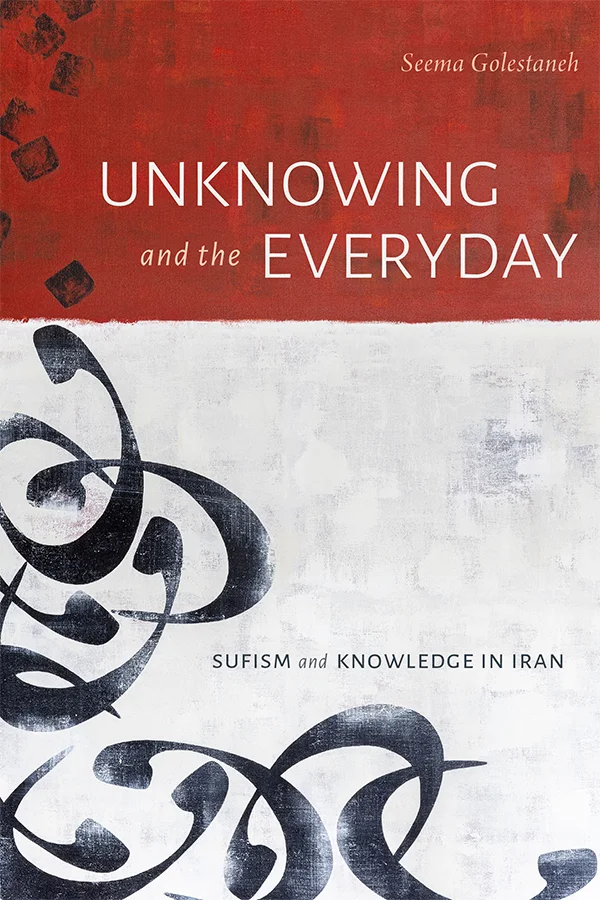
“Unknowing and the Everyday is a brilliant, counterintuitive work of phenomenology. Seema Golestaneh takes the reader to a universe of ambiguity through which her Sufi interlocutors practice a clear sense of being in the world, acting upon it and building relations with others. Together, her beautifully crafted ethnography and rich historical analysis bring to light the hermeneutical practice of mysticism in the politically charged environment of Iran without ever reducing them to mere political acts.” - Behrooz Ghamari-Tabrizi, Professor and Chair, Department of Near Eastern Studies, Princeton University
“A poetic and original contribution to the conversation about selfhood and ethics in Islamic studies, Unknowing and the Everyday opens up remarkable new ways to think of the role of literature in ethical life, the role of authority in the discursive tradition of Islam, and perhaps most crucially, ways of being that are outside the taken-for-granted conceptions of the modern liberal subject. Seema Golestaneh’s sensitivity to how the texts and practices of classical Sufism continue to inform and be in dialogue with contemporary Iranian life is a model for what the ethnography of religion can be. This is an outstanding work which will add greatly to the study of Iran and to the anthropology of Islam.” - Anand Vivek Taneja, author of Jinnealogy: Time, Islam, and Ecological Thought in the Medieval Ruins of Delhi
“Unknowing and the Everyday is a fascinating ethnography of the idea of mystical knowing (erfan in Farsi), which from the perspective of the living can only be described as a kind of unknowing, unlearning, and disassembling of the certitudes and ideological layers of our lives that reconfigures notions of self and reality. Tracing the multiple interpretations and concrete deployments in people’s lives of the concepts of mystical knowledge, the remembrance of God (zekr), and the dissolution of the self and identity (fana) through a number of Sufi sites and congregations in contemporary Iran, Seema Golestaneh gives us both the attuned description of a world and an anthropological ‘improvisation’ on it. What can the unlearning of the unreality of the real toward the (impossible) encounter with a divine Real do for the experience of young Iranians today confronted with the official memory of the Iran-Iraq War, the selective commemoration of martyrs by the state, and the petrification of traumatic cuts?” - Stefania Pandolfo, author of Knot of the Soul: Madness, Psychoanalysis, Islam
"Golestaneh’s writing throughout the book is lucid and effective, frequently poetic. ... A beautifully crafted memoir of a wandering Sufi of an academic, lost in the charmingly mystical landscape of contemporary Isfahan."
- Guangtian Ha,
International Journal of Middle East Studies
"This theoretically rich and analytically compelling book weaves broader themes of text, body, memory, and place together to interrogate scholar’s approaches to Sufi conceptual paradigms of zekr, sama‘, and, importantly, ma‘rifat. This strikingly written monograph centers the voices of Golestaneh’s interlocutors to engage complex Sufi states of being and knowing through accessible narratives of their everyday life. It is a must-read for scholars interested in Sufism and Islamic mysticism and anyone with interest in Iran." - Merin Shobhana Xavier, Journal of the American Academy of Religion
"Golestaneh’s monograph is an excellent read for anyone who wants to get an intimate glimpse of how Sufism is practiced in modern Iran under the watchful gaze of the Islamic Republic." - Ata Anzali, Journal of Religion
"Unknowing and the Everyday offers an intimate portrayal of how theological speculation about the unknown and people’s everyday spiritual and secular wants intersect, engendering local, practical theologies and creative religiosities." - Uzair Farooq Mir, Exertions
"Unknowing and the Everyday explores Persian-speaking Sufi movements in contemporary Iran through the lives of practitioners from Sufi masters to students. A central question being explored in the book is how concepts like knowledge and what we do not know translate into both Sufi practice and general life situations. More importantly, how does engaging with Sufi practice change or impact the way people deal with life’s uncertainties?" - Carimo Mohomed, Islamic Studies