“Unseen Flesh is a courageous and rich ethnography of Black lesbians’ encounters with gynecologists in Brazil. Nessette Falu pulls us into several theoretical conversations about medical violence and Black queer subjectivities and interrogates the sensorial and political consequences of gynecological exams. Yet she does not leave us hanging in the wings of medical domination and oppression; Falu uncovers how Black lesbians shape self-making through political and creative struggle.” - Dána-Ain Davis, author of Reproductive Injustice: Racism, Pregnancy, and Premature Birth
“An original and necessary work, Unseen Flesh opens an important critical window on well-being and gynecological health in Brazil, which are colored and conditioned by race/color, class, and sexual identity. Nessette Falu’s focus on Black Brazilian lesbians is historic and significant in itself—the result of her long-term, invested, and loving encounters with people who had been silenced.” - Jafari S. Allen, author of There’s a Disco Ball between Us: A Theory of Black Gay Life
"Falu’s book makes a remarkable contribution to unnaturalising medical discourse and understanding its sociohistorical dimension. The text alternates fluidly between significant excerpts from her ethnography, facing the challenge of operationalising intersectional analysis empirically, and abstract reflection, with reference to international debates, as well as linking with the pertinent theoretical production in Brazil." - Thiago Aguiar Simim, Ethnic and Racial Studies
"Unseen Flesh is a very welcome and important entry into the growing literature onmedical racism. The book’s focus on Black queer women’s experiences of gynecological racism in Brazil is not only innovative, but also showcases the ways in which homophobia, sexism, classism and racism intersect within medical spaces, leading to negative health outcomes." - Carmen Alvaro Jarrín, Annuac
"[A]n indispensable account of how Black lesbians experience and contest gynecologic racism. . . . Unseen Flesh . . . is a critical text for teaching Black feminist ethnographic methods to undergraduate and graduate students alike and is a key reference for medical ethnographers studying race in gynecology and reproductive health. In light of the book’s wide-ranging applicability, Falu has undoubtedly become an important interlocutor for those scholars tracking the promising development of contemporary Black queer anthropology."
- Benjamin M. Slightom, Exertions
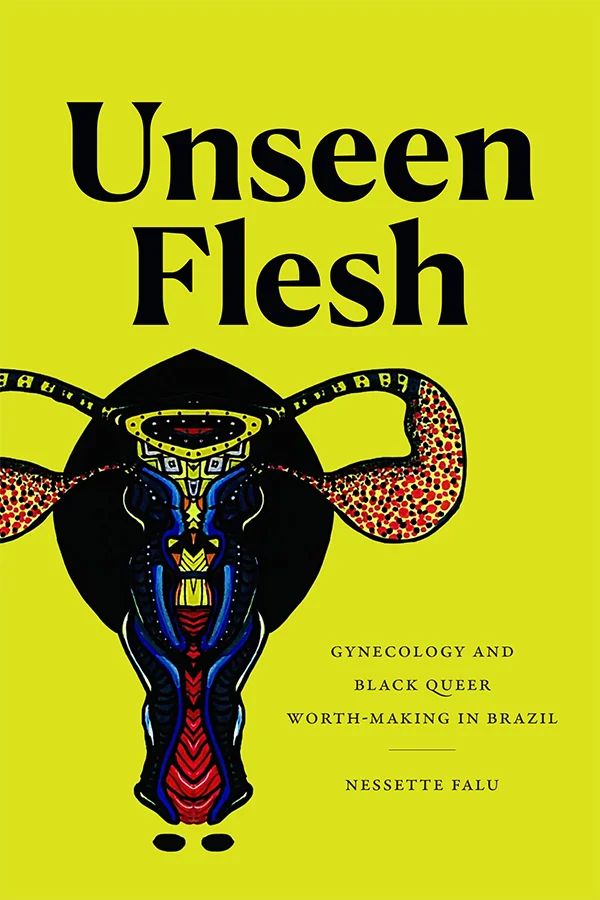
"It is rare that an academic book claims to be written 'with fire' (p. 20), but 'fire' is an excellent descriptor for Nessette Falu’s debut ethnography, Unseen Flesh. From its acerbic documentation of gynotrauma among Black lesbians in Brazil, to its moving attention to ethical and political resistance, to its exquisite cover art by Bahian watercolor and graffiti artist Ani Ganzala, Falu brings fire and evocative storytelling to the forefront of her work." - Christa Craven, Journal of Anthropological Research
"Theoretically innovative and rhetorically advanced, Unseen Flesh is best suited for graduate students and advanced undergraduates. I see it being a strong fit for graduate courses in gender studies, ethnic studies, and anthropology. Readers curious about Black feminisms may find the content of interest, although they may struggle with terminology. Ultimately, Unseen Flesh offers an insightful and ethnographically rich look at the ways Black lesbians in Bahia are forging networks to navigate prejudice within the healthcare system and beyond." - Alejandra Marks, Medical Anthropology Quarterly
"Unseen Flesh constitutes a needed contribution to denormalizing gendered/racialized violent practices in the medical field of gynecology. … This text is obligatory reading in any class dealing with strategies for dismantling systems of domination in the Americas; instructors and students of Black feminist thought, Africana studies, gender and sexuality studies, and public health may benefit from its analyses." - Maria Ximena Abello-Hurtado, Gender & Society
"Falu’s combination of theory and ethnography sings. . . . This book is a valuable resource." - Emily Matteson, Anthropological Notebooks
"Throughout Unseen Flesh, Falu showcases why this book is not just a contribution to anthropology but also a must-read for medical students around the world where gyno-trauma defines the clinical experiences of Black women and Black queer people, specifically. This ethnography is a gift to medical practitioners, health policy experts, and anyone who believes that equity and humane medical care play a pivotal role in protecting the public’s health and well-being." - Meryleen Mena, Transforming Anthropology