
Home / Books / Visitation

Visitation

The Conjure Work of Black Feminist Avant-Garde Cinema
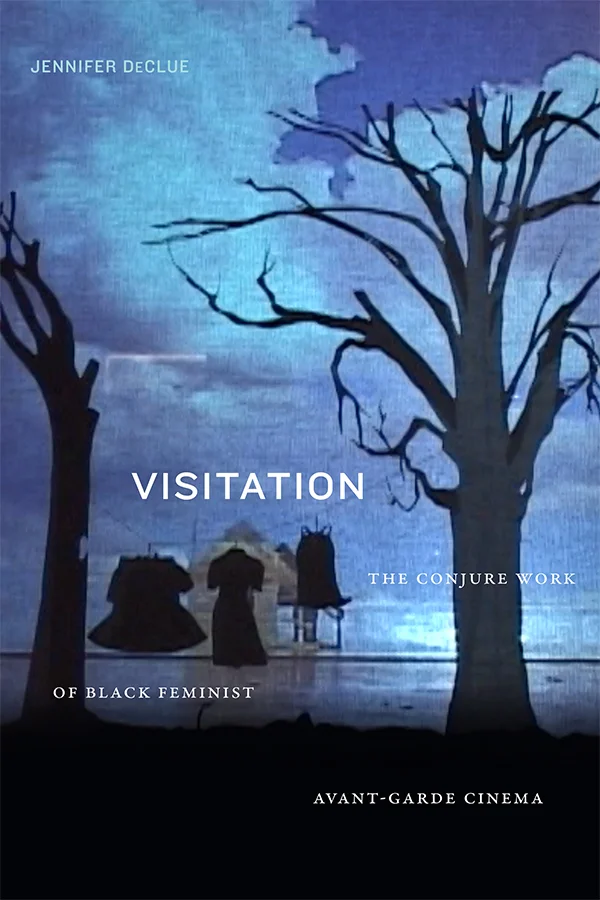
Book

Pages: 240

Illustrations: 48 illustrations

Published: November 2022

Author: Jennifer DeClue

In Visitation, Jennifer DeClue shows how Black feminist avant-garde filmmakers draw from historical archives in order to visualize and reckon with violence suffered by Black women in the United States. DeClue argues that these filmmakers—including Kara Walker, Kara Lynch, Tourmaline, and Ja’Tovia Gary—create spaces of mourning and reckoning rather than voyeurism and pornotropy. Through their use of editing, performance, and cinematic experimentation, these filmmakers intervene in the production of Blackness and activate new ways of seeing Black women and telling their stories. Theorizing these films as a form of conjure work, DeClue shows how these filmmakers raise the specters of Black women from the past and invite them to reveal history from their point of view. In so doing, Black feminist avant-garde filmmakers channel spirits that haunt archives and create cinematic arenas for witnessing Black women battling for survival during pivotal and exceedingly violent moments in US history.

Praise

“Jennifer DeClue’s original study centers the ‘shifting ground of many pasts . . . where the embodied and disembodied meet.’ Visitation honors Black feminist artists whose avant garde films are revealed to be conjure work. A transformative, vital work.” - Jennifer DeVere Brody, Professor of Theater and Performance Studies, Stanford University

“Jennifer DeClue’s Visitation powerfully and imaginatively turns to the works of Black women filmmakers to point to the alternative archives that their films produce, archives that counter the histories that are recorded and solemnized in official repositories. This is a must-read text for all of us.” - Roderick A. Ferguson, Yale University

"The book foregrounds important scholarly contributions to the vanguard studies of cinema and experimental media installations. . . . DeClue’s Black feminist critical perspective—rendering occluded Queer and feminine archival voices through an avant-garde mode—situates a critical charge to continue in this vanguard scholarship through a methodology of tenderness that bespeaks the closing pages of her book. Her work imparts that there is often more to be reckoned with in revisiting archives and revealing singular testimonies, cultural ethics, and marginal voices that continue to resound despite attempts of historical exclusion." - M. Sellers Johnson, International Journal of Communication

"Anyone who aligns themselves with Black feminist theory will find this book useful in enacting that theory and exploring how it interacts with avantgarde film. DeClue’s holistic approach to cinematic analysis suggests new opportunities of study within film and media studies that expand their object of analysis. . . . [G]raduate students and others with a vested interest in avantgarde art, film, Black feminism, and archives of resistance will find this book a worthwhile read that contributes to their understanding of their field." - Marley Duncan, Women's Studies

Buy

Availability: Loading...

Price: Loading...

Request a desk or exam copy Spring 2026 Web Sale

Information

Author/Editor Bios

Back to Top
Jennifer DeClue is Associate Professor of the Study of Women and Gender at Smith College.

Table Of Contents

Back to Top
Acknowledgments  vii
Introduction. Visitation  1
1. The Archive and the Silhouette: Framing Black Feminist Avant-Garde Cinema  29
2. Reckoning at the Bridge: Saved and the Archive of Laura Nelson  65
3. Carrying the Knowledge / Performing the Archive: An Afternoon with Marsha P. Johnson  99
4. Ecstasy and the Archive: A Black Feminist Phenomenology of Freedom  143
Coda. On Tenderness  183
Notes  187
Bibliography  211
Index  221

Rights

Back to Top

Sales/Territorial Rights: World

Rights and licensing

Awards

Back to Top

DUP First Book Fund Recipient

Additional Information

Back to Top
Related Links Paper ISBN: 978-1-4780-1916-9 / Hardcover ISBN: 978-1-4780-1652-6 / eISBN: 978-1-4780-2379-1 / DOI: https://doi.org/10.1215/9781478023791