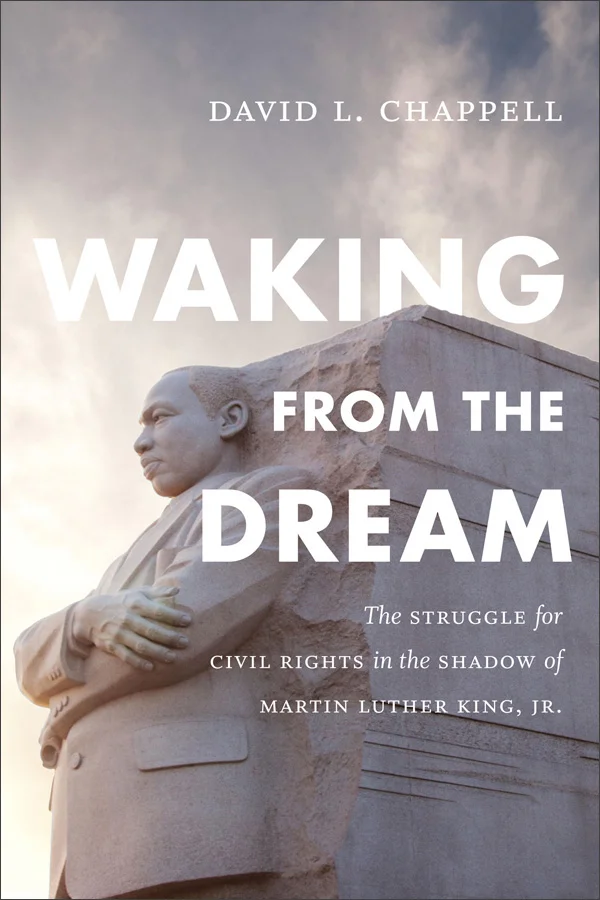
"As a foray into still largely unexplored terrain, Chappell's book is vital." - Kirkus Reviews
"Chappell brilliantly recovers the usually neglected ferment and experimentation of a generation of Americans who tried to make good the goals of the civil rights movement in the years since Martin Luther King's assassination. Waking from the Dream is also a masterly, thoughtful examination of the very different ways in which Dr. King's name has been invoked since 1968." - Tony Badger, Paul Mellon Professor of American History, Cambridge University
"A vitally needed appraisal of how the civil rights movement re-created itself in surprisingly effective ways after Dr. King's death. . . . No one is better qualified than David Chappell to examine these largely unexplored developments and to make sense of their ironies, tragedies, and triumphs. This is a brilliant, absorbing work that compels us to rethink our conceptions and judgments about the civil rights movement." - Stewart Burns, author of We Will Stand Here till We Die
"David L. Chappell has long been one of our sharpest and most original historians of civil rights. He confirms that reputation with Waking from the Dream. Chappell invites us to reconsider Dr. King's legacy and critically appreciate the efforts of those who carried on in the 1970s and 1980s to keep his unfulfilled agenda before the nation's conscience. This is an important book that will be of tremendous value to anyone interested in the history of race, inequality, and civil rights in modern America." - Eric Arnesen, George Washington University
"Waking from the Dream skillfully traces Martin Luther King, Jr.'s legacy during the two decades following his assassination. The previously untold story of continuing struggle and posthumous inspiration that dominates this compelling and groundbreaking book will forever change the way civil rights historians view this era." - Raymond Arsenault, author of Freedom Riders: 1961 and the Struggle for Racial Justice
"Waking from the Dream offers the kind of clear-eyed analysis of our post-civil rights worlds of politics and memory work that we desperately need. David L. Chappell gets to some essential truths about the costs and benefits of myth-making. It is critical that we know this history so that we can properly contextualize the successes and failures of civil rights politics that brought us to this allegedly post-racial age." - Jonathan Scott Holloway, author of Jim Crow Wisdom: Memory & Identity in Black America since 1940
"Beautifully written and thought-provoking. . . . Historians have cast the period after King's death as the New Nadir. The constant invocation of his name by allies, outsiders, and enemies made it appear as if nothing could measure up to his image, memory, or the seminal feats of Montgomery, Birmingham, and Selma. Chappell, however, has uncovered what the bright light of King has blinded so many to—the ongoing work by communities, politicians, and NGOs to build and sustain a more inclusive rights-based nation." - Carol Anderson, author of Eyes off the Prize
"In Waking from the Dream, Chappell chronicles how the remaining leaders of the civil rights revolution and their heirs have attempted to live up to [Martin Luther] King's legacy, and to navigate this second, more anodyne phase of the fight for racial equality. [...] Along the way, he notes, they've managed to score political wins smaller in scale than the victories of the King era, but no less important." - Jamelle Bouie, Bookforum
"Chappell’s research is judicious, his writing is lucid, and he has produced a significant book on the post-King era." - Terry H. Anderson, Journal of Southern History
"Chappell combines two remarkable strengths in a historian. First, he is an excellent storyteller with the ability to translate the personalities and political intrigues of another generation into narratives that still matter." - Richard Lischer, Christian Century
"...Waking from the Dream remains a valuable addition to our understanding of the black freedom struggle in shifting social, political, and economic climates." - Robert Widell, Journal of American History
"David L. Chappell is a leading historian of the civil rights movement, and his latest book should help solidify that stature. ... His main contribution is the interpretive sweep and boldness he brings to these topics. Chappell has already altered many historians’ thinking about the civil rights movement in its heyday, and this book’s provocative arguments may lead readers to rethink their assumptions and judgments about the civil rights movement after King, too."
- David Howard-Pitney, American Historical Review
"This important book will serve as a useful resource for teachers helping students explore what happened to the civil rights movement following the 1960s, as well as for specialists in recent political and African American history." - Timothy N. Thurber, North Carolina Historical Review
"Chappell, through this monograph, makes an important contribution to civil rights movement studies by focusing on five important case studies and assessing the legacy of Dr. Martin Luther King Jr." - Elizabeth Gritter, History: Reviews of New Books
"An impressive work. The language is accessible and clear, which would make it a useful supplementary teaching tool. At the same time there is sufficient originality to hold the attention of specialists. . . . Overall, this is an excellent work and it is at its best when it is at its most dmost distinctive; this reviewer thoroughly recommends it." - Tom Packer, History
"Waking from the Dream is a work of historical recovery, reinterpretation, and continuity of the Civil Rights Movement from 1968 through the early 1990s. Chappell’s book exposes an overlooked period of the struggle for civil rights, one in which courageous and significant achievements were made by less celebrated yet equally determined actors." - Ian M. McDowell, Journal of African American History