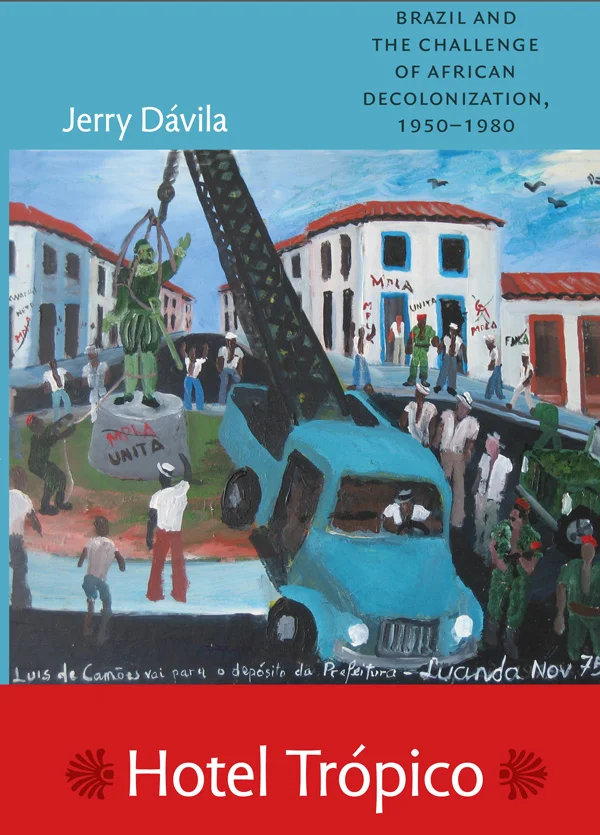
“Hotel Trópico is a very informative monograph on Brazilian diplomacy whose strength lies in the fascinating narratives and episodes the author draws from elite Brazilians’ reflections, demonstrating the die-hard rhetoric of racial democracy in their politics of identity. . . . Jerry Dávila is to be celebrated for his meticulous research and nuanced historical interpretations. The book is very well written and free of unnecessary jargon. . . . The book will be read not only by scholars and students of modern Brazil but also by many others who are interested in race and nation in modern Latin America. It should be widely adopted for undergraduate and graduate courses in modern Brazil and Latin America as well as global and Atlantic history.” - Mieko Nishida, Hispanic American Historical Review
“Hotel Trópico is an intriguing and well-researched study that nicely unites cultural history with diplomatic history. Dávila’s breadth and scope makes the book well suited for scholars, researchers, and students with a thorough understanding of Brazilian history.” - Manuella Meyer, Ethnohistory
“Davila works with extensive primary sources and interviews. His insightful and incisive work has the potential to become a new foundational text on international relations and race relations in late twentieth-century Brazil. The work is also an important addition to the history of the Atlantic world and demonstrates the ways in which South Atlantic interactions continued to be significant in the creation of Brazilian national identity through the twentieth century.” - Elizabeth W. Kiddy, History: Reviews of New Books
“Impressive research in Brazilian and Portuguese archives (especially those of the foreign ministries and the secret police), newspapers on three continents, memoirs, and interviews with retired Brazilian diplomats and intellectuals make this book a model diplomatic history and a sophisticated meditation on race and national identity.” - Hendrik Kraay, Journal of Interdisciplinary History
“This book will be of interest to anthropologists in part because it carries out, in a very focused, engaged, and empirical way, the goal of ‘studying up’ that has been widely proclaimed for four decades but relatively rarely put into practice. For scholars of Brazil and Latin America, it will advance and inform research and thinking on race and ethnicity in the region in important ways.” - John Norvell, American Anthropologist
"Hotel Trópico is a meticulously researched reconstruction and analysis of the origins, ironies, contradictions, incongruities, dilemmas, successes, and failures of Brazil's first serious attempt to set up ongoing relationships with developing countries outside the Western Hemisphere. Written with a decided slant toward the Brazilian perspective, this study of foreign policy decision-making, with a 30-year scope and an epilogue, reveals the great degree to which relations with Africa were always conditioned mainly by evolving Brazilian elite perceptions and debate about Brazil and its role in the world…. The considerable strength of Hotel Trópico rests on Dávila's solid prior scholarship on Brazil's race relations, unprecedented access to comparatively recent Brazilian diplomatic and Portuguese governmental archives, extended interviews with key players over five years, and broad institutional and collegial ties in several countries. The research is meticulous and copiously documented, the argumentation is skillful and clear, and the style is lively, detailed and almost novelistic in its narrative." - Wayne A. Selcher, The Americas
“Jerry Dávila has transformed the history of Brazil’s diplomatic initiatives in Africa during the era of decolonization, not only adding depth and fascinating detail to this story but also showing how the pursuit of a special Brazil-Africa relationship both drew upon Brazil’s claims to be a ‘racially democratic’ nation and laid bare the contradictions in those claims.” - Barbara Weinstein, author of For Social Peace in Brazil
“Hotel Trópico is a superb book. It takes on broad themes such as race and imperialism, modifies much of the current knowledge about Brazil’s dictatorship, and suggests a reevaluation of that form of government in Argentina, Chile, and Uruguay. Hotel Trópico will be read not only by scholars of Brazil and Latin America but also by those studying Africa, empire, and postcolonialism.” - Jeffrey Lesser, author of A Discontented Diaspora
“[T]his is a solidly researched and colourfully written study, and its broad geographical and thematic scope should appeal to a wide readership both within and beyond the confines of Afro- and Luso-Brazilian studies.” - Ori Preuss, Journal of Latin American Studies
“At a time when Brazil is garnering widespread attention as a global economic and geopolitical power, this book provides an indispensable historical framework to understand the conditions that have led to this status. Africa in fact served as a platform for Brazil to assert itself as an emerging world power in the 1960s. Dávila offers one of the most sophisticated and in-depth analyses of Brazil-Africa relations to date. One of the highlights of his book are the interviews, which capture quite vividly the complicated nexus among affect, culture, race, myth, desire, memory, and foreign policy.” - Fernando Arenas, American Historical Review
“Jerry Dávila's insightful and very well-written book has arrived at an opportune moment. . . . The considerable strengths of Hotel Trópico rest on Dávila's solid prior scholarship on Brazil's race relations, unprecedented access to comparatively recent Brazilian diplomatic and Portuguese governmental archives, extended interviews with key players over five years, and broad institutional and collegial ties in several countries. The research is meticulous and copiously documented, the argumentation is skillful and clear, and the style is lively, detailed and almost novelistic in its narrative.” - Wayne A. Selcher, The Americas
“This book is no standard diplomatic history. It falls within the genre of work—mostly related to the study of US foreign relations—that seeks to show how domestic race relations have left a profound mark on the conduct of foreign policy. . . . [A] well-written and insightful book. . . .” - Philip Chrimes, International Affairs