
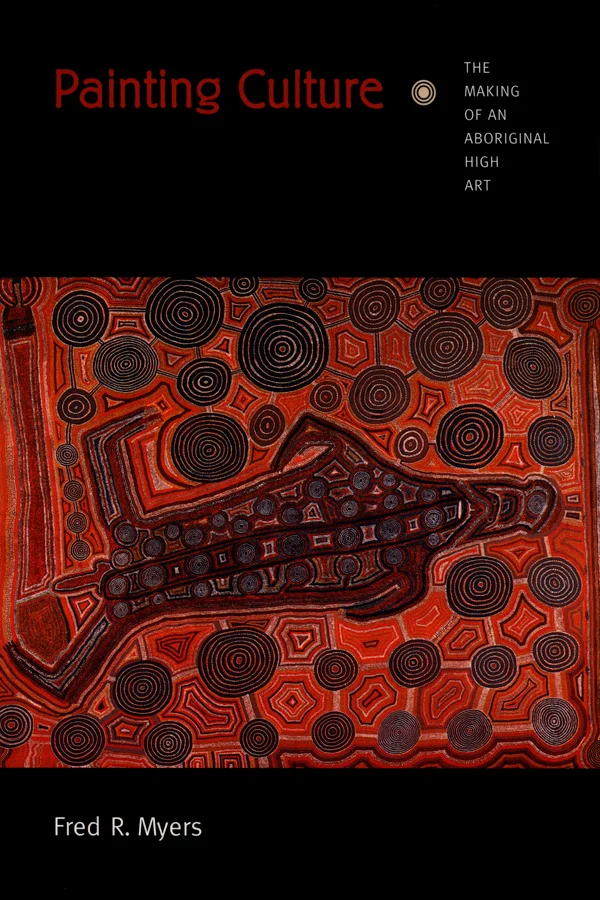
Painting Culture
The Making of an Aboriginal High Art
Objects/Histories
Book
Pages: 440
Illustrations: 8 color photos, 46 b&w photos, 78 line drawings
Published: December 2002
Author: Fred R. Myers
Subjects
Art and Visual Culture > Art Criticism and Theory, Anthropology > Cultural Anthropology, Native and Indigenous Studies
Art and Visual Culture > Art Criticism and Theory, Anthropology > Cultural Anthropology, Native and Indigenous Studies
Praise
Buy
Availability: Out of stock
Price: $45.00
This title will be released on December 16, 2002
Buy the e-book:
Information
Author/Editor Bios
Back to TopFred R. Myers is Professor and Chair of Anthropology at New York University and President of the American Ethnological Society. He is the author of Pintupi Country, Pintupi Self; editor of The Empire of Things: Regimes of Value and Material Culture; and coeditor of The Traffic in Culture: Refiguring Anthropology and Art.
Table Of Contents
Back to Top
Acknowledgements
Prologue
Introduction: From Ethnoaesthetics to Art History
1. Truth or Beauty: The Revelatory Regime of Pintupi Painting
2. Practices of Painting: A Local History and a Vexed Intersection
3. The Aesthetic Function and the Practice of Pintupi Painting: A Local Art History
4. Making a Market: Cultural Policy and Modernity in the Outback
5. Burned Out, Outback: Art Advisers Working between Two Worlds
6. The “Industry”: Exhibition Success and Economic Rationalization
7. After the Fall: In the Arts Industry
8. Materializing Culture and the New Internationalism
9. Performing Aboriginality at the Asia Society Gallery
10. Postprimitivism: Lines of Tension in the Making of Aboriginal High Art
11. Unsettled Business
12. Recontextualizations: The Traffic in Culture
Appendix: A Short History of Papunya Tula Exhibition, 1971-1985
Notes
References
Index
Prologue
Introduction: From Ethnoaesthetics to Art History
1. Truth or Beauty: The Revelatory Regime of Pintupi Painting
2. Practices of Painting: A Local History and a Vexed Intersection
3. The Aesthetic Function and the Practice of Pintupi Painting: A Local Art History
4. Making a Market: Cultural Policy and Modernity in the Outback
5. Burned Out, Outback: Art Advisers Working between Two Worlds
6. The “Industry”: Exhibition Success and Economic Rationalization
7. After the Fall: In the Arts Industry
8. Materializing Culture and the New Internationalism
9. Performing Aboriginality at the Asia Society Gallery
10. Postprimitivism: Lines of Tension in the Making of Aboriginal High Art
11. Unsettled Business
12. Recontextualizations: The Traffic in Culture
Appendix: A Short History of Papunya Tula Exhibition, 1971-1985
Notes
References
Index
Rights
Back to TopSales/Territorial Rights: World
Rights and licensingAwards
Back to TopWinner, 2008 J. I. Staley Prize
Additional Information
Back to Top
Paper ISBN:
978-0-8223-2949-7 /
Hardcover ISBN:
978-0-8223-2932-9 /
eISBN:
978-0-8223-8416-8 /
DOI:
https://doi.org/10.1215/9780822384168
Publicity material