Follow us on Instagram.
“An Empire of Indifference recounts how the paternalism of development was replaced by the expectation of colonial self-management.” — Matt Kavanagh, American Book Review
“Martin's book represents one of the first political philosophies to offer a thorough critique of the political economy of the event. . . . Among other things, this book offers a powerful reflection on method. Martin is particularly illuminating on the limitations of Foucault's enormously influential account of biopower in Society Must be Defended. . . .” — Melinda Cooper, Postmodern Culture
“An Empire of Indifference recounts how the paternalism of development was replaced by the expectation of colonial self-management.” —Matt Kavanagh, American Book Review
“Martin's book represents one of the first political philosophies to offer a thorough critique of the political economy of the event. . . . Among other things, this book offers a powerful reflection on method. Martin is particularly illuminating on the limitations of Foucault's enormously influential account of biopower in Society Must be Defended. . . .” —Melinda Cooper, Postmodern Culture
“An Empire of Indifference is a brilliant study, both theoretically profound and politically compelling.” — Michael J. Shapiro, author of, Methods and Nations: Cultural Governance and the Indigenous Subject
“An Empire of Indifference is the perfect answer to Thomas Friedman’s The World Is Flat. Randy Martin well understands that finance capital flattens and gouges at the same time. This book is the anti-Friedman.” — Neil Smith, author of, The Endgame of Globalization
“While a great deal has been written about globalization, empire, and international finance, I know of no other work besides this one that looks at their intersection through the rhetorical and conceptual lens of finance. An Empire of Indifference is a strong piece of original scholarship on a very important topic.” — Chris Hables Gray, author of, Peace, War, and Computers
If you are requesting permission to photocopy material for classroom use, please contact the Copyright Clearance Center at copyright.com;
If the Copyright Clearance Center cannot grant permission, you may request permission from our Copyrights & Permissions Manager (use Contact Information listed below).
If you are requesting permission to reprint DUP material (journal or book selection) in another book or in any other format, contact our Copyrights & Permissions Manager (use Contact Information listed below).
Many images/art used in material copyrighted by Duke University Press are controlled, not by the Press, but by the owner of the image. Please check the credit line adjacent to the illustration, as well as the front and back matter of the book for a list of credits. You must obtain permission directly from the owner of the image. Occasionally, Duke University Press controls the rights to maps or other drawings. Please direct permission requests for these images to permissions@dukeupress.edu.
For book covers to accompany reviews, please contact the publicity department.
If you're interested in a Duke University Press book for subsidiary rights/translations, please contact permissions@dukeupress.edu. Include the book title/author, rights sought, and estimated print run.
Instructions for requesting an electronic text on behalf of a student with disabilities are available here.
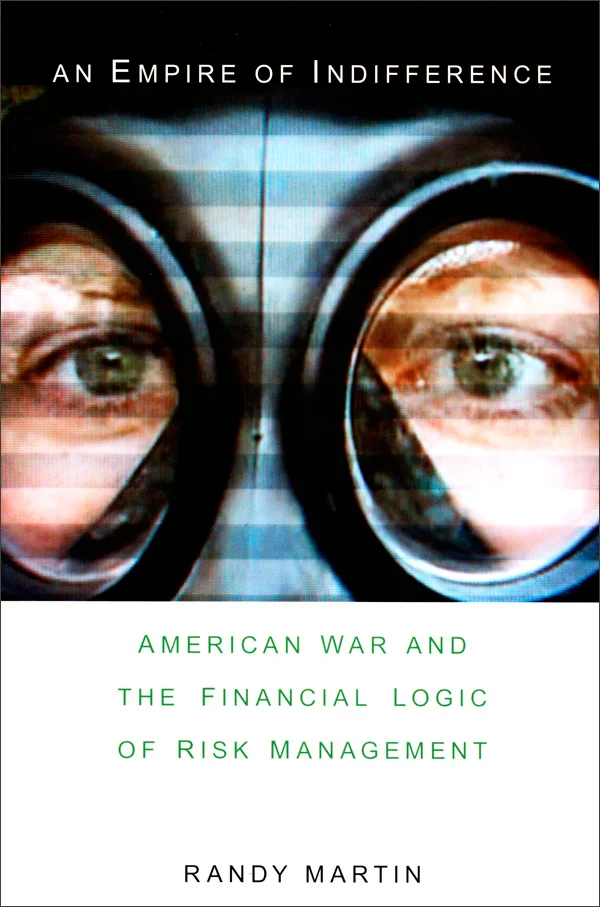
Drawing on theorists including Michel Foucault, Giorgio Agamben, Michael Hardt, Antonio Negri, and Achille Mbembe, Martin illuminates a frightening financial logic that must be understood in order to be countered. Martin maintains that finance divides the world between those able to avail themselves of wealth opportunities through risk taking (investors) and those who cannot do so, who are considered “at risk.” He contends that modern-day American imperialism differs from previous models of imperialism, in which the occupiers engaged with the occupied to “civilize” them, siphon off wealth, or both. American imperialism, by contrast, is an empire of indifference: a massive flight from engagement. The United States urges an embrace of risk and self-management on the occupied and then ignores or dispossesses those who cannot make the grade.
Randy Martin is Professor of Art and Public Policy at the Tisch School of the Arts at New York University. His books include Financialization of Daily Life, On Your Marx: Relinking Socialism and the Left, and Critical Moves: Dance Studies in Theory and Politics, also published by Duke University Press. He is a former editor of the journal Social Text.
Sign up for Subject Matters email updates to receive discounts, new book announcements, and more.