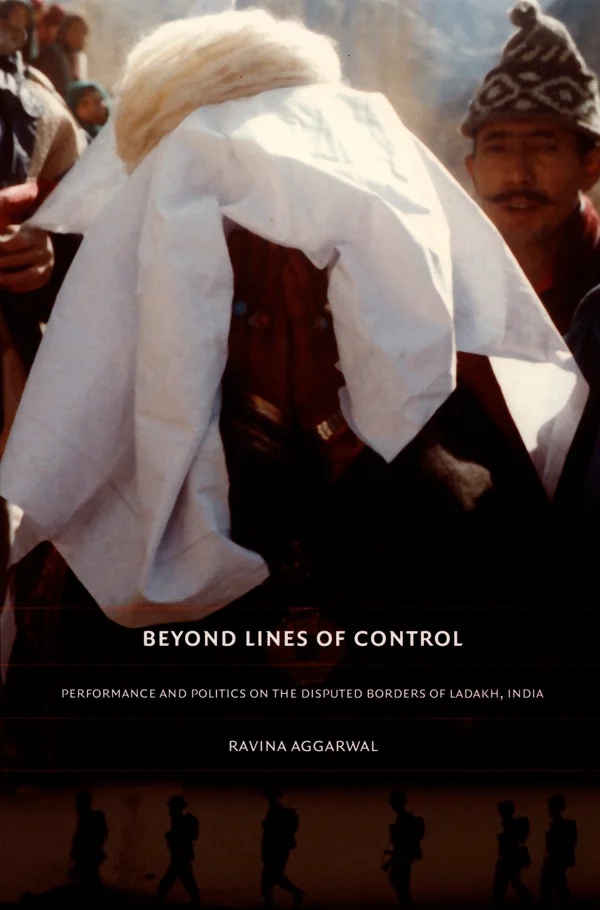
“[A] richly textured anthropological account of the ways in which different subjectivities are ritually performed and constituted in northern India.” - Jon E. Fox , American Journal of Sociology
“[T]his is a significant, inspired and highly informative book. It provides much new ethnographic and historical information, places Ladakh firmly on the map in South Asian studies, and should also be of interest for its well-chosen and often beautifully narrated illustrations of how contemporary theoretical debates in feminist anthropology, performance and border studies can be deployed constructively in seeking to understand how people in ostensibly marginal places find ways to locate themselves at the center of their own worlds.” - Martijn van Beek, Anthropological Quarterly
“[T]the connections between Aggarwal’s field research and conclusions are seamless. The importance of border performance in and beyond such disparate areas as film, military parade, funeral, archery, and daily village life in Western Ladakh is clearly connected and convincingly proven. This important book will uniquely inform those studying South Asia, religion and nationalism, Buddhism, Islam, or the nature of identity. Those familiar with Ladakh will also find much of its history given the particularized treatment it has long deserved.”
- Christian Haskett , Religious Studies Review
“[The] prose is often poetic and ends with a beautifully evocative image of the Indus flowing across borders. Anyone with a knowledge of Ladakh and its corpus of anthropological literature will appreciate the great contribution this book makes to an under-researched set of themes. It can be strongly recommended to anyone with a serious interest in the region and will enrich the knowledge and understanding of scholars of Ladakh, Tibet, Kashmir and the Indian state, alike.” - Fernanda Pirie , Critique of Anthropology
“Aggarwal’s book is a valuable intervention in the field of anthropological scholarship, since it successfully places cultural practices in their historical as well as socio-economic conexts.” - Chitralekha Zutshi , Canadian Journal of History
“Ravina Aggarwal’s book is a fascinating account of the performances of power at the Line of Control that separates India and Pakistan and of the efforts of border communities in Ladakh to negotiate and contest power through performance.” - , American Ethnologist
“This book succeeds in showing the particularity of this region and a multiplicity of contexts in which people cross and create borders.” - Dia Mohan , Modern Drama
"Beyond Lines of Control effectively untangles the web of beliefs, animosities, and political developments in Ladakh so that outsiders can begin to understand some of the forces at work in the region. . . . Aggarwal develops her facts and arguments well, and a thorough index (a blessing for any work of nonfiction) allows the careful reader to go back and retrace unfamiliar developments. Best of all, the author's engaging writing style makes it a pleasure to learn more about this fascinating society." - , Peaceful Societies
[A] warm and intimate but carefully measured view of Ladakh. This book is an excellent supplement to more centrist views of India. It is written clearly and compellingly, and it is suitable for any undergraduate or graduate course in the anthropology or geopolitics of South Asia.” - Jim Fisher , Journal of Asian Studies
“Beyond Lines of Control is a theoretically sophisticated, gracefully written ethnography about the politics of performance—and the performance of politics—in one of the most contested geopolitical landscapes in the world.” - Piya Chatterjee, author of A Time for Tea: Women, Labor, and Post/Colonial Politics on an Indian Plantation
“Beyond Lines of Control is an informative book about a region that is understudied in both anthropology and area studies. By moving back and forth between the everyday and the extraordinary, the mundane and the memorialized, Ravina Aggarwal asks us to reflect on the politics of memory for a region that sees itself as forgotten and liminal in the history of the Indian nation-state.” - Kamala Visweswaran, author of Fictions of Feminist Ethnography