
Home / Books / Crip Colony

Crip Colony

Mestizaje, US Imperialism, and the Queer Politics of Disability in the Philippines
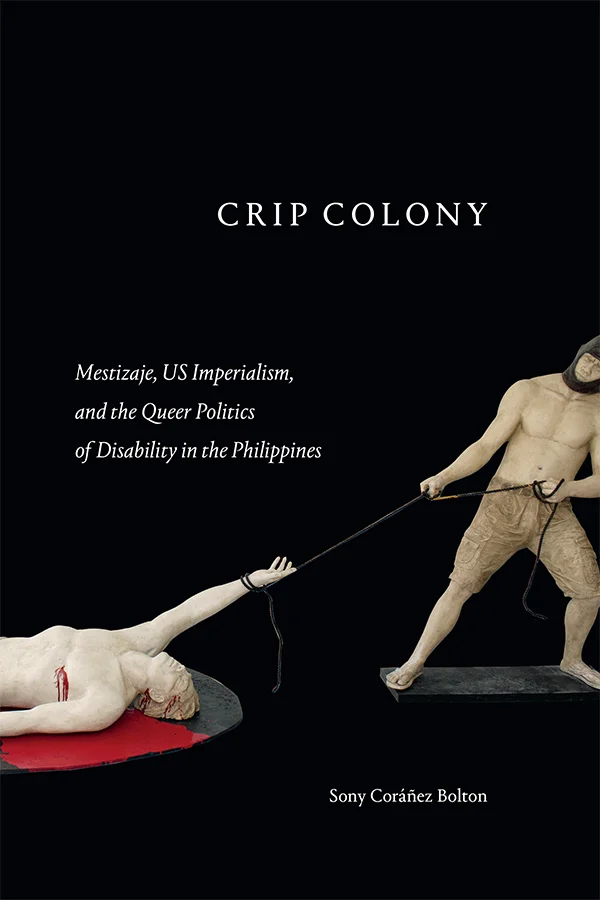
Book

Pages: 224

Illustrations: 3 illustrations

Published: February 2023

In Crip Colony, Sony Coráñez Bolton examines the racial politics of disability, mestizaje, and sexuality in the Philippines. Drawing on literature, poetry, colonial records, political essays, travel narratives, and visual culture, Coráñez Bolton traces how disability politics colluded with notions of Philippine mestizaje. He demonstrates that Filipino mestizo writers in the late nineteenth and early twentieth centuries used mestizaje as a racial ideology of ability that marked Indigenous inhabitants of the Philippines as lacking in civilization and in need of uplift and rehabilitation. Heteronormative, able-bodied, and able-minded mixed-race Filipinos offered a model and path for assimilation into the US empire. In this way, mestizaje allowed for supposedly superior mixed-race subjects to govern the archipelago in collusion with American imperialism. By bringing disability studies together with studies of colonialism and queer-of-color critique, Coráñez Bolton extends theorizations of mestizaje beyond the United States and Latin America while considering how Filipinx and Filipinx American thought fundamentally enhances understandings of the colonial body and the racial histories of disability.

Praise

“Through a comparative reading of primarily Spanish-language texts, Sony Coráñez Bolton reframes our understanding of race and empire. The book reveals how discourses of mestizaje and ability/disability deeply informed Spanish and US imperialisms in the Philippines. Vibrant and insightful, Crip Colony ultimately imagines a new framework for hemispheric disability studies.” - Denise Cruz, Professor of English and Comparative Literature, Columbia University

“By attending to the ways in which mestizaje theory operated in the Philippines, Sony Coráñez Bolton reorients scholarship on mestizaje away from its primary focus on the Americas while demonstrating how the theory is conceptually dependent on disability. This indispensable book reframes how scholars in disability studies, Asian American studies, and beyond engage with questions of disability, empire, coloniality, and mestizaje.” - Julie Avril Minich, author of Accessible Citizenships: Disability, Nation, and the Cultural Politics of Greater Mexico

"Coráñez Bolton's original analysis of Filipino mestizaje bridges the gulf between American hemispheric studies and Asian American studies, which have heretofore existed in silos." - Bassam Sidiki, Critical Inquiry

“Sony Corañez Bolton’s Crip Colony is a theoretically sophisticated contribution to the current surge in Filipinx American studies scholarship.”

- Martin Joseph Ponce, Society for U.S. Intellectual History

"In this stunning theoretical and archival work, Sony Coráñez Bolton dives into the interstices of global colonial strategies and postcolonial projects by re-examining culturally significant Philippine images and narratives using the lenses of race, disability, and queerness. It is a monumental feat that begins with something small: a childhood memory of his mother using three languages— Spanish, English, and Tagalog—that lets him map out his own positionality as a mestizo Filipinx American professor of Spanish."

- Anna Felicia C. Sanchez, Southeast Asian Studies

"Crip Colony accomplishes and articulates a critical remapping of the Philippines and other spaces. Advocating for Filipinx and Latinx bodies to refuse disabling imperial diagnoses, this book contributes to postcolonial, disability, and Filipinx studies and will influence related fields for years to come."

- Drew Trinidad, GLQ

"Suffice to say, Crip Colony will make a lasting contribution to Philippine, American, and what we could call global Latinx studies. Coráñez Bolton certainly sets the highest standard for the study of modern Spanish-language Philippine literature." - Paula C. Park, Philippine Studies

"The contribution of Crip Colony that speaks the most to me is how it shows the ableist mandate of 'benevolent rehabilitation' that still underlies anticolonial calls for sovereignty, autonomy, and development. . . . A humbling, monumental, and exciting intellectual contribution that proposes new critical vocabularies and that opens the door widely for future scholarship and reflection." - Laura J. Torres-Rodríguez, Journal of Latin American Cultural Studies

"The key intervention Crip Colony makes is in its deployment of theoretical insights from disability studies to excavate the ableist logics underpinning the Filipinx colony. . . . The use of disability studies in a Southeast Asian context— in the case of Crip Colony, colonial Philippines—is thus a welcome addition to the field." - Kuansong Victor Zhuang, Journal of Asian Studies

Buy

Availability: In stock

Price: $25.95

Request a desk or exam copy

Information

Author/Editor Bios

Back to Top
Sony Coráñez Bolton is Assistant Professor of Spanish, American studies, and Latinx and Latin American Studies at Amherst College.

Table Of Contents

Back to Top
Acknowledgments  ix
Crip Colonial Critique: Reading Mestizaje from the Borderlands to the Philippines  1
1. Benevolent Rehabilitation and the Colonial Bodymind: Filipinx American Studies as Disability Studies  33
2. Mad María Clara: The Queer Aesthetics of Mestizaje and Compulsory Able-Mindedness  67
3. Filipino Itineraries, Orientalizing Impairments: Chinese Foot-Binding and the Crip Coloniality of Travel Literature  99
4. A Colonial Model of Disability: Running Amok in the Mad Colonial Archive of the Philippines  131
Epilogue. A Song from Subic: Racial Disposability and the Intimacy of Cultural Translation  162
Notes  171
Bibliography  187
Index  197

Rights

Back to Top

Sales/Territorial Rights: World

Rights and licensing

Awards

Back to Top

Winner of the 2024 Lora Romero First Book Publication Prize, presented by the American Studies Association

Additional Information

Back to Top
Related Links Paper ISBN: 978-1-4780-1956-5 / Hardcover ISBN: 978-1-4780-1692-2 / eISBN: 978-1-4780-2418-7 / DOI: https://doi.org/10.1215/9781478024187