
Home / Books / Cuban Counterpoint

Cuban Counterpoint

Tobacco and Sugar
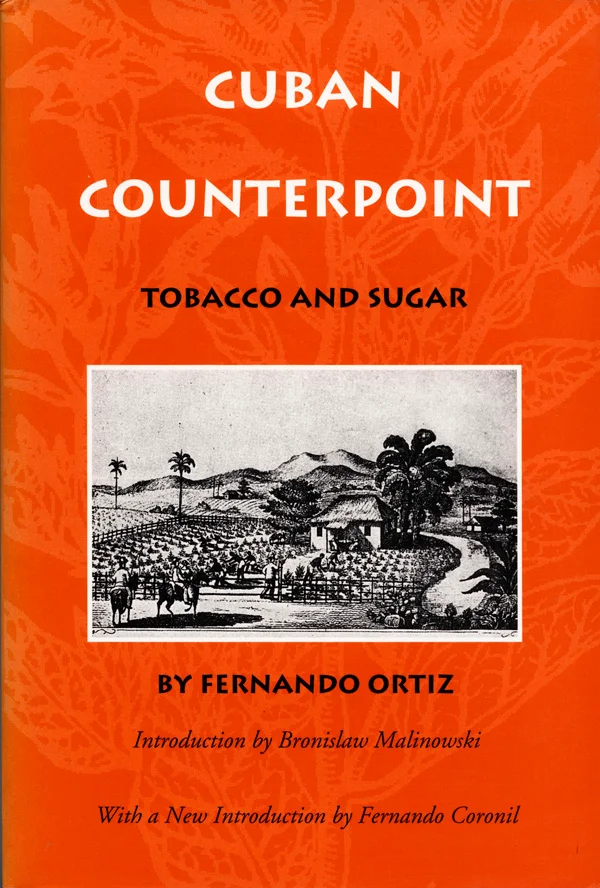
Cuban Counterpoint cover image

Book

Pages: 408

Illustrations: 25 b&w photographs

Published: February 1995

First published in 1940 and long out of print, Fernando Ortiz’s classic work, Cuban Counterpoint is recognized as one of the most important books of Latin American and Caribbean intellectual history. Ortiz’s examination of the impact of sugar and tobacco on Cuban society is unquestionably the cornerstone of Cuban studies and a key source for work on Caribbean culture generally. Though written over fifty years ago, Ortiz’s study of the formation of a national culture in this region has significant implications for contemporary postcolonial studies.
Ortiz presents his understanding of Cuban history in two complementary sections written in contrasting styles: a playful allegorical tale narrated as a counterpoint between tobacco and sugar and a historical analysis of their development as the central agricultural products of the Cuban economy. Treating tobacco and sugar both as agricultural commodities and as social characters in a historical process, he examines changes in their roles as the result of transculturation. His work shows how transculturation, a critical category Ortiz developed to grasp the complex transformation of cultures brought together in the crucible of colonial and imperial histories, can be used to illuminate not only the history of Cuba, but, more generally, that of America as well.
This new edition includes an introductory essay by Fernando Coronil that provides a contrapuntal reading of the relationship between Ortiz’s book and its original introduction by the renowned anthropologist Bronislaw Malinowski. Arguing for a distinction between theory production and canon formation, Coronil demonstrates the value of Ortiz’s book for anthropology as well as Cuban, Caribbean, and Latin American studies, and shows Ortiz to be newly relevant to contemporary debates about modernity, postmodernism, and postcoloniality.

Praise

“The first and only comprehensive study of the West Indian people. Ortiz ushered the Caribbean into the thought of the twentieth century and kept it there.” - C. L. R. James

Buy

Availability: Loading...

Price: Loading...

Request a desk or exam copy Spring 2026 Web Sale

Information

Author/Editor Bios

Back to Top

Fernando Ortiz (1881–1969) was one of Cuba’s most influential public intellectuals. His vast work on Cuban culture includes the five-volume work, Los instrumentos de la música afrocubana. Fernando Coronil is Assistant Professor of Anthropology and History at the University of Michigan.

Table Of Contents

Back to Top
Introduction to the Duke University Press Edition, by Fernando Coronil ix

Introduction, by Bronislaw Malinowski lvii

By Way of Prologue, By Herminio Portell Vilá lxv

Cuban Counterpoint 3

The Ethnography and Transculturation of Havana Tobacco and the Beginnings of Sugar in America 95

Glossary 311

Index Follows Page 312

Rights

Back to Top

Sales/Territorial Rights: World

Rights and licensing

Additional Information

Back to Top
Paper ISBN: 978-0-8223-1616-9 /

Publicity material