
Home / Journals / New German Critique / Dada and Photomontage across Borders

Dada and Photomontage across Borders

An issue of: New German Critique
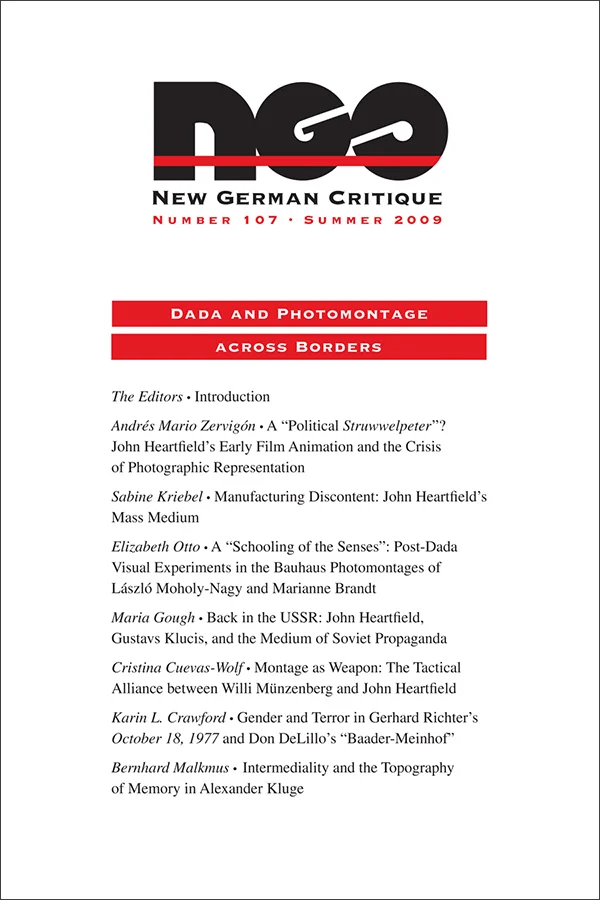
NGC 36:2 cover image

Journal Issue

Volume 36, Number 2

Published: 2009

An issue of: New German Critique

This special issue of New German Critique explores the art of Dada and photomontage in transnational contexts. Dadaism, an art movement cultivated during World War I, questioned traditional aesthetics and eventually led to the formation of surrealism. Focusing on Dada’s achievements in building a network of artists in Europe and America, this issue examines photomontage as an integral part of the movement, as well as its relationship to mass media, photography, propaganda, constructivism, and left-wing politics in the Soviet Union and western Europe during the 1920s and 1930s.

The central figure of the issue is John Heartfield, a Dadaist who influenced much of the art world in Europe after World War I. The collection investigates Heartfield’s lesser-known early work with cinema in the service of the German High Command. Believing that photographic cinema was akin to war propaganda, Heartfield rejected live-action war footage in favor of American cinematic animation to promote an honest discussion about the horror and realities of war. One essay explores Heartfield’s photomontages while turning to film theory as a way of interpreting the politics of his work, demonstrating how his photomontages retain the organic and traditional nature of photography even as they produce cognitive dissonance and satire. Another essay on Heartfield’s role in Soviet discussions of the 1930s offers fascinating insights based on new archival research. The issue also looks at the relationship between Heartfield and the illustrated German magazine Arbeiter-Illustrierte-Zeitung and how that magazine influenced photomontage across Europe.

Buy

For more information or to access this journal, visit the New German Critique page.

Availability: Loading...

Price: Loading...

Request a desk or exam copy

Information

Table Of Contents

Back to Top

1. Introduction–The Editors

2. A "Political Struwwelpeter"? John Heartfield's Early Film Animation and the Crisis of Photographic Representation–Andrés Mario Zervigón

3. Manufacturing Discontent: John Heartfield's Mass Medium–Sabine Kriebel

4. A "Schooling of the Senses": Post-Dada Visual Experiments in the Bauhaus Photomontages of László Moholy-Nagy and Marianne Brandt–Elizabeth Otto

5. Back in the USSR: John Heartfield, Gustavs Klucis, and the Medium of Soviet Propaganda–Maria Gough

6. Montage as Weapon: The Tactical Alliance between Willi Münzenberg and John Heartfield–Cristina Cuevas-Wolf

7. Gender and Terror in Gerhard Richter's October 18, 1977 and Don DeLillo's "Baader-Meinhof"–Karin L. Crawford

8. Intermediality and the Topography of Memory in Alexander Kluge–Bernhard Malkmus

Additional Information

Back to Top
Paper ISBN: 978-0-8223-6722-2 /