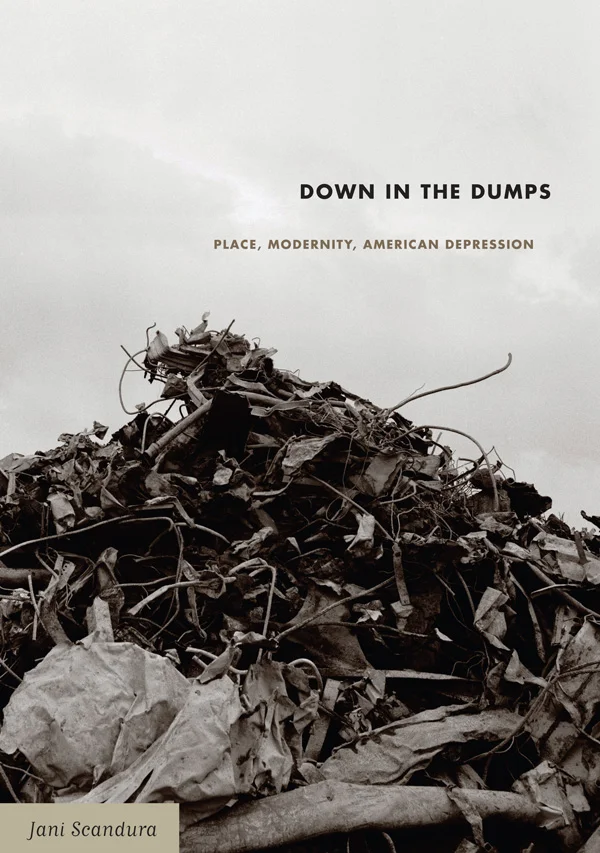
“Down in the Dumps is a fascinating work of bricolage. . . . [It] makes texts from the residues of modernity and the myths of modern America. . . . We learn as much about ourselves as national and local submects from those places and persons which we fail to memorialise as we do from any of those sanctioned with tributes or festooned with flags.” - Caroline Hamilton, Australasian Journal of American Studies
“By analysing the meanings of refuse, [Down in the Dumps] has an element of the subversive, which makes for very exciting reading. . . . [Scandura’s] book is engaging and thought-provoking. When was the last time you read a book about dumps, rubbish, refuse and the importance of these things to the meanings of our everyday lives? Where do we draw the line between what counts as historically important and what doesn't? These are some of the questions this book seeks to answer.” - Alan Han, M/C Reviews
“Jani Scandura’s Down in the Dumps exemplifies the innovative research being done on place, space and memory in the field of new modernism. . . . [The book is] particularly well suited to elucidate the surfaces and excavate the depths of what might otherwise be discarded in the proverbial dustbin of history.” - Jessica L. Shumake, TOPIA
“The key virtues of the book are its diverse materials and its methodological innovations. Scandura offers a remarkably rich assortment of unearthed archival research, engaging visual material, and thoughtful analysis of loosely connected subjects ranging from the conventional (Bishop’s poetry and Hemingway’s fiction) to the exotic (the Key West Tropical Aquarium and the salacious story of Carl Von Cosel’s necrophilia with the mummified corpse of Elena Hoyos). The most interesting feature of the book is unquestionably its methodology. The argumentation is associative rather than deductive, and the prose happily wanders off on tangents and creates surprising juxtapositions. . . . She refuses to discard the refuse of her own research. Readers should anticipate a book that demands attention to its form as much as its content. For many readers it will be well worth the effort.” - Michael Tavel Clarke, American Literature
“A brilliant meditation on the centrality of detritus, debris, and depression to the cultural history and geography of American modernity. Jani Scandura’s book is a standout in a crowded field: innovative in its method and composition, elegantly written, and thickly documented, it is destined to become a key text in the new modernist studies.” - Rita Felski, author of Literature after Feminism
“Part history, part ethnography, part self-reflection, and part psychogeography, Down in the Dumps performs a wholly original encounter with the American 1930s. Jani Scandura displaces the national economic narrative and the archive of migration narratives, WPA guides, and leftist manifestoes with local stories that transform the Great Depression from an economic tragedy into a tragicomic account of site-specific modernities.” - Bill Brown, author of A Sense of Things: The Object Matter of American Literature