
Home / Books / Earth Diplomacy

Earth Diplomacy

Indigenous American Art, Ecological Crisis, and the Cold War
Book

Pages: 400

Illustrations: 97 illustrations, including 16 page color insert

Published: August 2024

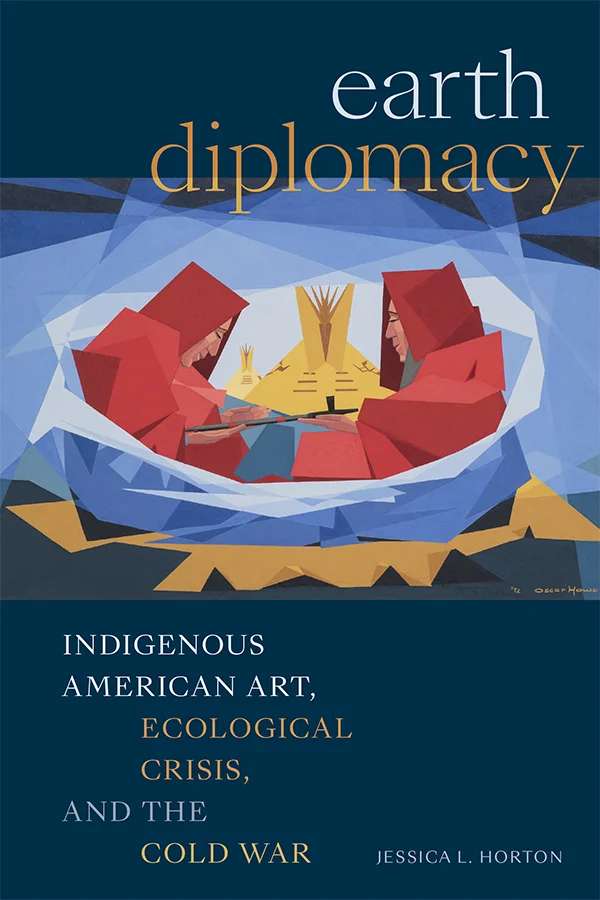
In Earth Diplomacy, Jessica L. Horton reveals how Native American art in the mid-twentieth century mobilized Indigenous cultures of diplomacy to place the earth itself at the center of international relations. She focuses on a group of artists, including Pablita Velarde, Darryl Blackman, and Oscar Howe, who participated in exhibitions and lectures abroad as part of the United States’s Cold War cultural propaganda. Horton emphasizes how their art modeled a radical alternative to dominant forms of statecraft, a practice she calls “earth diplomacy”: a response to extractive colonial capitalism grounded in Native ideas of deep reciprocal relationships between humans and other beings that govern the world. Horton draws on extensive archival research and oral histories as well as analyses of Indigenous creative work, including paintings, textiles, tipis, adornment, and artistic demonstrations. By interweaving diplomacy, ecology, and art history, Horton advances Indigenous frameworks of reciprocity with all beings in the cosmos as a path to transforming our broken system of global politics.

Praise

“Jessica L. Horton persuasively shows how the lectures, teaching, performances, and works of Native American artists can be seen as a continuation of deep traditions of ‘earth diplomacy’ through which Indigenous peoples have long affirmed the reciprocal relationships between humans and nonhumans. Designed to maintain and restore harmony and peace, these political and spiritual practices through art constitute diplomacy in its most essential sense. Horton’s highly original intervention is particularly powerful in the present moment, as we grapple with environmental collapse.” - Ruth B. Phillips, author of Museum Pieces: Toward the Indigenization of Canadian Museums

“Jessica L. Horton offers a significant rupture to conventional art historical discourse in relation to the roles played by Indigenous artists during a pivotal twenty-year period during the Cold War. By shifting analysis outside of a governmental and colonially structured understanding, Horton brings much-needed attention to other methods of understanding diplomacy that respectfully and responsibly narrate Indigenous arts and artists in agential ways. With her impressive engagement with archival materials and artworks, Horton makes an important contribution to the literature of Indigenous art history.” - Carmen L. Robertson, author of Mythologizing Norval Morrisseau: Art and the Colonial Narrative in the Canadian Media

"It is not often that one reads a book that can be considered truly transformative. Jessica L. Horton . . . has written just such a book. . . . Earth Diplomacy advances a capacious paradigm-shifting way of thinking about Indigenous American art from the mid-1950s to the mid-1970s." - Daniel M. Cobb, Winterthur Portfolio

"A timely and generative intervention. . . . [Horton] liberates Indigenous art histories from settler-colonial frameworks by making Indigenous American art global or, rather, revealing it as having been a global phenomenon all along. In doing so, she also helps to transform our understanding of the global itself." - Luke Naessens, Art History

"By emphasizing the agency of Indigenous artists within Cold War cultural diplomacy, Horton contributes to ongoing historiographic debates about the intersections of art, politics, and Indigenous resistance. Additionally, though, she pushes forward the study of Cold War art history. Framing Indigenous artists as diplomats, she positions Indigenous modernisms as central, rather than peripheral, to the era’s geopolitical and aesthetic stakes." - Caroline Riley, CAA Reviews

Buy

Availability: In stock

Price: $30.95

Request a desk or exam copy

Information

Author/Editor Bios

Back to Top
Jessica L. Horton is an Associate Professor in the Department of Art History at the University of Delaware and author of Art for an Undivided Earth: The American Indian Movement Generation, also published by Duke University Press.

Table Of Contents

Back to Top
Acknowledgments  ix
Introduction  1
1. Contested Kinship: More-than-Human Relations or the Family of Man?  35
2. Rebalancing Power: Diné Sandpainting and Sand Mining  80
3. Earth Mothers: Diné Weaving and Trans-Indigenous Ecofeminism  120
4. Tipis and Domes: Modeling the Blackfeet Cosmos at a World Fair  162
5. The Truth-Line: Oscar Howe's Sacred Pipe Modernism  217
Conclusion: Artist-Diplomat-Vampire  269
Notes  279
Bibliography  329
Index  365

Rights

Back to Top

Sales/Territorial Rights: World

Rights and licensing

Additional Information

Back to Top
Paper ISBN: 978-1-4780-3049-2 / Hardcover ISBN: 978-1-4780-2626-6 / eISBN: 978-1-4780-5949-3 / DOI: https://doi.org/10.1215/9781478059493