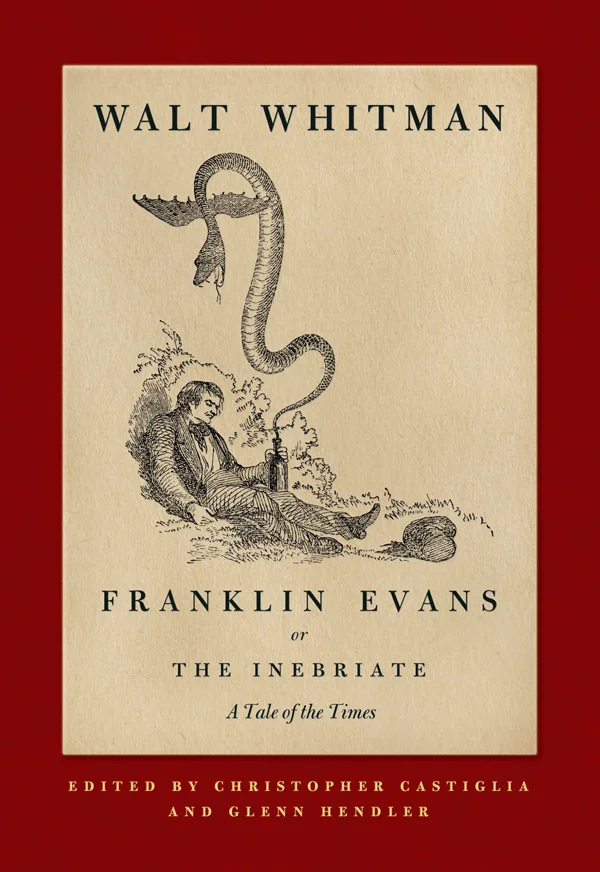
“Franklin Evans fascinates as a document of its time, revealing much about both 1840s America and its not-yet-great author.” - Michael Feingold, Village Voice
“[A] handsome paperback edition, with a wonderfully thorough scholarly introduction. . . .” - Carlin Romano, Philadelphia Inquirer
“[A]s an historical document whose text clearly renders many of the social tensions of the antebellum era, while showing just how the young Walter Whitman was making his living, [Franklin Evans] makes very interesting reading. . . . Franklin Evans is worth more than a cursory glance for what it truly represents—an effort by the young Walt Whitman to engage a wider audience with an homage to the bustling variety of New York life. Ever with an eye on the main chance, Whitman hopefully concludes his tale: ‘if my story meets with favour . . . my readers may hear from me again’ (114).” - Brooke Brinckhorst, M/C Reviews
“[S]ure to become required reading for the borough’s bookish set.” - Daniel Goldberg, Brooklyn Paper
“[T]he story’s assimilative energy, strange idealism and fascination with the pleasures of the masculine body, are characteristically Whitmanesque.” - John Bowen, TLS
“This well-introduced volume is a useful . . . edition for literary and historical study.” - Publishers Weekly
“Although worthless as a novel, Franklin Evans is a precious document that tells us much about the young Whitman. . . . [The editors] supply a fine and detailed introduction, a scrupulously annotated text, and several fascinating illustrations.” - Eric Ormsby, New York Sun
“Readers interested primarily in the social history of the country will find much here that is compelling. The temperance movement was the first wide-spread social reform movement in the United States, and the novel’s greatest claim to interest from a wider readership comes from what it reveals about that movement. . . . [T]here are also glimpses of the young poet’s developing voice. The novel reveals a belief in the power of words to change the lives and influence the actions of individual readers, most of whom would have come from the working class. Joined with more original language, this conviction would give Leaves of Grass, written a decade later, its passion and force.” - Kim Roberts, White Crane Journal
“Sensational and sentimental by contemporary standards, the novel nevertheless holds some interest for the Whitman scholar as part of the long foreground to the visionary poetry Whitman went on to write.Recommended.” - P.J. Ferlazzo, Choice
“Walt Whitman famously came to believe that Franklin Evans was ‘rot’ not worth the three days of concerted drunken effort he claimed it took him to write the temperance novel. In their outstanding introduction Christopher Castiglia and Glenn Hendler convincingly counter Whitman’s own negative review and clear space for renewed appreciation of Whitman’s only novel. . . . ‘[R]ot’ or not, Franklin Evans has now been deservedly made available to a wider audience.” - Alex Wulff, Rocky Mountain Review
“Christopher Castiglia and Glenn Hendler provide a truly state-of-the-art introduction to Walt Whitman’s only novel, a lively and thorough account of the varied contexts that best illuminate the significance of Whitman’s rough and rowdy tale.” - Michael Moon, author of Disseminating Whitman: Revision and Corporeality in Leaves of Grass