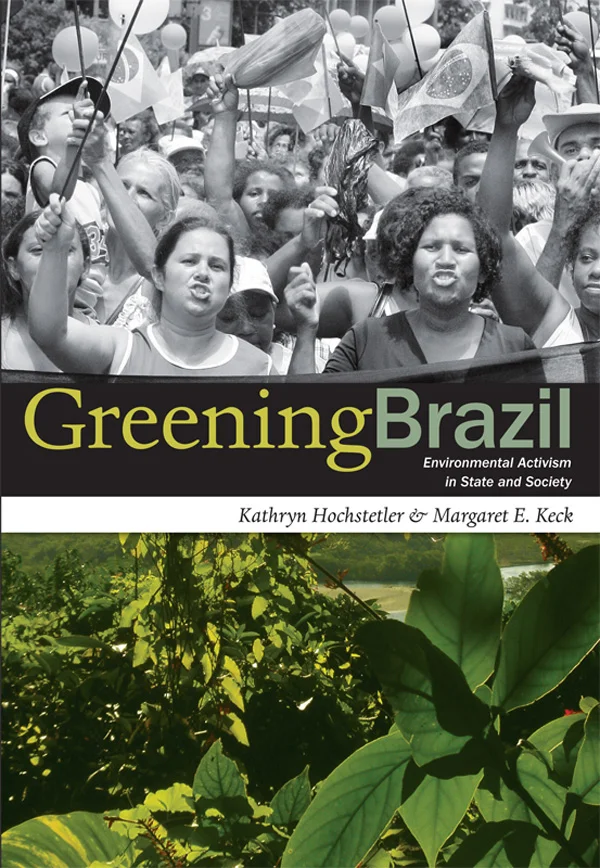
“Greening Brazil is a superb analysis of the growth of the Brazilian environmental movement since the 1950s. The authors bring to the task a sophisticated understanding of Brazilian politics and a deep knowledge of international trends in environmental politics. Greening Brazil is the most satisfying account yet written of any environmental movement outside of Europe and the United States.” - Angus Wright, Latin American Politics and Society
“Greening Brazil is an important contribution to Brazilian studies and Latin American environmental issues. . . The writing is excellent, the story is compelling, and the argument is clear: that Brazilian environmental politics have deep domestic roots.” - Christian Brannstrom, Bulletin of Latin American Research
“[A]n excellent primer on regional environmental politics generally, and would be well situated in an undergraduate or graduate class on comparative international environmental politics. An excellent primer on regional environmental politics generally, and would be well situated in an undergraduate or graduate class on comparative international environmental politics.” - Hannah Wittman, Society & Natural Resources
“A well informed and closely studied portrait of Brazil’s environmental movement. . . [F]ills a large gap in the understanding of Brazil’s internal politics on environmental issues—politics with broader global implications.” - Henry Veltmeyer, Left History
“At long last, we finally now have the first book that traces and analyzes the politics of environmental protection in Brazil over the last three decades in a rigorous, nuanced, and engaging manner. This book . . . will undoubtedly become the definitive work on the environmental politics of Brazil.” - Jordi Diez, Governance
“Greening Brazil is a vital contribution for readers interested in the development of social environmentalism in Brazil, as well as the recent rise in environmental politics in Brazil and Latin America. Kathryn Hochstetler and Margaret Keck . . . produce a persuasive view of the social, institutional, and governmental interactions that have shaped governance of the environmental movement and politics in Brazil. . . . It should be seen as a pioneering book in the field, hopefully encouraging more research on the subject.” - Isabel DiVanna, Canadian Journal of History
“Greening Brazil, a breakthrough book, makes an outstanding contribution to this puzzle. It demonstrates how small agencies in low salience issue areas confronting powerful detractors survive, expand and make a difference. Kathryn Hochstetler and Margaret Keck persuasively argue that extensive interpersonal and professional networks carefully cultivated by key leaders, along with their finely honed discernment over which battles to fight and how to fight them, are the key explanatory factors. . . . Moreover, the book is a vivid example of how to advance knowledge, informed by theory, on the real workings of Latin American institutions beyond deductive analyses of pathologies in institutional design followed by prescriptions on how to fix them.” - Eduardo Silva, Journal of Latin American Studies
“This book provides a valuable contribution to the debate on environmental policy and governance in the context of democratization and decentralization of environmental management in Brazil. This book is strongly recommended for graduate-level students and scholars from diverse social science backgrounds interested in studying public policy and environmental planning and management.” - Luiz Fernando Macedo Bessa, International Affairs
“This is a fine book that can be used in advanced undergraduate and in graduate courses focused on global and/or Latin American environmental issues and politics. Concise and easy to read, it can also interest the non-initiated reader. It will take considerable time or a comparable book to be written on the same subject.” - José Drummond, Environmental History
“Together, [Hochstetler & Keck] represent 40 years of regular visits to Brazil to interview key players, attend meetings, and study archival material. The result is a model of thoughtful and perceptive analysis and a terrific example of how to study national environmental politics, how to integrate in-depth research with the broader relevant scholarly context, and how to tell a complicated story in a clear and engaging style.” - Gary Bryner, Review of Policy Research
“Two lifetime students of Brazil combine extensive participant observation with hundreds of interviews and a mastery of relevant academic theory to offer a sophisticated insider recounting of Brazil’s environmental travails.” - Foreign Affairs
“With Greening Brazil, Keck and Hochstetler create a comprehensive overview of the creation, transformation, and transition of environmentalism in Brazil from the period of military dictatorship to democracy, including the roles of actors on the local, state, national and international levels and encompassing institutions and individuals within and outside the government. The authors spare no detail in providing the reader with an effective, well-written account of where environmentalism in Brazil came from and where it is going. Perhaps most importantly, this book adequately demonstrates that environmentalism and sustainability, in Brazil and across the globe, are complex, multi-level processes involving various actors that cannot be analyzed through one paradigm or one societal component alone.” - Cori Sue Morris, International Affairs Review
“Greening Brazil is an extremely interesting, insightful, and important book. It is important precisely because it fills a huge gap in outsiders’ understanding of Brazil’s internal politics on environmental issues, providing insights into an often misunderstood country whose environmental performance has truly global implications.” - J. Timmons Roberts, coauthor of Trouble in Paradise: Globalization and Environmental Crises in Latin America
“Kathryn Hochstetler and Margaret E. Keck have vast and complementary direct experiences with environmental reform in Brazil, and their long-term commitment to following these issues has clearly paid off in their analysis of the country’s long, rich, and distinctive reform history.” - Jonathan Fox, University of California, Santa Cruz