
Home / Books / How the Earth Feels

How the Earth Feels

Geological Fantasy in the Nineteenth-Century United States
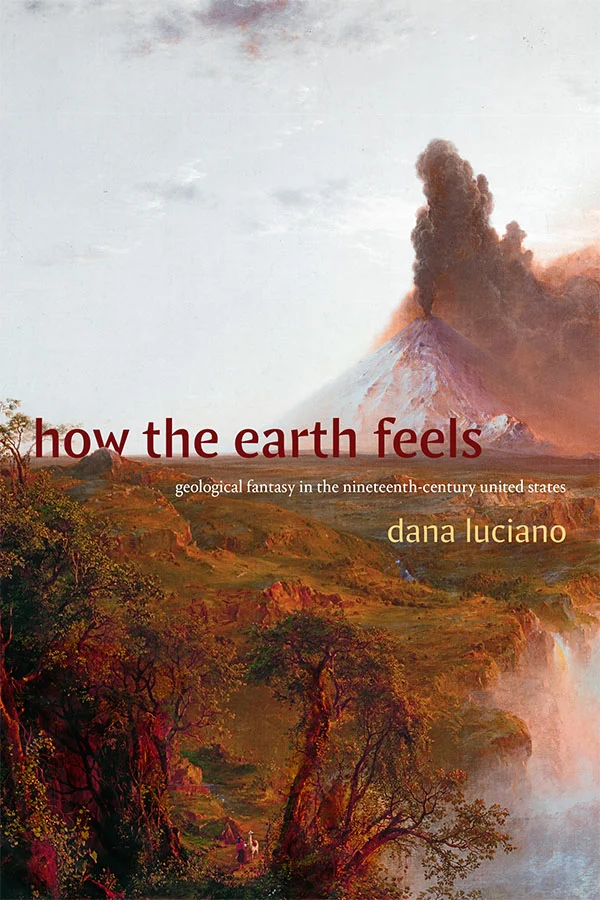
How the Earth Feels cover image

ANIMA: Critical Race Studies Otherwise

More about this series

Read the Introduction

Book

Pages: 256

Illustrations: 5 illustrations

Published: January 2024

Author: Dana Luciano

In How the Earth Feels Dana Luciano examines the impacts of the new science of geology on nineteenth-century US culture. Drawing on early geological writings, Indigenous and settler accounts of earthquakes, African American antislavery literature, and other works, Luciano reveals how geology catalyzed transformative conversations regarding the intersections between humans and the nonhuman world. She shows that understanding the earth’s history geologically involved confronting the dynamic nature of inorganic matter over vast spans of time, challenging preconceived notions of human agency. Nineteenth-century Americans came to terms with these changes through a fusion of fact and imagination that Luciano calls geological fantasy. Geological fantasy transformed the science into a sensory experience, sponsoring affective and even erotic connections to the matter of the earth. At the same time, it was often used to justify accounts of evolution that posited a modern, civilized, and Anglo-American whiteness as the pinnacle of human development. By tracing geology’s relationship with biopower, Luciano illuminates how imagined connections with the earth shaped American dynamics of power, race, and colonization.

Praise

“Tracking the strange pleasures and anxieties around geologic thinking in literary texts, popular culture, and scientific disciplines, Dana Luciano beautifully renders how time is felt and experienced at different scales and intensities. Her account of how biopolitics underwrote the pleasingly terrifying view of deep time as expressed by the fossil record is a signature accomplishment. How the Earth Feels makes a stunningly original contribution. I savored every sentence in this book.” - Stephanie Foote, author of The Parvenu’s Plot: Gender, Culture, and Class in the Age of Realism

“This wide-ranging book takes geology as nothing less than the foundation of modernity, a form of world-making extending from the nineteenth century to our own time, featuring the giddy fantasies of racism and colonialism as much as the rigors of a new science. Empiricism and materialism double here as biopolitics. Clear-eyed, lucid, timely.” - Wai Chee Dimock, author of Weak Planet: Literature and Assisted Survival

"In this compellingly argued and beautifully written monograph, Luciano (Rutgers Univ.) discusses 19th-century scientific and literary writings about the emerging field of geology as a rigorous field of inquiry. . . . Highly recommended. Advanced undergraduates through faculty; professionals." - D. J. Rosenthal, Choice

"[How the Earth Feels] is not only an original contribution to the environmental humanities and American cultural history, offering a detailed exploration of the relationship between science and society in the nineteenth century, but it also provides essential insights for scholars engaged with the Anthropocene today." - Amanda Halter, Amerikastudien

"How the Earth Feels helps us to identify the histories of thought that continue to structure, encircle, and limit our ways of being and our efforts to reckon with both the non-human world and the precarity of individual species across deep time. This book will be of interest to scholars and students in various fields, including the history of science, critical race studies, feminist studies, and environmental humanities. I twill also be of interest to anyone open to feeling the ground move beneath and around them." - Melissa Gniadek, Revue Française d’Études Américaines

"Uncovering this urgently relevant history, How the Earth Feels will appeal to scholars of early and nineteenth-century American literature, science studies, environmental humanities, temporality studies, gender and sexuality studies, new materialism, critical race, and decolonial studies." - Abby Goode, Early American Literature

Buy

Availability: Loading...

Price: Loading...

Request a desk or exam copy

Information

Author/Editor Bios

Back to Top
Dana Luciano is Associate Professor of English and Women’s, Gender, and Sexuality Studies at Rutgers University and author of Arranging Grief: Sacred Time and the Body in Nineteenth-Century America.

Table Of Contents

Back to Top
Acknowledgments  ix
Introduction. The “Fashionable Science”  1
1. “The Infinite Go-Before of the Present”: Geological Time, Worldmaking, and Race in the Nineteenth Century  31
2. Unsettled Ground: Indigenous Prophecy, Geological Fantasy, and the New Madrid Earthquakes  57
3. Romancing the Trace: Ichnology, Affect, Matter  87
4. Matters of Spirit: Vibrant Materiality and White Femme Geophilia  114
5. The Natural History of Freedom: Blackness, Geomorphology, Worldmaking  137
Coda. Ishmael’s Anthropocene: Geological Fantasy in the Twenty-First Century  171
Notes  181
Bibliography  211
Index

Rights

Back to Top

Sales/Territorial Rights: World

Rights and licensing

Additional Information

Back to Top
Related Links Paper ISBN: 978-1-4780-2570-2 / Hardcover ISBN: 978-1-4780-2096-7 / eISBN: 978-1-4780-2784-3 / DOI: https://doi.org/10.1215/9781478027843