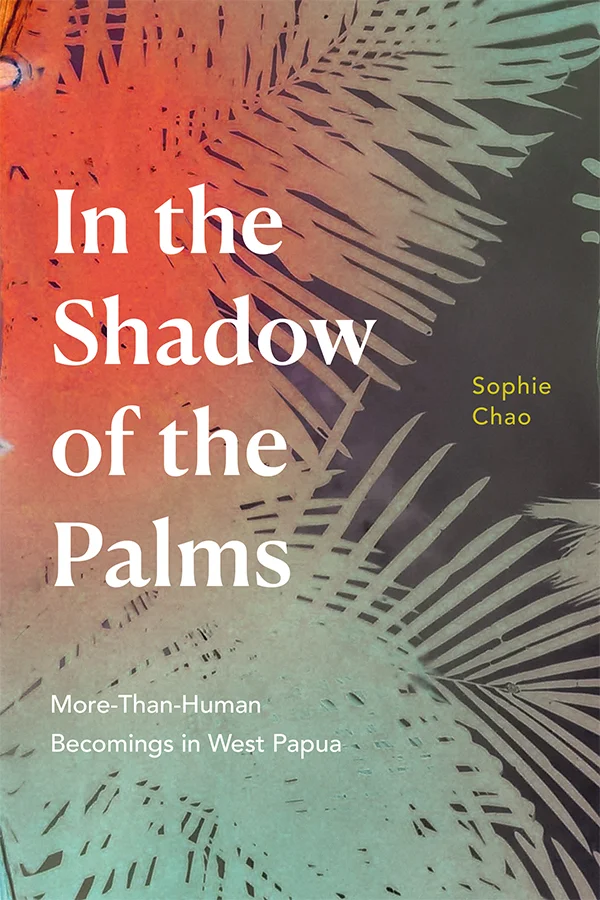
“The stories Sophie Chao tells in this amazing book are mesmerizing, and her interpretation of them is clear and powerful. She makes a major contribution to the intersection of multispecies and posthumanist scholarship and critical BIPOC studies in ways that could shape imaginations both in and beyond the academy. Brilliant, insightful, and meticulous, In the Shadow of the Palms will be an influential and important book.” - Anna Lowenhaupt Tsing, coeditor of Feral Atlas: The More-than-Human Anthropocene
“Raising fundamental questions about ethnographic practice, theory, and activism, Sophie Chao offers a truly new examination of human-plant relations that pushes us forward in how we imagine, understand, and narrate these forms of relation. This excellent and beautifully written book, which is at points both heart-wrenching and joy producing, makes a field-changing contribution to anthropology, human-animal studies, political ecology, environmental humanities, and postcolonial studies.” - Paige West, author of Dispossession and the Environment: Rhetoric and Inequality in Papua New Guinea
“[In the Shadow of the Palms] is a beautiful read, a brilliantly executed thesis. . . . [Chao’s] explanations of the Marind life-worlds are grounded thoroughly in lived-experience shared through cohabitation, active-listening, and situated entangled interaction.”
- Robert Wolfgramm,
Pacific Circle Newsletter
"In the Shadow of the Palms is a brave, compelling piece of ethnographic work, cleverly structured and delightful in its elegant yet accessible prose, offering a new, powerful take on the longstanding issue of agribusiness expansion in Indonesia." - Silvia Pergetti, ANUAC - Rivista della Società Italiana di Antropologia Culturale
"This is a brilliant book—beautifully written—based on rigorous and sensitive ethnography and sharp theoretical analysis that seamlessly blends ethnography with theory. Chao’s respect and admiration for her interlocutors shines through the text and brings to life Marinds kinship with sago and more-than-human becomings—and how this is under threat by the oil palm as an actor of multispecies violence. In the Shadow of the Palms is an important contribution to environmental anthropology and will be of interest to those interested in extractive agriculture, posthumanism, indigenous studies and settler colonialism, decolonising anthropology, political ecology and development studies—both within and beyond Southeast Asia and Papuan Oceania." - Camelia Dewan, Anthropology Book Forum
"In the Shadow of the Palms offers a haunting and novel perspective on themes of dispossession and alienation wrought by the expansion of oil palm agribusiness in Indonesia. . . . In the Shadow of the Palms stands out for its courageous attempt to apprehend and translate the internal experience of the Marind community. Meticulous descriptions of interactions with various animal and plant species evidence a profound intersubjectivity of human and environment in the Marind world." - Carter Beale, Forest and Society
"This was a story that needed to be told. A counter-narrative to the development agenda that promises a rosy future, without elaborating on the destruction and loss that it entails. . . . Chao's deeply thought-provoking and riveting tome is both theoretical and real, development economics and the anthropology of slow violence. It is a homage to an indigenous community with their own means of resistance—until they too finally fall prey to oil palm." - Serina Rahman, Journal of Southeast Asian Economies
"In sum, this book is beautifully written, deeply researched, and deserves to be read widely. Not only by students and scholars of Indonesia, but for all those interested in Southeast Asia and environmental politics. In the Shadow of the Palms may well become a classic in both anthropological studies and studies of Southeast Asia. No mean feat for a first book." - Tomas Cole, Asian Studies Review
“[In the Shadow of the Palms] is ethnographically rich, analytically incisive, and politically engaged. . . . Chao brings people, plants, and animals into a muddled assemblage to explore relationships, interdependencies, oppression, and generation with great effect. . . . This book will appeal greatly to scholars of more-than-human worlds and global capitalism.”
- Sebastian Antoine,
Journal of Anthropological Society of Oxford
“As a reader, I laud Chao’s caring analysis and description; her eye for trouble—abu-abu—and her unrelenting commitment to thinking with rather than for the Marind. This accessible yet in-depth account of Marind ontologies, their fracturing, and their tentative remaking in the face of the oil palm is an important volume for diverse scholars and students in different fields, for instance those engaged with plantation ecologies, multispecies thought, and indigenous ontologies.” - Irene van Oorschot, Etnofoor
“With laudable density and nuance, Chao critically engages . . . the subtle ways in which Marind knowledges about the agency of plants are produced, applied and interpreted.” - Nicolas Mahillon, Ethnos
“[In the Shadow of the Palms] expertly crafts the oil palm subject as the alien protagonist in a multispecies existential crisis. In vivid ethnographic reporting and beautiful language, Chao traces the violent invasion of this immoral vegetal colonizer. . . . Chao is a talented author whose sophisticated development of her core arguments [has] deservedly earned her accolades.” - Michelle A. Miller, Singapore Journal of Tropical Geography
“Chao’s book has successfully re-centered the feelings and the needs of rakyat kecil or ordinary people who are too often ignored and removed from narratives of development. Her work clearly communicates the feelings of anger, hurt, and utter disappointment of the Marind people whose lives have been destroyed by orang besar, Indonesian political bigwigs, and taipans (tycoons)who converted the Marind lands into oil palm plantations.” - Pujo Semedi, American Anthropologist
“In the Shadow of the Palms represents, above all, a deeply ethical project—in the sense of giving voice to otherwise marginalised and silenced people; and ethical in its broader existential ambitions. This is a book we all need to read: it speaks to the current predicaments facing all of us.” - Warwick Anderson, The Australian Journal of Anthropology
"Chao documents terrifying dreams of becoming disoriented and lost in an oil palm plantation; dreams featuring screaming; dreams in which the life-sustaining waters of a river turned black and oily and are choked with dead bodies. This close attention to the elusive, psychic, unbidden, uncontrollable phenomena of dreams throughout In the Shadow of the Palms underlies the hauntings of which Chao writes. There is no leaving behind this research." - Eve Vincent, The Australian Journal of Anthropology
"In the Shadow of the Palms is ethnography at its best, a deep journey into a world rich with meanings explained in accessible language that will engage and yarn with any reader whether they are an anthropologist or someone who just wants to meet the Marind and their disturbed palm oil damaged community. This is the deep anthropology aspired to by many but not often achieved. This is what the Global North needs to learn from the Global South." - Jakelin Troy, The Australian Journal of Anthropology
"Counterposing her analysis of translations of Marind perspectives with oil palm company narratives featuring promises of economic growth, job opportunities, and progress, Chao highlights the incongruity between government and corporate views and Marind values relating to the forest and aspirations for a nourishing future. This difference is an argument for the prominence of peripheries, how ‘out-of-the-way places’ and peoples, subject to the resource frontiers of development, produce necessary commentaries on the gaps in and alternatives to globalising political economies." - Sally Babidge, Nathália Dothling, Sarah Thomson, Tyler Riordan, Kirsty Wissing, Ainá Sant'Anna Fernandes, Sara Mejía Muñoz, The Australian Journal of Anthropology
"A rich and theoretically dense ethnography of multifaceted interest. Its greatest virtue perhaps lies in how it cross-illuminates and demonstrates the mutual constitution of these spheres, and in how it sheds light on them through the stories, personal reflections, affective experiences, and dreams of Marind subjects. Through this agenda, the book provides a refreshingly distinct contribution to the evolving field of anthropological oil palm studies, and to political and more-than-human anthropology in general." - Isabell Herrmans, Inside Indonesia
"In so doing, Chao takes the reader deep into the heart of a non-Western ontological order. She shows how the Marind worldview and being is relational, multispecies, in motion, dynamic, and ever-changing." - Rebecca Ann Dudley, Culture, Agriculture, Food, and Environment
"Chao’s ethnographic masterpiece quickly reveals that the ways in which dispossession is experienced on the ground differs. She shines new light on what life looks and feels like on an oil palm frontier." - Nicholas Bainton, Oceania
"In the Shadow of the Palms is a wonderful book that will be of interest to a wide range of scholars and activists. This includes those whose work is specifically focused on the necrobiopolitics of the Plantationocene, as well as anyone who might be having trouble finding possibilities for hope in this moment of planetary undoing."
- Kevin Burke,
American Ethnologist
“Chao’s work demonstrates what it is to do engaged research. … [A] precise story of grief, loss, and endurance in a world fractured by colonialism and untrammelled agribusiness expansion, beautifully realised in [her] poetic voice.”
- Mardi Reardon-Smith,
Society and Space
"Chao has a superpower — her writing. ... You’d have to search long and hard for a book that better captures the ineluctable violence of our times, that makes the damage feel so poignant, so inexorable, so real." - Danilyn Rutherford, Journal of Asian Studies
"In the Shadow of the Palms is not a lamentation of the wrongs carried out by the State and agribusiness on the Marind people. It is a testament to the fact that the Marind people are still here, and that what happens to their culture will illustrate whether or not the world is capable of embracing a philosophy of being that considers both the human and other-than-human. . . . Chao tempts readers through her words to conceptualize the value of other lifeforms, examine more deeply what it is to be human, and envision love during a period of extinction." - Jessica Richardson, Edge Effects
"Chao deepens multispecies approaches to STS and anthropology by showing how human-oil palm relations are constituted through practices of ecological destruction and mutual exposure to pesticide, plantation logic, and productivity imperatives. . . . In the Shadow of the Palms highlights not only issues of Indigenous land rights and the political ecology of palm oil, but crucially also attends to the material and mental violence that human-oil palm interactions can entail." - Jia Hui Lee, Science as Culture
"In the Shadow of the Palms takes a novel approach to examining the relentless expansion of the oil palm frontier into Indonesian-controlled West Papua. Departing from human rights and environmental justice frameworks, which focus primarily on the anthropogenic forces driving plantation expansion, Sophie Chao’s powerful ethnography centres oil palm as an other-than-human actor, considering how Indigenous communities in Merauke Regency conceptualize and engage with the monocrop. Based on eighteen months of ethnographic fieldwork and almost a decade of involvement in the land rights campaigns of Upper Bian Marind, Chao immerses the reader in the multispecies sociality of the Marind lifeworld, viscerally conveying the violent impacts of oil palm locally." - Julia C. Morris, Journal of the Royal Anthropological Institute
“Chao has written a striking ethnographic view of the Marind peoples' entanglements with the palm oil industry in the Merauke region in West Papua, Indonesia.” - Jennifer Marshman, Global Media Journal
"This book is essential reading for those interested in finding connections between academic discourses of multispecies theory and critical race studies." - Orven Mallari, Sojourn
"Chao notes that she is still haunted by everything she experienced, and I am still haunted by her writing. It is an exceptional book on all counts—theoretically astute, ethnographically rigorous, and above all profoundly moving." - Tania Murray Li, Southeast Asian Studies
"Chao’s comprehensive analysis of Indonesian occupation, the oil palm industry, and Indigenous-Marind epistemology makes this book a significant contribution to contemporary, scholarly currents within Pacific studies, environmental history, and multispecies anthropology." - Nathan Samayo, The Journal of Pacific History
“Chao employs qualitative ethnography and anthology to present a compelling argument about oil palms as invasive entities disrupting West Papuan and Marind lives. . . . Chao’s book offers valuable academic detail, and help to brings greater visibility to West Papua’s invisible oppression in present era.”
- Joshi Maharani Wibowo,
Society & Natural Resources