
Home / Books / Living and Dying in São Paulo

Living and Dying in São Paulo

Immigrants, Health, and the Built Environment in Brazil
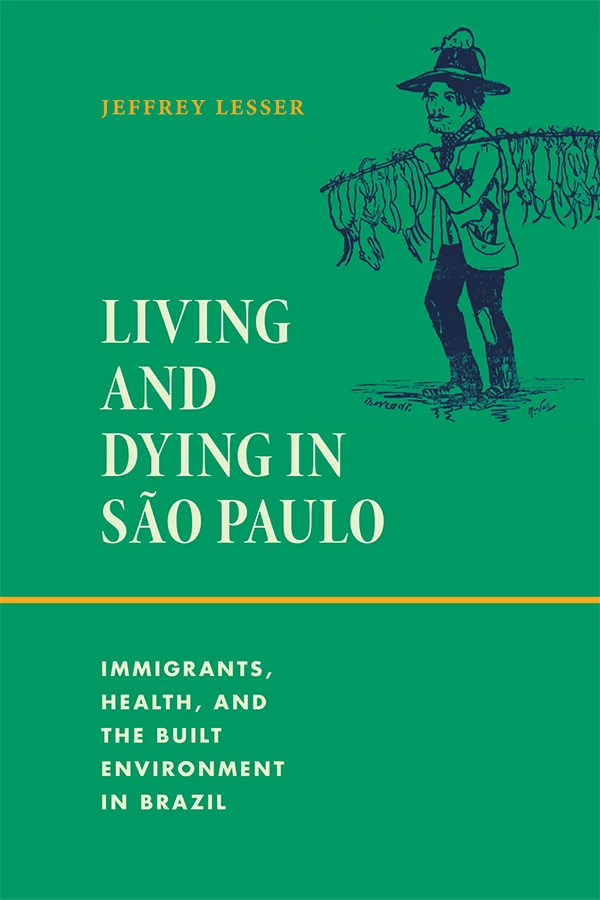
Book

Pages: 320

Illustrations: 49 illustrations

Published: April 2025

Author: Jeffrey Lesser

There is a saying in Brazil: “Mosquitoes are democratic: they bite the rich and the poor alike.” Why then is bad health---from violence to respiratory disease, from malaria to dengue---dispersed unevenly across different social and national groups? In Living and Dying in São Paulo, Jeffrey Lesser focuses on the Bom Retiro neighborhood to explore such questions by examining the competing visions of well-being in Brazil among racialized immigrants and policymakers and health officials. He analyzes the fraught relationship between Bom Retiro residents and the state and health care agencies that have overseen community sanitation efforts since the mid-nineteenth century, drawing out the connected systems of the built environment, public health laws and practices, and citizenship. Lesser employs the concept of “residues” to outline how continuing historical material, legislative, and social legacies structure contemporary daily life and health outcomes in the neighborhood. In so doing, Lesser creates a dialogue between the past and the present, showing how the relationship between culture and disease is both layered and interconnected.

Praise

Living and Dying in São Paulo is methodologically innovative, conceptually powerful, and engagingly written. Jeffrey Lesser’s book has rare precision and creativity. Not only does he give an insightful reading of place and people, he also makes a bold case for historians to adopt new approaches and for those in the social and biomedical sciences to pose questions historically. This is the kind of writing I am sure most historians—myself included—wish they could do.” - Jerry Dávila, author of Hotel Trópico: Brazil and the Challenge of African Decolonization, 1950–1980

“Drawing on historically grounded and community-based research on public health in São Paulo’s Bom Retiro neighborhood, Jeffrey Lesser outlines the close relationship between public health programs and racialized anxieties directed at poor Black and immigrant communities to show how class stigmatization and ethnic stereotyping have complicated official efforts to effectively engage with the community. Timely and urgent, Living and Dying in São Paulo is a superior work of scholarship by a leading historian of Brazil.” - Christopher Dunn, author of Contracultura: Alternative Arts and Social Transformation in Authoritarian Brazil

"[Living and Dying in São Paulo] distances itself from a purely top-down perspective on public policies, bringing us closer to how these policies are actually carried out." - Antonella Delmonte Allasia, Mecila

"The book skillfully weaves together historical vignettes, contemporary observations, anecdotes, and data, moving fluidly between past and present." - Lucas Magalhães Moreira, Family Medicine

"An essential scholarly work that addresses a pressing issue from a novel lens." - Denise Martin, International Migration Review

Buy

Availability: Loading...

Price: Loading...

Buy the e-book:

Open Access

Read the OA Edition

Funding information for the OA format is found at the bottom of this page.

Request a desk or exam copy

Information

Author/Editor Bios

Back to Top
Jeffrey Lesser is Samuel Candler Dobbs Professor of History at Emory University. He is the author of A Discontented Diaspora: Japanese Brazilians and the Meanings of Ethnic Militancy, 1960–1980 and Negotiating National Identity: Immigrants, Minorities, and the Struggle for Ethnicity in Brazil, both published by Duke University Press.

Table Of Contents

Back to Top
A Long Set of Acknowledgments  xi
An Introduction: Selling a Gun  1
1. Naming a Death  31
2. Bom Retiro Is the World?  59
3. Bad Health in a Good Retreat  80
4. Enforcing Health  102
5. A Building Block of Health  130
6. Unliving Rats and Undead Immigrants  163
A Conclusion: Light and Dark in a Saintly City  195
Notes  201
Bibliography 249
Index  295

Rights

Back to Top

Sales/Territorial Rights: World

Rights and licensing

Additional Information

Back to Top

Funding Information

Back to Top
This book is freely available in an open access edition thanks to the generous support of Emory University and the Andrew W. Mellon Foundation.