
Home / Books / None Like Us

None Like Us

Blackness, Belonging, Aesthetic Life
Book

Pages: 208

Illustrations: 9 illustrations, incl 8 in color

Published: November 2018

Author: Stephen Best

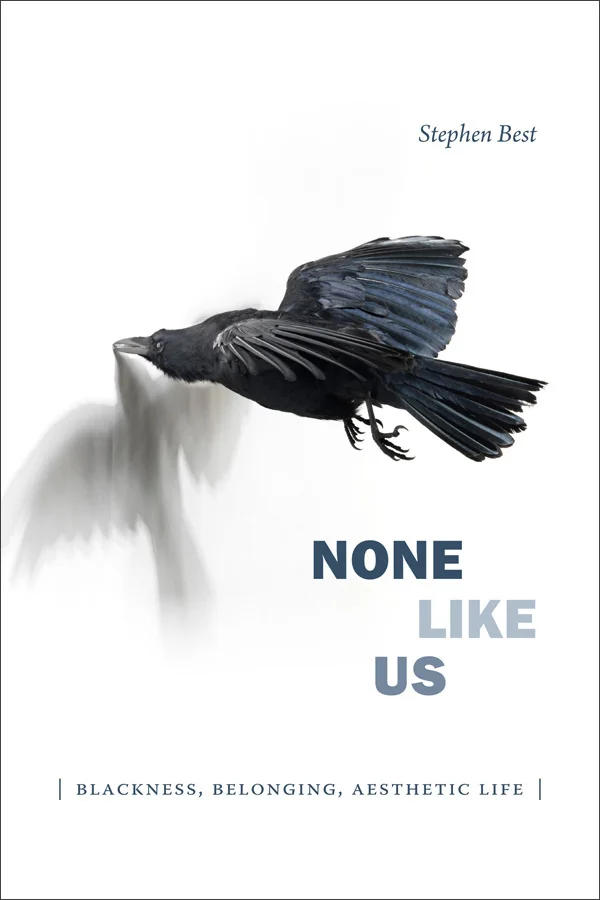
It passes for an unassailable truth that the slave past provides an explanatory prism for understanding the black political present. In None Like Us Stephen Best reappraises what he calls “melancholy historicism”—a kind of crime scene investigation in which the forensic imagination is directed toward the recovery of a “we” at the point of “our” violent origin. Best argues that there is and can be no “we” following from such a time and place, that black identity is constituted in and through negation, taking inspiration from David Walker’s prayer that “none like us may ever live again until time shall be no more.” Best draws out the connections between a sense of impossible black sociality and strains of negativity that have operated under the sign of queer. In None Like Us the art of El Anatsui and Mark Bradford, the literature of Toni Morrison and Gwendolyn Brooks, even rumors in the archive, evidence an apocalyptic aesthetics, or self-eclipse, which opens the circuits between past and present and thus charts a queer future for black study.

Praise

“Stephen Best's ambitious new book makes a valuable contribution to current debates at the intersection of literary and historical studies and provides nothing less than an aesthetic reappraisal of the aims and methods of black historiography. Erudite, searching, and eclectic, the intervention of None Like Us will reverberate widely across the field of black studies for years to come.” - Tavia Nyong’o, author of Afro-Fabulations: The Queer Drama of Black Life

“Stephen Best gives us an entirely new way of understanding the constitution of black subjectivity. Identifying cognates for that process in the aesthetic strategies of numerous exemplary literary and visual artworks, he allows us to see black subjectivity itself as an aesthetic function, wholly distinct from the problematic collectivisms conventionally taken to originate in slavery. Deeply learned and beautifully written, None Like Us will provoke lively discussion among black studies scholars, significantly reorienting the theoretical conversation.” - Phillip Brian Harper, author of Abstractionist Aesthetics: Artistic Form and Social Critique in African American Culture

"None Like Us begins as an intervention into black studies. To accomplish this, it turns to works of art and invention by people whom history has needed to be black. But as it unravels any claim to genre, discipline, field, identity, or audience, the book issues a broad invitation to the reader to see black studies and queer theory, black and queer life, not as identities to inhabit, but as critical perspectives on history and on a present tense that has been so scarred by various melodramas of the self—of its defense, self-possession, and propriety—that have played themselves out on both sides of anti-racist critique." - Kris Cohen, Public Books

"Compelling. . . Highly recommended. Upper-division undergraduates through faculty." - C. E. Bender, Choice

"Best’s ambitious and well-reasoned thesis confronts the challenge of thinking like a work of art but also of thinking the work of art as an object of critical studies, particularly in Black Studies. ... Responsibly argued and impressively confessional, Best o?ers thoughtful ways of recon?guring Black Studies." - Alice Mikail Craven, Modern Language Review

“… None Like Us is distinctive as it aims to break with the well-established and perhaps taken-for-granted tenet in the black political present and contemporary black criticism, of a communitarian, shared slave past…. With its themes of identity and belonging, history and the archive, along with a range of visual and literary works, None Like Us would appeal to the interdisciplinary field of Black Studies sociologists; historians, anthropologists, in addition to scholars with an interest in art and visual culture.” - Karen Wilkes, Visual Studies

“The problem that Best outlines in the introduction is that Black history and culture has been defined primarily through the narrative of slavery.... He follows the interventions of queer theorists of negativity (Leo Bersani especially) to argue for Blackness as a site of self-shattering, where Blackness names the failure of any invocation of a ‘we.’”
  - Lakshmi Padmanabhan, Art History

None Like Us is attempting to produce a version of Blackness that does not need to work through the white gaze and, instead, understands freedom on its own terms. . . . Best prioritizes the present, the surface, and the pleasures of engaging on one’s own terms.” - Amber Jamilla Musser, Cultural Critique

"Best picks apart the tropes that are often treated as foregone conclusions: that the heirs of a people made chattel would incur and even embrace the terms foisted upon them, that the first-person plural of Black studies is monolithic." - Lauren Michele Jackson, The New Yorker

Buy

Availability: Loading...

Price: Loading...

Request a desk or exam copy

Information

Author/Editor Bios

Back to Top
Stephen Best is Associate Professor of English at the University of California, Berkeley, and author of The Fugitive's Properties: Law and the Poetics of Possession.

Table Of Contents

Back to Top
Introduction. Unfit for History  1
Part I. On Thinking Like a Work of Art
1. My Beautiful Elimination  29
2. On Failing to Make the Past Present  63
Part II. A History of Discontinuity
Interstice. A Gossamer Writing  83
3. The History of People Who Did Not Exist  91
4. Rumor in the Archive  107
Acknowledgments  133
Notes  135
Bibliography  173
Index  193

Rights

Back to Top

Sales/Territorial Rights: World

Rights and licensing

Awards

Back to Top

Honorable Mention, 2019 ASAP Book Prize (presented by the Association for the Study of the Arts of the Present)

Additional Information

Back to Top
Paper ISBN: 978-1-4780-0150-8 / Hardcover ISBN: 978-1-4780-0115-7 / eISBN: 978-1-4780-0258-1 / DOI: https://doi.org/10.1215/9781478002581

Publicity material